


 chargement...


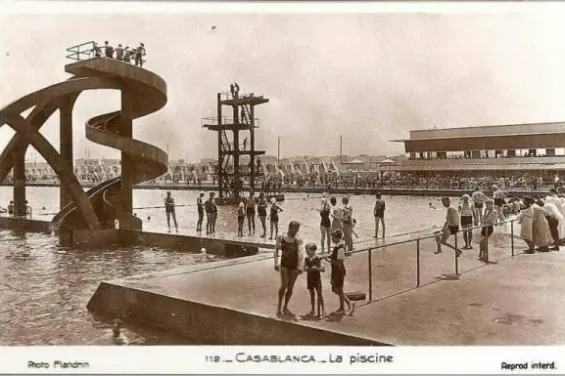
On July 14, 1934, Casablanca inaugurated what was hailed as the world’s largest swimming pool. The summer attraction was indeed monumental, stretching a staggering 480 meters in length and 75 meters in width.
Built directly into the rocks at Mriziga beach, the Georges Orthlieb Pool was designed by French engineer Maurice L’Herbier and quickly became an icon of Casablanca’s modernist aspirations and cosmopolitan leisure culture.
The Centre Balnéaire Georges Orthlieb, also known as Casablanca’s municipal swimming pool, was more than just a recreational facility, it was an architectural feat. Though located just outside of Ain Diab in the older TSF quarter, the Orthlieb «was close enough and certainly grand enough to be included in the locus of beachfront activity at the time», writes anthropologist Scott A. Lukas in The Themed Space: Locating Culture, Nation, and Self.
A concrete salt water pool
The pool featured vast concrete decks, exposed steel support beams, and seawater renewed daily by the tides or a pumping station. Alongside its technical prowess stood striking design elements: reinforced concrete diving platforms, a spiraling staircase, and a looping buttress slide.
The Orthlieb was central to the emerging identity of Casablanca’s coastline. By the early 1930s, French elites and middle classes had migrated southward, settling into newly built villas and apartments along the Atlantic. The district of Ain Diab bloomed with boulevards, cafés, beaches, and entertainment venues, shaped by urban planner Albert Laprade.

But the Orthlieb Pool remained a favorite, largely due to its impressive scale. «At nearly six hectares in size, the pool was the largest swimming structure in all of Africa and indeed rivaled by only a few other pools in the world at the time», Lukas notes.
«A structural feat that effectively contained the ocean for safe swimming, the Orthlieb Pool provided thousands of city dwellers with an enormous concrete deck bound by steel and exposed horizontal support beams. Like the Lido (another concrete swimming pool along the coastline), though much bigger, Orthlieb was a hugely popular and unabashedly engineered site of water play and oceanside leisure.”
Yet despite its former glory, the Orthlieb Pool was not immune to time. «Owing to numerous structural flaws, [it] was prone to lengthy periods of closure and ultimately fell out of use altogether», writes Lukas.

Following Morocco’s independence, the site suffered from chronic disrepair. Its enormous scale and technical complexity made maintenance increasingly difficult. In 1986, the site was officially repurposed to make way for the Hassan II Mosque, the second-largest functioning mosque in Africa and a gem of Casablanca’s shore.
Today, little remains of the Orthlieb Pool but photographs and collective memory: sunbathers in vintage swimsuits, European settlers in costume, Moroccan men in djellabas. For older Casablancais, it remains «a place remembered with great nostalgia».