

 chargement...


Whoever says summer in Morocco, says delicacies enjoyed by the beach, picnics, or cold drinks sipped on a hot sunny day. While Moroccans embrace this season, certain dishes stand out: oranges, fresh mint, grilled or fried aubergines, a favorite for a quick sandwich by the beach, or a barbecue with family and friends on the terrace at night.
You might think these eating habits, typical of a hot Moroccan summer, were born or invented yesterday. But the truth is, they are likely rooted in our culinary heritage, centuries old—dating back to the Almohad Caliphate. The empire ruled Morocco, parts of North Africa, and the Iberian Peninsula (Al-Andalus) during the 12th and 13th centuries.
We find evidence in the oldest manuscripts on cooking in Morocco and Al-Andalus, which document how Almohad Moroccans and Andalusians cooked, bringing up hundreds of recipes that spanned all tastes and flavors. Among these recipes, some slightly altered, are still consumed by Moroccans as part of their summer traditions. Let’s discover them together.
A beignet by the beach
A day at the beach in Morocco can’t go without a sugar-coated soft beignet. While sunbathing, you will definitely hear a man shouting, «beignet, beignet», selling fried donuts coated with ground sugar. Well, in 12th/13th-century Morocco and Andalusia, they also ate the same beignets, in almost the same way but probably not by the beach.
This snack is mentioned in 12th and 13th centuries culinary manuscripts, including what historians consider the oldest known cookbook from the Iberian Peninsula, Kitāb al-Ṭabikh fī al-Maghrib wa al-Andalus fī ʽAṣr al-Muwaḥḥidīn (The Book of Cooking in Maghreb and Al-Andalus in the Era of the Almohads) by an unknown author, and Fiḍālat al-Jiwān fī Ṭayyibāt al-Ṭaʿām wa-l-Alwān (The Virtue of the Table in the Goodness of Food and Colors) by Murcia scholar Ibn Razīn al-Tuŷībī. In both books, the snack is called Issfanj Arrih, which translates as «the air sponge», or less literally, the sponge donut.
The centuries-old recipe goes as follows: «Fine white flour kneaded with water, salt, yeast, and fresh oil until well mixed». More water is added gradually to the mixture «until the dough becomes lighter in texture».

«It is then left to ferment», writes Ibn Razīn. «Afterward, a pan is heated over the fire with plenty of oil. Dough portions are taken with the finger and dropped into the hot oil», he adds, even suggesting an alteration for those who prefer their Issfanj puffed up: «Knead with eggs and prepare as described».
The Kitab mentions another sophisticated version of Issfanj, where the donuts are filled with a mixture of nuts: «Take blanched almonds, walnuts, pine nuts, and pistachios, and grind them all in a mortar until they become like salt in texture. Take pure honey and bring it to a boil over the fire until it is about to thicken. Then add the ground nuts to the honey and stir until the mixture thickens», reads the book.
The donuts are then stuffed with the nut mixture, «leaving the dough between the filled rounds thin», then fried. The author adds that «ground sugar and rose water» could be added to the nut mixture. Sounds familiar, right? Like our nowadays donuts covered with ground sugar.
A fresh mint syrup
Lemonade, soda, or fresh juice are go-to summer drinks. But the love Moroccans have for mint manifested centuries before tea made it to the country. In fact, in hot summer days of Almohad Morocco, people made a mint syrup that was probably added to other juices or infusions. In Kitāb, it is called Sharāb naʿnāʿ, or the Mint Syrup.
As its name suggests, the recipe relies on mint : A «handful each of» mint, bitter orange, widely abundant in Marrakech, and clove basil (African basil).

«Boil all of them in enough water to cover the herbs, until their essence is fully extracted. Strain the liquid and add it to one raṭl (approx. 468g) of sugar», mentions Kitab. Thirty grams of clove flowers is added, and the mixture is boiled again until it reaches the consistency of syrup.
And this is how you make your 12th-century syrup, which you can add to orange juice or simply dilute with water for a refreshing drink.
The simplest summer food : A barbecue
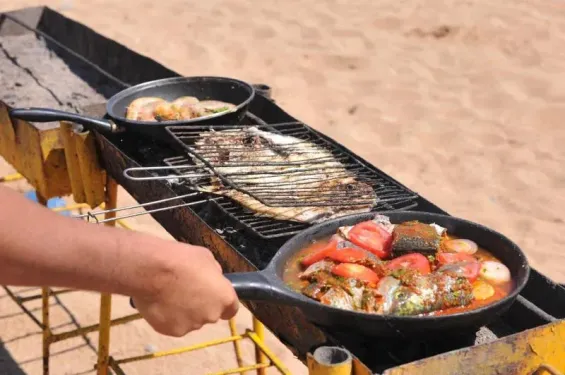
And a summer can’t go without a barbecue with the family, either for a picnic or in the family garden. In 12th-century Morocco and Al-Andalus, this was called shiwāʾ or grill. And because of the heat, summer was the perfect season for such «simple food», reads Kitāb.
The book details the process: «Take from the meat the young, fat cuts and slice them thinly with a sharp knife, making fine cuts». The meat should have some fat but be free of bone, it dictates. Preferred parts are the shoulder, the hip, and similar areas.

Then comes the seasoning, slightly different from the charmoula we know nowadays. Add murri naqi, a liquid condiment made using a fermented solid-state starter called budhaj made with barley or wheat flour, known from Maghrebi and Arab cuisines. Then «vinegar, thyme, pepper, crushed garlic, and a little oil. All these are well beaten together, then the slices are soaked in it».
«The slices are then arranged on a clean skewer or spit, without overlapping, so that the fire may reach them properly. The skewers are turned constantly over charcoal fire until the meat is cooked and browned. During cooking, the meat is basted with the marinade until it is fully cooked», the book reads. However, it warns, it is «hard to digest and slow to settle».
A fish tagine
Going to the beach or camping by the sea also means savoring fish and seafood-based dishes. By now you know the drill. In Kitab, the recipe is for fish tagine, a favorite among people in Ceuta and western Andalusia. «Mrouj fish», the Almohads called it, consisting of any kind of fish, cleaned, peeled, boiled in water and salt, then drained.
In a tagine pot, oil is heated on moderate heat. «Once the oil boils, place the boiled fish pieces into the oil and fry them until they turn golden brown. Remove the fish from the oil and set it aside», it says.

Next, take another pot and mix two parts vinegar, murri naqi, pepper, cumin, garlic, a small amount of saffron, and bay leaves. Cover this mixture with melted oil and place it over gentle heat. When it begins to boil, add the fried fish pieces little by little into the oil marinade, the recipe says.
Cook briefly while stirring occasionally, the moisture should evaporate until only the oil remains. Then remove from the heat and let it cool. Then serve in the liking of the people of Ceuta and western Andalusia, the Kitab concludes.
Fried aubergines
Another summer essential in Moroccan cuisine is aubergines, grilled or fried for quick to-go sandwiches or for zaalouk. Ibn Razīn dedicates a chapter to this vegetable, with one recipe standing out: filled fried aubergines.
«Take sweet eggplants and cut them into halves without peeling. Boil them in salted water until cooked, then drain the water», reads the recipe.

Each half is then carefully emptied so that its shape is preserved. The inside is mashed together with ground meat. «All of this is mixed with eggs and spices», and then «the hollowed halves are filled with this mixture, coated with semolina or breadcrumbs», to be fried—the American way. The aubergines are enjoyed with a sauce, the book concludes.