


 chargement...


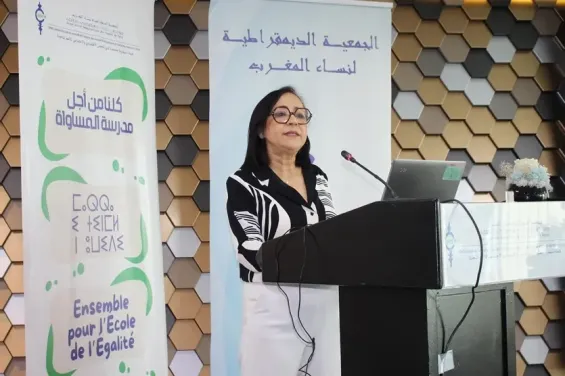
This week in Rabat, the Democratic Association of Moroccan Women (ADFM) unveiled the findings of its «Compilation of Sexist Prejudices and Stereotypes in High Schools». The report highlights «deep-rooted mechanisms that hinder the development of both girls and boys, while reinforcing inequalities within Morocco’s education system», according to the NGO, which is celebrating its 40th anniversary this year.
The aim is to shed light on the «prejudices and stereotypes» that legitimize gender inequality in school environments, with long-term consequences for academic and career trajectories. The study reveals the persistence of «prejudices around the so-called ‘physiological nature’ of women», along with the emergence of «new, more subtle forms of sexism». According to ADFM, these newer discourses «incorporate language of equality to legitimize traditional hierarchies, making them harder to detect».
The association also points to gender stereotypes found in school textbooks. In addition, it flags digital platforms as «key spaces for the spread of sexist content, where images, influencers, and algorithms can amplify gender bias».
Amina Lotfi, a member of ADFM’s executive board and the For a School of Equality movement, stressed that «despite efforts and reforms over the past decades», Morocco’s education system has yet to place gender equality pedagogy «at the heart of its mission».
To address this, the NGO is calling for «a comprehensive, coherent, and ambitious vision grounded in the universal principle of equality». This vision, Lotfi added, must be translated into a practical strategy with short-, medium-, and long-term goals, supported by adequate human and financial resources, and accompanied by a transparent system for regular monitoring and evaluation.
According to ADFM, the compilation is based on exploratory qualitative research conducted in 13 high schools across the Rabat-Salé-Kénitra and Casablanca-Settat regions. The study focused on secondary education (ages 15–19), a period described as «critical for the internalization of gender norms by students, teachers, and school staff».
The initiative is part of the broader For a School of Equality movement and the Gender Generation program, which brings together government officials, institutional actors, civil society organizations, high school students, and international partners.