

 chargement...


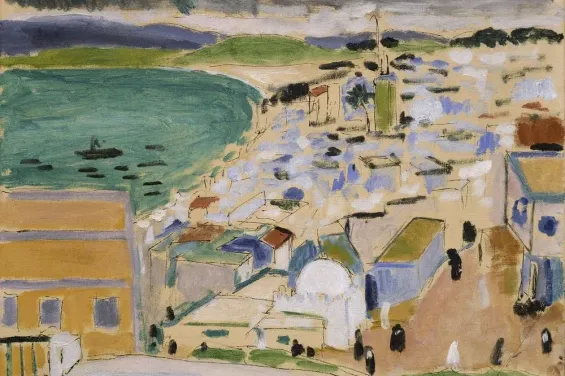
«The public is against you, but the future belongs to you». These were the words of Russian art patron Sergei Shchukin to Henri Matisse (1869-1954) as the artist prepared for his journey to Morocco. Time has indeed vindicated Shchukin's insight, just as it did for collector Ivan Morozov, who acquired several of Matisse's paintings created in Tangier. In a compelling new book, American author and photographer Jeff Koehler explores the profound influence of this North African city on Matisse's work, illustrating how this pioneering Fauvist of the 20th century ultimately «never left Morocco».
Entitled «Matisse in Morocco: A Journey of Light and Color» (Pegasus – 2025), Koehler's book chronicles Matisse's journey as a quest for artistic rejuvenation. While numerous texts have examined the sojourns of foreign artists in Morocco, such as Eugène Delacroix in 1832 or Hilda Rix during Matisse's era, Koehler provides a historical perspective that situates this artistic exploration at the intersection of public life and personal introspection.

Between January 1912 and February 1913, Matisse, originally from Hauts-de-France, made two trips to Morocco on the advice of his colleague Etienne Dinet, who had spent considerable time in Algeria. Seeking distance from a Paris dominated by Picasso's Cubism, Matisse found himself more prolific than ever in Tangier, marking a pivotal moment in his artistic evolution. During this period, he created around twenty paintings, drawing inspiration from the citadel's light, iconic sites like Villa Brooks and the Kasbah, the lush Mediterranean vegetation, and his interactions with locals, including Zohra, whom he captured in their everyday lives.
Beyond the artistic impact of this stay, Koehler offers a historical lens that illuminates the regional backdrop of Matisse's journey. Initially, Matisse traveled to Tangier to fulfill outstanding commissions. However, upon arrival, the relentless rains led him to question the wisdom of his decision. This was a time when the French Protectorate (1912-1956) was on the verge of being declared.
 Zohra on the Terrace - Henri Matisse (1912)
In this turbulent context, Matisse's journey unfolded in two phases, with the environment fostering the evolution of his artistic creations. This period saw the abstraction of works like «Moroccan Café» (1913) and other pieces inspired by Moroccan colors, which influenced his art well into the 1920s.
From the initial reception of these works in France to their confiscation in Russia following the Bolshevik Revolution (1917), and their subsequent exhibition in the United States and the USSR in 1990 and 1991, Koehler's book also delves into the interactions between Matisse, his peers, and collectors, culminating in his transformative stay in Tangier.