


 chargement...


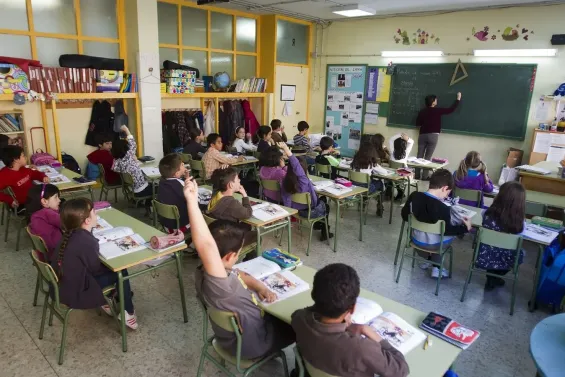
The shockwave is gradually spreading across Spain. Two regions have now announced their withdrawal from the Program for Teaching Arabic Language and Moroccan Culture (PLACM), an initiative supported by the Spanish Ministry of Education and the Hassan II Foundation for Moroccans Living Abroad (MRE). With the new school year, students in Madrid and Murcia will no longer benefit from the program, which falls under a state framework between Morocco and Spain. After more than three decades of cooperation, the decision was made under pressure from the People's Party (PP) and the far-right Vox party at the regional level.
This setback was made possible because responsibility for including or excluding certain learning units lies with Spain’s autonomous regions. This was underscored by Mohamed Chaïb Akhdim, a former socialist MP in the Catalan Parliament (PSC) and later in the Spanish Congress (PSOE), in an interview with Yabiladi. As the first Moroccan-born elected official to serve in Spain’s chambers, he now presides over the Ibn Battuta Foundation in Barcelona, where the PLACM continues to operate.
«Our organization also offers Arabic courses, with a teacher», he explained, «but it is crucial that this learning remains primarily anchored within public schools and the formal education system».
This importance is also stressed by sociologist, journalist, and migration specialist Paulino Ros. Based in Murcia, Ros has devoted much of his research to the region, which is home to a large Moroccan community spanning several generations. For this reason, he told Yabiladi that «the decision to withdraw from the PLACM is extremely worrying, dangerous, and unfair».
A partnership under strain
Chaïb Akhdim pointed to «the many dangerous statements voiced within the far-right», whose members have sought to link anti-Moroccan rhetoric to Morocco’s funding of the PLACM. While acknowledging that controversy exists, he also insisted that Morocco «must address the issue directly in order to clarify the future of learning under this program».
Ros, author of The Moroccans Who Changed Torre Pacheco in 40 Years (1979–2019), underlined that the PLACM’s value «does not lie only in providing students with the language and culture of one of their two countries in a conventional educational framework. It is also a means for schools to build relationships with thousands of families through their children. It is a pedagogical tool that fosters interaction between the classroom, the learner, and their family, with an essential role in socialization and integration».
Murcia: 10% of Moroccan origin, 0% PLACM
Ros emphasized that «the lack of understanding is even greater when one considers the objective reasons for the PP-Vox pressure to withdraw the PLACM, since the program has always functioned well and proven its worth, beyond its community dimension. Both Moroccans and Spaniards attach great importance to it, and it has consistently enjoyed broad public support».
«Murcia alone is home to some 120,000 Moroccan nationals, nearly 10% of the regional population, the vast majority of whom arrived as labor migrants. It is unacceptable to undermine a public program simply to fuel attacks against a community», Ros argued. He further condemned what he described as «electoral maneuvers designed to serve the far-right agenda as elections approach».
According to him, «this is exactly what the PP-Vox alliance is doing at the regional level: constructing a biased discourse around cultural identity and pushing an ideology that is not only hostile to migration in general, but openly rejects the Moroccan presence, which is a major social reality in regions such as Murcia».
The weight of the far-right
Ros also noted that right-wing alliances have exploited the structure of Spain’s education system «to counteract a broader and more inclusive national political vision». «They drip-feed their toxic discourse on a daily basis, particularly through their media outlets», he said. For now, civil society organizations «are mobilizing against the measures the PP and Vox are implementing or planning to implement at the local level».
Nevertheless, the sociologist remains cautious about what can be achieved in the short term without stronger political engagement. «Left-wing parties, including the PSOE, Podemos, and others, are also taking initiatives at the local level to counter the far-right’s moves», he explained.
Meanwhile, NGOs and trade unions are examining possible legal avenues to challenge measures such as the withdrawal of the PLACM, based on constitutional principles. «But we must remember that the wheels of justice turn slowly», Ros cautioned, «and any annulment could take two or three years».