

 chargement...


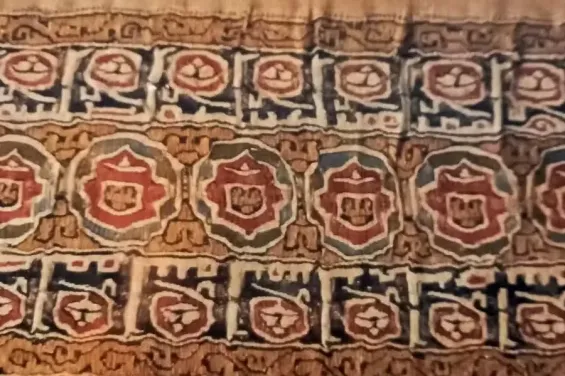
The Gothic cloister of the 12th-century Cadouin Abbey in Dordogne, France, holds relics from seven to eight centuries of pilgrimage. Listed as a UNESCO World Heritage Site in 1998, the abbey became famous for housing a fabric long believed to be the authentic Shroud of Christ, around which a powerful cult of devotion grew. That belief, however, collapsed in the 1930s when scholars discovered that the cloth bore Muslim inscriptions. Rosalie Quéré, the site’s manager, recently revisited this history.
Speaking to ICI, she explained that the fabric was once locked in a chest suspended in the abbey church. «People used to pray under the chest, under the Shroud», she recalled. Over the centuries, the site became an important destination for the faithful, whose generous donations sustained the abbey and its community of up to 32 cloistered monks. «They came to pray here, and it was also a place where they strolled in the cloister. This is what we call periods of meditation for the monks», Quéré added.
After the Hundred Years’ War (1337–1453), the cloister was rebuilt in the Gothic style, adorned with elaborate sculptures. The abbey enjoyed its golden age for centuries, until 1933, when scholars identified Arabic inscriptions on the cloth. «In these decorations, there is text. And this text is in ancient Arabic, in Kufic script», Quéré explained. The translation revealed references to «Caliph al-Musta'li», as well as to «Allah, Mohammed, Ali».
Until that discovery, legend held that Adhémar de Monteil, Bishop of Puy-en-Velay, had retrieved the shroud during the First Crusade and the capture of Antioch in 1098. When he later died of illness, the cloth supposedly passed to a priest from Dordogne, entrusted with bringing it to the bishop’s cathedral. «But the canons of Puy did not take the Périgord priest seriously, so he returned home, to Brunet, a neighboring parish of Cadouin», Sud Ouest recounts.
For centuries, the fabric was carefully kept in a lead chest. Once it was revealed to be «Muslim», however, the so-called Shroud of Christ was desacralized and pilgrimages to Cadouin were permanently banned.