


 chargement...


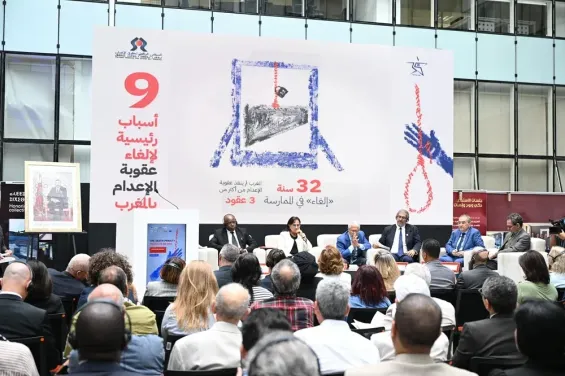
Will the reform of Morocco's Penal Code signal a decisive step towards abolishing the death penalty? This is the hope of the National Human Rights Council (CNDH) in a country where death sentences are still handed down, although no executions have taken place since 1993. The CNDH is advocating for the legal abolition of the death penalty, in line with the constitutional principle of the right to life, especially following Morocco's historic vote for a moratorium at the UN General Assembly in December 2024. The recent supportive vote by the Human Rights Council suggests that the Kingdom may be on the brink of a significant transformation.
On World Day Against the Death Penalty, the CNDH convened a meeting on Friday, October 10, in Rabat, where numerous political, institutional, and civil society figures expressed their support for this cause. Amina Bouayach, CNDH President, told Yabiladi: «legal abolition remains one of our ambitions, objectives, and action perspectives».
«These three elements are interconnected, and we are moving in this direction. With my colleagues and partners, both institutional and associative, we at the CNDH believe this process is already underway. Morocco's vote for the UN moratorium in December 2024, followed by the Human Rights Council's resolution against the death penalty, are pivotal moments in this journey», Bouayach affirmed to our editorial team.
According to her, «the royal pardon for those sentenced to death is equally significant, signaling that the abolition process should be implemented not only in practice but also legally».
Towards progressive reforms
In this context, Bouayach expressed optimism about the potential advancements the upcoming Penal Code reform could bring, aiming to translate «this political and sovereign will into a step-by-step process towards abolition». Similarly, Abderrahim Jamaï, coordinator of the Moroccan Coalition Against the Death Penalty and former Bar Association President, stated that «advocating for this cause has become an obligation, a duty, and a necessity» to uphold the right to life globally.
 Amina Bouayach, President of the CNDH / Ph. CNDH
«Abolition is now integral to public and judicial policies aimed at addressing societal issues with wisdom and courage. It's crucial to recognize that maintaining this sentence hinders progress towards a state of law and human rights».
Jamaï contends that Morocco's recent votes at the UN are a clear signal. «Only one step remains towards abolition, addressing the political, procedural, and legal challenges that place Morocco at odds with its Constitution, particularly Article 20, and the universal values it upholds», he emphasized.
«We urge decision-makers to revise the Penal Code to eliminate the death penalty, as outlined in Article 16. We anticipate they will enhance our legal framework based on constitutional principles and the best comparative legal practices», he added, calling on human rights organizations to support this momentum.
Raphaël Chenuil-Hazan, Managing director of Ensemble contre la peine de mort (ECPM), notes that Morocco's UN votes, coupled with Penal Code reforms requiring unanimous judge agreement for death sentences and automatic clemency requests, indicate an «irreversible trend towards abolition».
«I don't believe in lost causes. I believe in just causes, and I tirelessly fight alongside Moroccan activists so that one day, abolition will be a reality in Morocco, a country I cherish deeply», said Chenuil-Hazan.
A global trend
Chenuil-Hazan reminds us that this is a global trend: «over three-quarters of UN member states have abolished the death penalty in law or practice. Only a minority continue executions», he stated, expressing outrage at ongoing executions in certain U.S. states and Iran.
 Ph. CNDH
In Morocco, abolishing the death penalty has been a key recommendation of the Equity and Reconciliation Commission since 2004. Internationally, it's addressed in the Second Optional Protocol to the International Covenant on Civil and Political Rights. Domestically, the right to life is enshrined in Article 20 of the 2011 Constitution.
«I hope that by World Day Against the Death Penalty in 2026, we can announce Morocco's definitive abolition to the world», declared Abderrahim Jamaï.
The meeting also featured interventions from Abderrahmane Allali, President of the Moroccan Observatory of Prisons (OMP), Dimiter Tzantchev, EU Ambassador to Morocco, Gala Veldhoen, General Rapporteur of the Parliamentary Assembly of the Council of Europe on the abolition of the death penalty, and Martin Blaise Nyaboho, head of Burundi's Independent National Human Rights Commission (CNIDH).
Additional speakers included Moroccan MP Loubna Sghiri, coordinator of the Network of Parliamentarians Against the Death Penalty, Ali Amar, coordinator of the Network of Moroccan Lawyers Against the Death Penalty, Malika Ghabbar, coordinator of the teachers' network, Mohamed El Aouni for the journalists' network, and Nadia Benhida as a representative of entrepreneurs.