


 chargement...


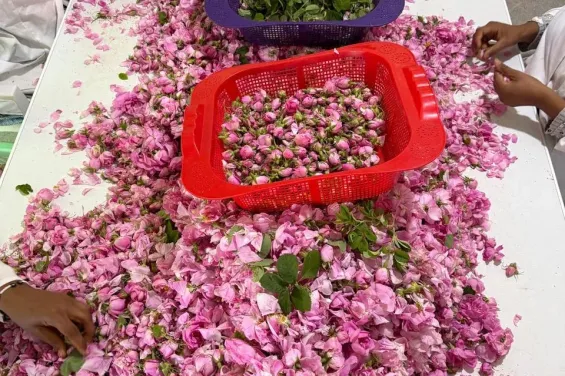
The family journey of Hafsa Chakibi between Morocco and France began with her grandfather’s migration. Her father, born and educated in France, later returned to Morocco to start his own family. Hafsa, a chemical engineer, was born in Casablanca, where she completed part of her primary education in French institutions before joining her parents in Béarn, France.
After excelling in preparatory classes, she graduated from the prestigious Chimie ParisTech engineering school. Specializing in petroleum water, she spent three years working at the French Institute of Petroleum (IFP). After earning her PhD, she continued to build her career without losing sight of her original calling.
«The main reason I wanted to study at Chimie ParisTech wasn’t to specialize in petroleum», she explained. «It was to develop my own distillation and extraction processes for oils, essences, and perfumes from plants».

The Call of the Valley of Roses
While advancing in her career, Hafsa Chakibi began to think about what she says she had «always wanted to do». Drawn by adventure, she launched her first distillation project using Damask roses from Kelaat M’Gouna in February 2018.
«I told myself I’d buy a ton of roses and if I managed to sell my product, I could look toward the future more serenely», she told Yabiladi.
The gamble paid off. Hafsa founded her brand Flora Sina and started production on a small scale. Self-financed through a family loan, she relied on her scientific background to meet the high-quality standards she envisioned. Her workshop was equipped with large traditional copper stills and stone-built furnaces for versatile production.
«Rose water is used in cooking, skincare, and cosmetics. In Kelaat M’Gouna, people also drink it to ease digestive problems», she explained.

Hafsa’s motivation came from a lifelong passion and frustration at how this heritage is often undervalued.
«It saddens me to see the rose reduced to a plastic bottle filled with synthetic water, when Morocco, especially Kelaat M’Gouna, has one of the few climates in the world ideal for high-quality Damask roses».
Building a Sustainable and Certified Enterprise
Drawing on her expertise, Hafsa aligned her production with international standards, noting that «professionals are increasingly seeking certified artisanal products». In 2020, her workshop met these requirements, obtaining ONSSA authorization in 2021, along with organic certification and an export license.
This milestone marked her permanent return to Morocco. In Kelaat M’Gouna, her workshop now helps revitalize the local economy, creating jobs for women while diversifying production.
«We work mainly with the valley’s roses but also use orange blossom and jasmine», she said.

A Socially Responsible and Eco-Conscious Vision
Hafsa’s initiative goes beyond distillation. Each year, she allocates part of her company’s profits to local development projects that promote craftsmanship, education, health, and women’s empowerment. These projects benefit the entire population of the Valley of Roses, a region renowned worldwide for its floral distillation heritage.
Among the initiatives supported are the creation of a sewing workshop, a school library, the marketing of Berber rugs by a local association, and the establishment of an organic vegetable garden.
«Economic progress can only happen collectively, in harmony with the territory’s identity», she emphasized. Hafsa works closely with local partners to ensure traceability and sustainability. She also aims to expand into other plants and flowers to «cover the entire agricultural calendar», ensuring stable, year-round employment for local women instead of seasonal work.

Reviving Moroccan Fragrance Traditions
After rose water, orange blossom water, and dried petals, Hafsa now plans to explore iris and saffron flowers, while highlighting Morocco’s endemic plants as valuable income sources for rural families.
Her long-term vision is to preserve traditional know-how within a structured, ethical framework that safeguards heritage, quality, and dignity. Today, Hafsa is working toward acquiring her own rose farm to complete the value chain and develop permaculture practices.
«I want to protect this tradition and the people who make it live on», she concluded, her eyes set firmly on the future, one that smells of roses, jasmine, and determination.