


 chargement...


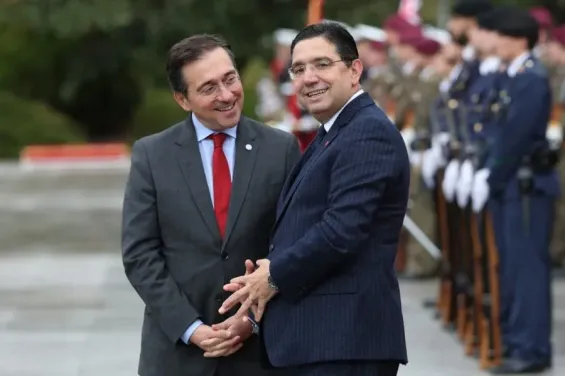
Morocco considers the latest UN resolution a «break» from previous ones, as it clearly defines the ultimate goal of negotiations: genuine autonomy under Moroccan sovereignty, Nasser Bourita said. The Minister of Foreign Affairs, African Cooperation, and Moroccan Expatriates made these remarks in an interview with the Spanish news agency EFE, adding that the resolution also identifies the four parties involved in the process : Morocco, Algeria, Mauritania, and the Polisario Front.
The minister emphasized the necessity of implementing the resolution, stating: «It (the resolution) calls on the parties to engage in negotiations based on the autonomy proposal to reach a just, lasting, and mutually acceptable solution». He explained that Morocco is currently updating the autonomy initiative, noting that «in 2007, autonomy was a diplomatic initiative, but now that the Security Council has made it the basis for the solution, it must be more detailed. It has become a plan, not just an initiative».
King Mohammed VI had called in a speech following the adoption of Resolution 2797 on October 31st for Moroccan political parties to participate in updating and detailing the autonomy initiative for the Sahara.
Regarding the parties involved in the negotiations, Bourita stated that «the resolution identified the four parties that must be at the negotiating table», affirming that Morocco will clearly engage with all parties as stipulated by the resolution.
Concerning the timing for the resumption of negotiations, the minister clarified that there is no specific date yet, saying: «Morocco will wait to receive an invitation for negotiations at the appropriate time, but this requires consultation (...) and the resolution clearly points to the United States as the host country for the negotiations, thus it also has a crucial role».
Self-Determination
Regarding self-determination, Bourita explained that «the fact that the autonomy plan is at the core of the solution indicates a general awareness that it is a solid legal basis, consistent with the UN Charter and principles of international law», adding that the support of countries like Spain, France, the United Kingdom, the United States, Germany, and the Netherlands for this proposal means they «do not support something contrary to international legitimacy».
The minister pointed out that the UN resolution did not link the right to self-determination with a referendum, clarifying: «The resolution talks about allowing the parties to express their will. When the parties sign an agreement after negotiations, they are expressing their will (...) For example, in Spain's position on Gaza, it says an agreement should be signed between the Palestinians and Israelis, without mentioning a referendum to know everyone's opinion».
Bourita added: «We have no problem with self-determination, but we reject narrow, outdated, and politically motivated interpretations. No one has ever said that self-determination is synonymous with a referendum. This does not exist at all (...) If we want to read the resolution clearly, it's simple. But if the goal is political manipulation, that's another matter».
The Polisario Front and Algeria link self-determination with conducting a referendum in their discourse, even though the United Nations confirmed at the beginning of the millennium that organizing this referendum was impossible due to the lack of agreement between Morocco and the Polisario on who has the right to vote.
The minister denied the existence of an «independent Sahrawi people» in the political sense, explaining: «We are talking about inhabitants. The resolution used the word 'people,' which means inhabitants in this context. There is no people in the political sense, but there are inhabitants from the region with whom Morocco interacts».
Regarding the possibility of Morocco accepting an international monitoring mechanism to implement autonomy in the future, Bourita said that «these are topics open for discussion during negotiations», adding that Morocco believes the international community has given it confidence by supporting the autonomy plan.
Airspace Management of the Sahara
Bourita responded to a question about whether Morocco proposed during the high-level meeting to transfer the management of the airspace over the Sahara to the Kingdom, saying: «This topic is clearly mentioned in the statement of April 7, 2022. A working group was established to manage the airspace issue, and several meetings have been held. We have made progress, and every meeting, including today's meeting, addresses this issue (...) I believe the working group will meet soon to advance the file further».
He added that the current relationship between Morocco and Spain is based on trust, mutual respect, partnership, and ambition. «There is no issue today that Morocco and Spain cannot resolve within the framework of their current relationship (...) For Morocco, anything outdated must be updated. Morocco and Spain are capable of finding innovative solutions that safeguard their mutual interests».
Regarding whether Morocco considers the continued management of the airspace by Spain over the Sahara as outdated, Bourita said: «Morocco starts from a simple reality: if you board a plane heading to the Sahara, you pass through Marrakech, and it is clear who directs the flight. If there is a problem, who intervenes? Who bears the responsibility for the security of that plane? It is Morocco. Within the framework of mutual respect, we can find solutions that take into account Spain's interests and Morocco's rights and sovereign reality».