

 chargement...


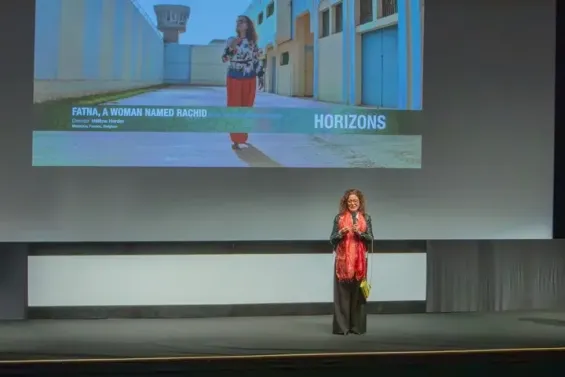
As a former political detainee in 1970s Morocco, how did you experience the preparation of this documentary and its presentation at the FIFM 2025?
I see it as an opportunity to bring women’s voices to the global stage and to give international visibility to an issue that is deeply important to me: life in the prison environment. It is also a chance to meet new people and exchange views on what Moroccan civil society is doing today.
With the film’s presentation, we meet audiences, engage in meaningful discussions with young people, and for me, this is essential. It helps raise awareness, especially on the fact that prisons should not be excluded when we think about society and its broader dynamics.
Just like schools, prisons are public institutions that have a role to play, with which we work, and whose preconceived images we try to challenge. We seek to shift biased perceptions and stereotypes about people deprived of liberty.
You yourself were one of these people. Was returning to prison difficult at first, or was it part of your path toward resilience after detention and torture?
It is indeed a journey. Given what I experienced, I feel closer to this space and more capable of defending this cause, advocating for it, and engaging with institutions and decision-makers with the aim of humanizing prisons.
 Hélène Harder / Ph. FIFM
Defending this cause, whether through memorandums for legal reform, better implementation of the law, or shifting mentalities around deprivation of liberty, delinquency, and youth education, is essential for public order, and it is an honor for me to champion it alongside committed and resourceful individuals.
This is a long-term effort, part of a broader human rights struggle to dispel the fear and mistrust surrounding the prison environment. We also aim to reach schools.
Today, we are beginning to see the first results of this work: improved relationships with the prison system and the introduction of alternative sentences. These advances, which take time, are part of the same process that began when prisons first opened up to the outside world and civil society.
That marked a turning point, and my presence at the FIFM reflects this evolution. The film recounts part of this involvement, which we are proud to share.

For younger people who know less about the political context of the 1970s in Morocco, could you tell us how the experience of detention shaped you?
It profoundly marked me. The fact that I continue to work to improve our associative and institutional approaches to prisons after my release is something very positive in my life. I often say that prison is a school we would wish on no one, a place that teaches us a great deal about the world and about ourselves.
In detention, many questions arise: How do you survive? How do you resist the deprivation of liberty? How do you keep from losing your mind when confined within four walls, knowing that human beings are meant to be born free? It is a daily battle, especially for women.
I must say that women develop tools to resist imprisonment, tools that deserve to be highlighted and studied. Creating spaces where they can thrive and regain confidence through art therapy, solidarity, and sisterhood is extremely important to me. I am happy to document this in writing, to see it filmed, and to share it in order to give hope and show that people can overcome the harshest trials.
I am one of those who endured this ordeal. I overcame it through writing my testimony, which became my book A Woman Named Rachid (Le Fennec, 2002). Today, it has inspired the documentary Fatna, a Woman Named Rachid by Hélène Harder. The book and film allow us to see whether I have truly overcome this ordeal and survived such a harsh experience.
The question now is how to teach young people not to succumb in prison, whatever the reason for their detention—because filling one’s time between four walls and behind bars remains extremely difficult.

Even more so when your femininity is stripped from you by being called “Rachid” during your years of detention, hence the title of the book and film…
Yes, and that is even harder to talk about. When your first name is taken away and replaced with another, especially one of the opposite sex, you are condemned to a kind of disappearance. Your existence is erased, and you are reduced to nothing. My fellow political detainees and I were not simply imprisoned; we were disappeared.
In that state of disappearance, the worst can happen. Yet even there, I witnessed the courage of women. I learned how we developed the ability to resist the annihilation imposed on us. We found refuge in writing, and when we had neither pen nor paper, we told each other stories to overcome idleness and the darkness we lived in, which we illuminated with our tales.
This is also when the conviction took root within me that writing is a vital weapon, one we need more than ever. It allows us to tell our experiences, but also to transmit and enrich the history of feminism and the stories of women who dedicated their lives to breaking the silence imposed on so many others.
In this case, the women who created these listening centers are volunteers who learned on the ground, training themselves by drawing inspiration from other experiences or by mustering the courage to break the silence. These efforts have changed laws and strengthened both civil society initiatives and institutional collaboration.
Yet much remains to be done in marginalized regions, especially regarding schooling and the fight against child marriage. These are all societal issues that we also find, to varying degrees, in the prison environment.
 Fatna El Bouih / Ph. FIFM
The film is born from archives, encounters, your journey, and your life story, combining documentary and inspiration. Will it be shown in educational settings, given your extensive work with young people?
Yes, the film can be screened in schools and youth centers. We have already received several requests. Some key scenes can be shown to young audiences as a basis for interaction, discussion, and listening, especially in the context of prevention. This also allows them to discover the films made by young detainees who recount their experiences of deprivation of liberty.
In this spirit, we are organizing the sixth edition of the Oukacha Film Festival from December 16 to 19, 2025. Alongside the screenings, we will organize stand-ups in which young detainees share their stories and life paths before prison. Many elements in the film can be used for awareness-raising, particularly on gender.
These days mark the culmination of three months of work during which young detainees engage in writing, storytelling, and expressing their experiences, with filmmakers and directors who volunteer to teach them screenwriting and cinematography.