

 chargement...


From centuries-old craftsmanship to practices rooted in nature and culture, Morocco has become a regular name on UNESCO’s Intangible Cultural Heritage list. Since 2008, the North African kingdom has successfully inscribed a series of elements meant to protect precious cultural practices and raise global awareness about their significance.
To this day, Morocco has registered 16 heritage elements with UNESCO, the first in 2008 and the most recent just yesterday. The list spans a wide spectrum of culture: music (like Gnawa and Malhoun), food and culinary know-how (from argan traditions to the Mediterranean diet), and folklore, including the Taskiwin dance and Tbourida.
Some of these elements are uniquely Moroccan, fully conceived, practised, and transmitted within the country. Others, however, are shared with neighbouring nations. Think of the Mediterranean diet, unsurprising, since the name already includes Spain, Italy, and Portugal. The same goes for couscous: a shared heritage between Morocco, Algeria, Tunisia, and Mauritania that has sparked tense cultural debates between Rabat and Algiers for years. Arabic calligraphy and Date Palm knowledge are also inscribed as multi-national elements that include Morocco among several other countries.
Here’s a look at Morocco’s most iconic UNESCO-listed traditions, rooted in the kingdom’s history and cultural craftsmanship.
Argan know-how
The argan tree, endemic to Morocco, carries centuries of practices tied to harvesting, oil extraction, and related artisanal products. In 2014, UNESCO accepted Morocco’s request to inscribe this precious know-how on the Intangible Cultural Heritage of Humanity list.
Inscribed under «Argan, practices and know-how concerning the argan tree», the element is rooted in the Arganeraie Biosphere Reserve of southwest Morocco. In its submission, Morocco stressed that the argan tree is «central to the cultural and social life of local communities».
Rural women are at the heart of this know-how. They are the guardians of the craft who transmit the expertise through imitation and daily practice. The file describes a chain of precise gestures, «from harvesting and drying the fruit to grinding, milling and mixing», preserved across generations.
All related traditions, including the crafting of hand-mills and the preparation of festive dishes, «strengthen social cohesion and mutual respect between communities».
.jpg)
Taskiwin, a martial dance of the High Atlas
Music, movement, rhythm, and even martial choreography, have also earned Morocco a place on UNESCO’s lists. In 2017, Morocco submitted «Taskiwin, martial dance of the western High Atlas» for inclusion on the List of Intangible Cultural Heritage in Need of Urgent Safeguarding.
Taskiwin is described as «a martial dance specific to the western High Atlas», performed with a richly decorated horn called the tiskt. Dancers also wear epaulettes, the ornamental shoulder pieces inspired by military uniforms, but in colourful, artistic versions fit for performers.
The dance is all about rhythm, built around «the art of shaking one’s shoulders to the rhythm of tambourines and flutes». UNESCO highlighted its social importance, noting that it «fosters cohesion and provides a key means of socialization for young people».
But Taskiwin is endangered. The nomination warned that the practice survives in only a few villages, with craftsmanship linked to its instruments also in rapid decline.

Gnawa, music for the soul
From martial rhythm to spiritual chanting, Morocco’s heritage keeps expanding. In December 2019, UNESCO accepted Morocco’s proposal to inscribe Gnawa on the Representative List of the Intangible Cultural Heritage of Humanity. The nomination was submitted in September 2018.
In it's nomination file, Morocco describes Gnawa as «a set of musical events, performances, fraternal practices and therapeutic rituals mixing the secular with the sacred». Gnawa is «first and foremost a Sufi brotherhood music» whose lyrics invoke «ancestors and spirits».
The file also traced its deep historical roots to communities formed through «slavery and the slave trade dating back to at least the sixteenth century», traditions that today form an integral part of «Morocco’s multifaceted culture and identity».
UNESCO noted the growing number of Gnawa brotherhoods and master musicians, supported by festivals across Morocco and abroad. These gatherings allow young artists to learn «lyrics, instruments, and rituals related to Gnawa culture».

Tbourida, military parades
War folklore and equestrian performance also have their place in Morocco’s cultural treasures. Tbourida, submitted by Morocco in 2019, was inscribed in 2021.
Described as a «Moroccan equestrian performance dating back to the sixteenth century», Tbourida reenacts ancestral Arab-Amazigh military parades. Under the command of a leader, troupes of 15 to 25 riders perform synchronized formations.
The parade has two main parts:
- The hadda, a trot followed by an «acrobatic arms drill»,
- The talqa, a collective gallop ending with a perfectly timed rifle shot «simulating a collective departure for war».
Riders wear traditional outfits, turbans, long garments, slippers, a small Qur'an, and an Arab sword, while horses are dressed in embroidered saddles showing the troupe’s tribal identity.

Malhoun, sung poetry
In 2023, UNESCO added Malhoun, Morocco’s poetic and musical art, to its heritage list. The nomination was submitted in 2022.
Malhoun is rooted in sung poetry in dialectal Arabic and sometimes Hebrew, accompanied by the lute, violin, rebab, and small drums. Its themes range from love, spirituality, and beauty to social issues, politics, gastronomy, and imaginary travel.
UNESCO praised its unifying force, noting that by blending «song, theatrics, metaphor and symbolism», Malhoun «unites all Moroccans, regardless of religion».
Today, transmission continues informally through master artists and artisans, but also through conservatories and publications that preserve historic texts.

Caftan, the latest addition
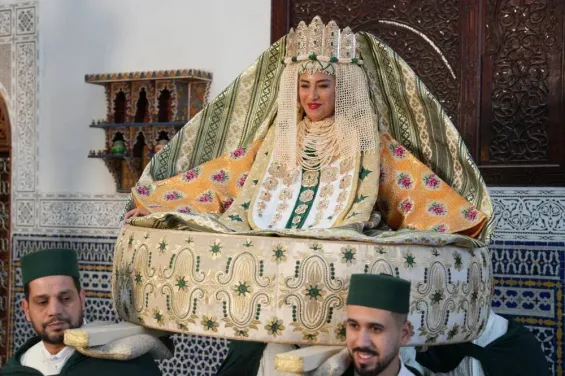
The most recent addition, and a source of national pride, is «Moroccan Caftan: Art, Traditions and Skills», inscribed in 2025 (20.COM) after Morocco submitted its nomination in 2024.
The file described the caftan as «a long tunic worn by people of all genders and ages for special occasions and celebrations». Its creation involves weavers, tailors, and artisans who produce «buttons, braids and embroidery».
UNESCO stated that the caftan is «a meaningful element of community life and shared heritage», marking social status and belonging, while also creating a significant economic ecosystem for Moroccan craftspeople.