


 chargement...


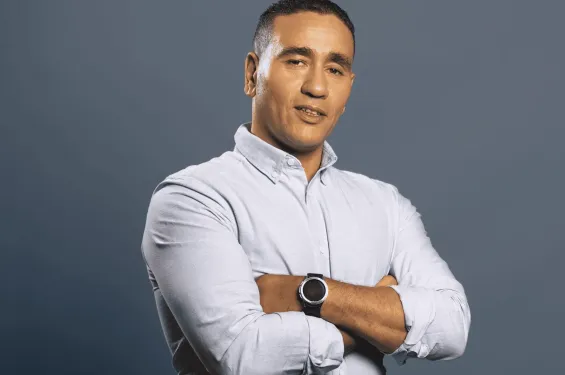
Abdou Bouzerda never imagined that one day he would cross paths with the world of journalism, let alone geopolitics. Growing up, however, he was always drawn to the news: a devoted radio listener and an avid reader of newspapers. That interest was nurtured by his father, who immigrated from Taourirt to the Netherlands in the 1960s and insisted that his son never let go of the Arabic language.
For the young Arnhem-born Moroccan, growing up in the eastern Netherlands, Arabic became an important outlet. Alongside the darija spoken at home, he learned classical Arabic from an early age. «I went to the mosque and also learned at home from my father how to read and write Arabic… I listened to stations from Rabat, Egypt, and also the BBC Arabic service», the 47-year-old journalist told Yabiladi.
Arabic opens the door to journalism
Journalism came later in life. Bouzerda initially studied international law before dropping it to work in business for several years. Eventually, he discovered his true calling. «I only joined journalism in my early thirties, around 30 or 31», he admitted.
His entry into the profession was largely due to his command of Arabic. As the Arab Spring protests spread across the Middle East and North Africa in 2011, media outlets were looking for journalists who could understand developments on the ground. «The only reason I could enter journalism without a formal journalism background was because of my Arabic skills», he said.

Bouzerda then pursued journalism training and began working as a freelancer for several media outlets, mainly in radio but also for newspapers and magazines. Gradually, his focus shifted toward Middle Eastern affairs. «When the Syrian civil war began and the rise of ISIS followed, there was a growing need in the Netherlands for journalists who could explain these developments», he explained.
Over time, this became his specialization. His ability to read Arabic sources, conduct research, and monitor developments in the region proved crucial. «Today it’s easier with AI and translation tools, but back then—between 2012 and 2017—it was very different. There was a real need for journalists who could understand Arabic sources and explain them in Dutch media», he said.
From newcomer to trusted analyst
His work went beyond translation, as he developed strong analytical skills in explaining geopolitical developments. Today, Bouzerda works for Dutch broadcaster VPRO, in foreign affairs program «Bureau Buitenland», and has become a recognized voice when it comes to Middle Eastern affairs.

«When I first started, I was just the new kid on the block explaining what ISIS was doing or what was happening in Syria», he recalled. «Now, after more than ten years, I’ve built a reputation in my field. I’m not saying I’m famous, but I do think I can influence discussions».
During his career, Bouzerda has also reported on Morocco. «In 2024, I stayed in Morocco for about five or six months and wrote background stories on migration, including about Moroccans moving to Germany for work», he said, referring to articles published in the Dutch daily NRC.
A War Measured in Missiles
With the current military escalation in the Middle East, Bouzerda also examines how the situation could affect Morocco. «First, there is the economic impact. Morocco does not produce oil or gas, so it depends on imports from that region», he explained.
Second is the large Moroccan community in the Gulf. «Many Moroccans live and work in places like the UAE and Qatar—not only in business but also in public services such as the police or fire departments. So when we see tensions affecting those countries, we also think about the Moroccans living and working there».
.jpg)
Assessing the current conflict, Bouzerda said that after more than a week of fighting, the United States and Israel initially appeared to dominate militarily. «But Iran has shown it was prepared, decentralizing its command structure and responding strategically».
He warned that the conflict could last «no longer than five or six weeks», arguing that the timeline largely depends on «the number of missiles Iran has and how many it can launch».
While the United States has overwhelming military power, he noted that «the cost of this war is enormous, about one billion dollars per day», which he described as a conservative estimate. He also highlighted the burden of missile defense systems, explaining that «every time Iran launches missiles toward the Gulf states or Israel, it is mainly the United States that intercepts them», with each interceptor costing «between three and five million dollars».

Beyond financial pressure, he warned of political consequences if energy prices continue to rise. «When ordinary Americans… start to complain, it could directly affect public support for the war effort».
In addition to geopolitical analysis, Bouzerda also explores the personal side of global conflicts through his podcast «Achter de Frontlinie», which translates into English as «Behind the Frontline».
In this podcast, he tries to understand what happens behind the frontlines, speaking with journalists, analysts, and experts who closely follow conflicts and geopolitical developments.
«The idea is to talk with people who have expertise or personal experience and who can provide perspectives that are not always heard in mainstream media. Sometimes the discussions are analytical, and sometimes they are more personal», he concluded.