


 chargement...


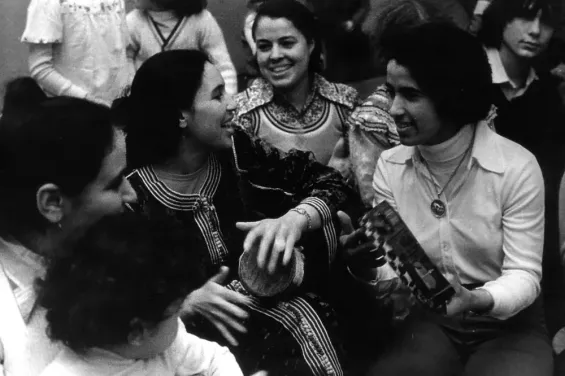
Among the first North African migrants to France, many women were far more than homemakers. This is what French-Moroccan sociologist and journalist Samia Chabani seeks to highlight through her work with documentation and private archives, which trace the migratory journeys of these often-overlooked pioneers. In 2006, she founded the association Ancrages and brought these stories to life in the exhibition Portraits of Women from Immigration in Marseille. Twenty years later, the project has evolved into a traveling exhibition titled Gender, Immigration, and Engagement, on display at the Marseille Municipal Archives from March 6 to April 4, 2026.
Beyond bringing these testimonies out of the shadows, the activist aims to anchor this narrative in the present through a collaboration with French-Vietnamese photographer Mathieu Do Duc. «It’s a counter-narrative effort to allow our daughters to identify with relatable examples», Samia Chabani told Yabiladi. To that end, dozens of women from different generations are portrayed, embodying collective action in working-class neighborhoods through initiatives ranging from drug prevention and social support to economic empowerment and assistance in family-related situations.
 Samia Chabani
Samia Chabani highlights the presence of «a generation of daughters of immigrants, with diverse trajectories». «The staging of this exhibition, produced by Ancrages in partnership with the Bouches-du-Rhône Departmental Archives, shows that the issues it addresses remain highly relevant», she said. She situates her initiative «within a moment of collective reflection at the crossroads of feminist struggles, the contributions of Marseillaises with immigrant backgrounds, and the recognition of civic engagement as a pillar of emancipation».
For years, Chabani has observed that «public narratives on migration tend to render women’s civic, cultural, and social contributions invisible». Through this exhibition, she aims to «move beyond reductive representations» that confine first-generation migrant women to roles shaped by family reunification. Instead, the project seeks to restore the strength of voices rooted in working-class neighborhoods, where «associative action has often served as a laboratory for citizenship and women’s empowerment».

Fatima Rhazi, a figure of emancipation in Marseille
In Marseille, Chabani notes that «many migrant women or women of immigrant descent come from Morocco, Algeria, and Tunisia, but also from many other countries». She therefore sought to «reconstruct pathways of engagement to demonstrate that these women have long been active in public and associative initiatives».
«I wanted to revisit the journeys of migrant women involved in supporting education for women and girls, economic empowerment, and the fight against gender-based and sexual violence, linking these commitments in France with those in their countries of origin, particularly in relation to reforms such as the Family Code», she explained.
Among the figures highlighted in the exhibition is Fatima Rhazi, a Moroccan activist, high-level athlete, and the first female photographer in Morocco. Born in Oujda in 1956, she moved to France in 1987 to prevent her in-laws from gaining custody of her daughter.
 Fatima Rhazi
«The situation forced me to flee so that my child wouldn’t be taken away from me. It’s such a painful story… Even my rights as a mother were violated. Fortunately, the Moudawana, the Moroccan Family Code, has evolved since then», Rhazi writes in her testimony.
In France, she became a facilitator at the Belsunce social center, where she encountered new forms of poverty. She later resumed her work in photography, drawing on «the richness of traditional costumes to create portraits». In 1994, she founded the association Femmes d’ici et d’ailleurs, aimed at «promoting socio-professional integration for women».
Today, she reflects on her journey of professional integration «by drawing on [her] own resources and culture». «My principle has always been to guide people towards autonomy, not to keep them dependent in order to justify funding. In our culture, we are encouraged to seek knowledge from the cradle to the grave», she writes, echoing Chabani’s broader effort to highlight the trajectories of first-generation migrant women.
Enriching the sociology of women and migration
In this context, Chabani presents «a broad spectrum of women, not all of whom identify as feminists, but who reflect this diversity and a legacy of public engagement». «Since the first exhibition, some have gone on to become deputy mayors. Twenty years later, they are more visible, and the aim is also to highlight the progress achieved», she said.

For Chabani, these narratives also serve as a response to various «forms of exclusion and stigmatization», compounded by the invisibility of Moroccan and North African migrant women «even in sociological research». Beyond deconstructing dominant and often victimizing narratives, she seeks to «change perceptions of women who arrived or were born in France, by highlighting both the constraints they face and their successes».
She also aims to convey «a positive message about those who embrace their heritage and fight for equality from within their cultural and religious identities».
For her, this evolution reflects a broader reality: «There is no single model of feminism, but rather a plurality of feminisms shaping social movements in France, in an ongoing struggle for human rights and the convergence of causes».