

 chargement...


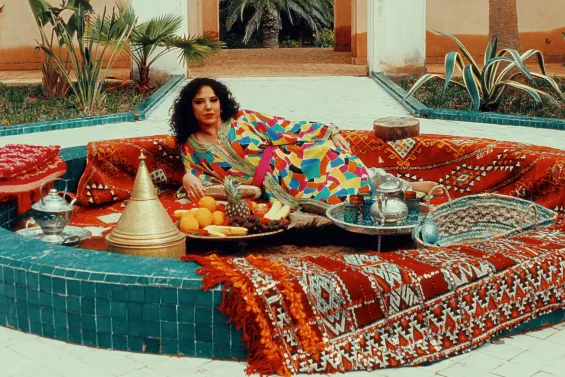
Tamar grew up between Moroccan and Brazilian cultures, between Darija and Portuguese. Born to a mother from Casablanca and a father from São Paulo, the singer, songwriter and dancer was raised on a rich and varied soundtrack. «Brazilian music at home, and Moroccan music at my grandparents’ or at weddings», the artist, who goes by Lala Tamar, told Yabiladi.
Drawn early on to Moroccan sounds, Tamar quickly developed a deeper connection to the music. «I started digging, researching, studying old materials, Ala, Andalusi, Malhoun… I realized it’s really the language of my heart, but I didn’t have the knowledge yet», she says.
 Lala Tamar. / Ph. Abdelilah Belam
That realization also led her to understand that there is no formal school for learning Moroccan music, but rather a tradition rooted in direct transmission through local maâlems.
A former member of Andalucious, an ensemble founded in 2015 around a shared passion for North African music, Tamar explored these repertoires, performing covers and navigating different musical styles from Morocco and the wider region.
Learning through tradition
Her journey eventually led her to Gnawa, not just as a genre but as a world to enter. «I began learning to dance Gnawa, to hold the karkaba (metal castanets), the mizan, the movements. When I was invited to sing in Essaouira, I used that opportunity to search for a teacher. That’s when I met Maâlem Saddiq.»
When the COVID-19 pandemic brought everything to a halt, Tamar moved to Essaouira to study with him more closely. «I spent most of that period there, really sitting with him and learning. I came to learn the guembri, the culture, not just the music.»
Through this immersion, she delved into the mythology and history of Gnawa. «I kept finding links between Gnawa and the Brazilian cultures I grew up with. I even went to Brazil to attend ceremonies like Candomblé and Umbanda, which are very similar to Gnawa lilas in some ways», she explains.
Echoes between Morocco and Brazil
Working closely with a maâlem also pushed her toward her own artistic voice. It marked the beginning of her solo journey as a singer and songwriter. «I would mix the material with Portuguese, or change lyrics from masculine to feminine, or bring different spiritual references. At first, I was worried because I respect this culture so much, but my Maâlem encouraged me deeply to go with it, to not be afraid.»
At the same time, Tamar reconnected with another layer of her heritage: Tamazight. In tribute to her grandmother, she wrote the song Achkid Aylli («come my daughter»). «My grandfather was born in Aït Ben Haddou and my grandmother in Taznakht, but I don’t speak Tamazight fluently. The first time I went there, I realized I couldn’t communicate with people. It made me feel there was a whole part of my heritage I couldn’t reach. So singing in Tamazight became a way to reconnect, even if imperfectly», she shares.
All these influences come together in her latest project, her first fully original album, set for release this week. «In my music, there’s Gnawa, along with Chaabi, Sahrawi, Andalusian, Brazilian, and even some Spanish influences. It’s really a mix of everything I’ve lived», she says.
With eight tracks in Darija, one in Tamazight, and one in Portuguese, the album explores identity, origins, love, and the ties between cultures. «I see them almost as love letters, between people, but also between cultures.»
As she awaits the public’s response, Tamar still sees herself as a disciple, mtaalma, driven by a deep, constant urge to keep learning about Moroccan music.