

 chargement...


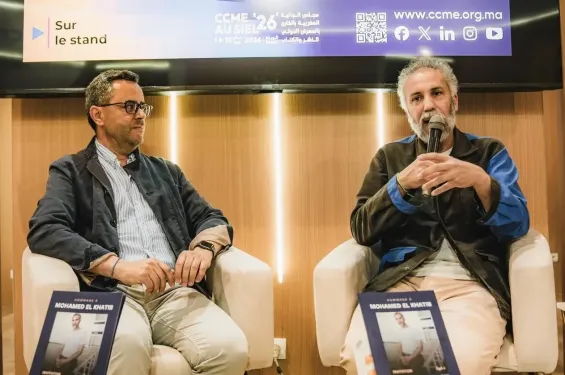
Playwright, director, visual artist, performer, and filmmaker, Mohamed El Khatib has gained international recognition through his documentary theater work. The French-Moroccan artist skillfully blends reality and fiction to explore personal, political, and social issues with depth and sensitivity. His work is currently being highlighted in a tribute organized by the Council of the Moroccan Community Abroad through a selection of films and creations presented at the 31st edition of the International Book and Publishing Fair.
Mohamed El Khatib advocates for a multidisciplinary and open approach to narrating exile and mourning, placing the protagonists of these experiences at the center of the storytelling process. This artistic vision has given rise to acclaimed works such as «Moi, Corinne Dadat», «Stadium», «La Dispute», and «La vie secrète des vieux», as well as «Renault 12», a documentary later turned into an exhibition of the same name at the MUCEM. The project draws inspiration from the road trips of Franco-Maghrebi families and the emotional geography of migration.
Through «Le grand palais de ma mère», presented at the Grand Palais, he also pays tribute to his late grandmother, placing intimate stories, grief, and popular culture at the heart of a narrative that challenges condescending perceptions. More than a creative process, his work unfolds as a therapeutic journey, allowing him to transform pain into a way of organizing inner chaos.
 Ph. CCME
Narrating Family to Enrich the Collective Story
This exploration of memory and identity is particularly present in the documentary «Renault 12», which recounts the death of the director’s mother and the family’s journey to Morocco following her passing. Mohamed El Khatib describes the experience as a «deep trauma» that profoundly «shook» his life and altered his perception of time. Through writing and filmmaking, he found a way to revive the story of the deceased and anchor intimate memories within a universal narrative.
By rediscovering the central role his mother played within the extended family stretching back to Morocco, Mohamed El Khatib gradually pieces together the rupture imposed by grief. The journey to repatriate her body becomes an initiatory path, revealing to him an unknown side of a woman shaped by «work, migration, and humanity», and remembered by relatives in Morocco as a pioneer. In this process, writing emerges as a form of reconciliation for immigrants and their children.
Speaking on the program «Faites entrer l’invité – spécial Marocains du monde» on Radio 2M on Wednesday, May 6, in partnership with Yabiladi as part of his participation in SIEL 2026 with the CCME, Mohamed El Khatib explained that his work is rooted in a «democratic» artistic approach. Whether in documentary or theater, he said he wants the stage to «reflect the society we live in» by «giving voice to people we are not used to hearing and showing bodies we are not used to seeing».
 Ph. CCME
Democratizing Artistic Expression
This philosophy is one of the reasons why the artist frequently works with «amateurs, who are above all experts in their own lives». «I didn’t want to confiscate their voices and hand them over to industry professionals, but rather open up and propose a landscape as diverse as the one we live in», the filmmaker explained, noting that this vision also shapes his documentaries.
Advocating for a «minimalist» artistic approach, Mohamed El Khatib also insists on making creation feel accessible. «When I meet young artists, I like telling them that anything is possible, that art can be created with very little, and that we can return to the essence of artistic practice», he said.
This vision is reflected in works where, «to speak about parents and questions of lineage, the setup remains as simple as possible : children, at the end of the performance, invite their parents to join them on stage in a generational gesture designed to facilitate dialogue between the two».
 Ph. CCME