

 chargement...


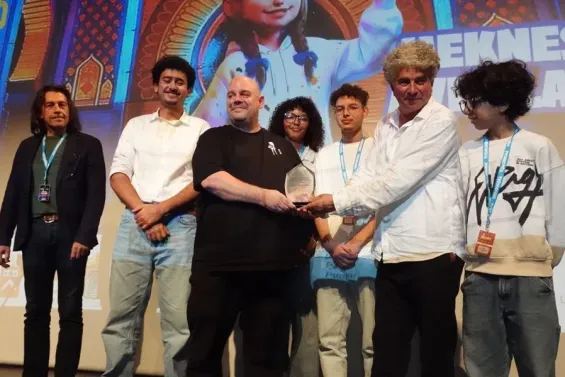
How does it feel to see «Allah Is Not Obliged» win an award at FICAM 2026?
The team worked on the film for nine years. Through my studio, I was proud to support the project during nearly half of that journey, handling special effects, sets, and post-production compositing. I’m very happy to see this wonderful project come to fruition and to see it recognized here.
The film is directed by Zaven Najjar and produced by Franco-Cameroonian producer Sébastien Onomo. It follows child soldiers during a civil war and is based on the novel of the same name by Ivorian author Ahmadou Kourouma.
As a director, you presented «Hola Frida» at FICAM 2026. Why focus on Frida Kahlo’s childhood?
We wanted to tell the story of her childhood because so little is known about it. People know her adult life, but we wanted to show how everything began, when she contracted polio at the age of six and started living with a disability. That experience profoundly shaped the way she saw life, and from there the incredible woman she became was born.

What does the figure of Frida Kahlo represent for you?
She is a talented woman and an inspiring figure for both adults and children. At first, we hesitated to take on the project because Frida Kahlo’s image has been appropriated for everything imaginable, mugs, cushions, and countless products. We love the character so much that we didn’t want to give the impression that we too were simply taking advantage of her fame.
We traveled to Mexico to meet members of the Kahlo family, including her great-niece Cristina, who is a talented photographer. She supported us because, as she explained, very few people dare to tell the story of Frida’s youth. My co-director, who deeply admires Frida and draws inspiration from her world, wanted to pay tribute to her through this project.
The film gradually evolved into a biopic centered on young Frida, with the aim of introducing her story to children around the world.
You have also won awards at FICAM. Tell us about that track record
Three years ago, I presented «Dounia and the Princess of Aleppo» here, which won both the jury prize and the audience award. The festival creates a special environment where we can see children fully immersed in the worlds we create. Young or old, everyone enjoys interacting with the films being screened.
Last year, we presented «Hola Frida», which won the audience award. I screened it seven or eight times for groups of children at FICAM, and I have wonderful memories of those moments in the large domed theater. Many mothers came with their children to watch the film and discuss it together afterward.
The feature also explores the relationship between Frida and her strong-willed mother, because there is not just one way to raise and love children, especially in societies where women carry multiple responsibilities.
You returned to FICAM 2026 with the same film. Did you receive the same enthusiasm?
Absolutely, especially since this year we screened the film outdoors at the Agora. It was a magical and emotional moment. The children were running and playing before the screening, but once the film started, their attention slowly shifted to the screen. Within ten minutes, everyone was fully focused.
For a director, the greatest reward is seeing young audiences stop what they are doing to watch a film voluntarily, without anyone forcing them to.

Did you tell Frida Kahlo’s story from a child’s perspective to make it more accessible?
Yes, especially because the film deals with difficult subjects such as disability. Frida Kahlo uses a wheelchair, she loses a leg, and we see her paint one in place of the one she no longer has. We also address her experience with polio and bullying, while showing how she managed to defend herself and rise above it all.
It’s a film children can watch, and we wanted to approach these themes in a way that teaches them something meaningful. We often don’t realize how much a child in a wheelchair lacks examples of successful people they can identify with, figures that can help them hold on to their dreams.
In fact, we received many letters from children saying: «I’m missing a leg too, I’m in a wheelchair, and I’m a chicken leg like Frida!» The film has also been screened free of charge in many hospitals.
Beyond FICAM, you have a long history with Morocco. Tell us about it.
It’s part of my family story. My grandfather left Cyprus dreaming of reaching the United States. Life first took him to France, then Spain. When he arrived in Morocco, he met my grandmother, a Moroccan-Spanish woman who had lost her family during the Spanish Civil War, and together they settled in Casablanca.

In the Medina, my grandfather became a shoemaker while my grandmother ran a small toy shop. They never left Morocco, and my father was born here. He was a traveler, musician, and drummer who later returned regularly to perform in the country, notably during the inauguration of the Hôtel Transatlantique.
Last year, thanks to FICAM, I returned to Morocco for the first time in more than 40 years.
Does having multiple origins help you break down barriers as a creator and highlight unconventional role models?
Having roots in many places, without feeling entirely rooted in one, makes me less afraid to speak about different cultures. That said, I would never want to tell stories on someone else’s behalf, which is why we consulted Frida Kahlo’s family. What matters to me is being part of a creative process grounded in respect.
For this project, we involved Mexican contributors, shared the script with them, and listened to their feedback in order to make the necessary adjustments. In the same way, I could never have made «Dounia and the Princess of Aleppo» alone or without Marya Zarif, who is Syrian, originally from Aleppo, and living in Canada while part of her family remains in Syria.
We also involved Syrian refugees, including little Raaf, the voice of Dounia, who had experienced a journey similar to the character’s.

I like creating while surrounding myself with people. I bring my skills and my studio, along with my team of 20 artists. Together, we place our talent at the service of these stories to create the most beautiful film possible, without taking the place of the people whose stories are being told.
Does all of this make you want to deepen your ties with Morocco?
Yes, especially because last year I met many Moroccan professionals working in animation and production. I wanted to develop co-productions and advise on projects. I also met companies working in the video game industry.
There is tremendous creative talent in Morocco, and I think that, much like in Quebec, there is a strong attachment to local culture here.
In Quebec, that cultural confidence helped produce filmmakers such as Xavier Dolan, Jean-Marc Vallée, and Denis Villeneuve, who went on to make major films in Hollywood.