


 chargement...


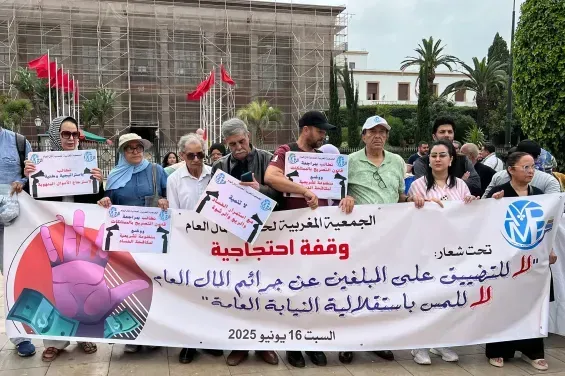
Civil society organizations have long played a key role in the fight against financial corruption, monitoring managerial and financial irregularities within elected bodies and filing complaints with the judiciary. Their efforts have contributed to bringing a number of parliamentarians, public officials and local elected representatives before the courts.
One of the most prominent figures prosecuted following complaints filed by public funds watchdog groups was former minister and former president of the Fquih Ben Salah municipal council, Mohammed Moubdii, who was sentenced a few days ago to 13 years in prison for embezzlement and misappropriation of public funds.
However, the entry into force in December 2025 of Law No. 03.23, amending and supplementing the Code of Criminal Procedure, has effectively barred associations from filing direct complaints against individuals suspected of involvement in corruption or the misappropriation of public funds.
Article 3 of the law states that «investigations and public prosecutions concerning crimes affecting public funds may only be initiated at the request of the Prosecutor General at the Court of Cassation, in his capacity as head of the Public Prosecutor’s Office, based on a referral from the Court of Auditors, or on a request accompanied by a report from the General Inspectorate of Territorial Administration, the general inspectorates of ministries or the administrations concerned, or based on a referral from the National Authority for Probity, Prevention and Fight against Corruption, or any other body expressly empowered by law to do so».
Article 7, meanwhile, grants the right to file complaints only to associations recognized as being of public benefit and holding authorization to litigate from the government department responsible for justice.
Diverging views between the government and rights advocates
A number of human rights organizations have criticized the reform, arguing that it strips civil society of its ability to report suspected cases of corruption and embezzlement of public funds.
The law was also adopted without being referred to the Constitutional Court by the institutions authorized to do so under Article 132 of the 2011 Constitution, a step that would have allowed its constitutionality to be reviewed, unlike what occurred with the Code of Civil Procedure.
For its part, the Economic, Social and Environmental Council (CESE) noted in its opinion on the draft law that restricting the right to initiate legal proceedings and limiting the Public Prosecutor’s Office’s ability to investigate and prosecute crimes involving public funds runs counter to provisions of the Criminal Code that penalize the failure to report crimes. It also argued that requiring associations to obtain «authorization to litigate» is inconsistent with efforts to strengthen the constitutional role of civil society.
Justice Minister Abdellatif Ouahbi, however, has defended the reform, arguing that reports of financial crimes should be limited to public institutions legally empowered to handle such matters. He maintains that statistics show a significant number of complaints filed with judicial police services and prosecutors are malicious and ultimately produce no legal consequences, serving instead to harass individuals through lengthy investigations and damage their reputations.
Protecting corruption instead of fighting it?
Speaking to Yabiladi, Safi Eddine El Badali, vice-president of the Moroccan Association for the Protection of Public Funds, said the organization has spent two decades monitoring suspected corruption within elected bodies, public institutions and semi-public entities.
He explained that the association bases its work on reports from the Court of Auditors, inspections conducted by the Ministries of Finance and Interior, and reports submitted by opposition municipal councillors. According to him, the association has filed hundreds of complaints that have led to the prosecution of municipal presidents, councillors, parliamentarians and civil servants on charges ranging from corruption and embezzlement to document forgery and misappropriation of public funds.
El Badali argued that the growing number of prosecutions in corruption cases prompted the government to pursue what he described as «a policy of protecting corruption rather than fighting it». He added that the amendments to the Code of Criminal Procedure were intended to curb the influence and activism of anti-corruption organizations.
According to him, the law was designed «to silence the voice of civil society, including the Moroccan Association for the Protection of Public Funds, in violation of the Moroccan Constitution».
He concluded by describing the measure as «a coup against constitutional legitimacy and the country’s political values».
«Entrenching the persistence of corruption»
For her part, Souad Brahma, president of the Moroccan Association for Human Rights (AMDH), told Yabiladi that the law represents a step backward in terms of the role assigned to civil society organizations under the Constitution.
She argued that excluding associations from reporting and accountability mechanisms sidelines an important constitutional tool while also undermining Morocco’s international commitments to strengthen civil society participation in public affairs. In her view, the reform risks entrenching corruption rather than combating it.
As an example, Brahma cited a complaint filed by her organization during the Covid-19 pandemic concerning alleged corruption involving pharmaceutical companies and the disbursement of significant public funds. She noted that some of the alleged irregularities had already been highlighted by a parliamentary fact-finding committee.
«We filed the complaint in 2021», she said. «One month after the law entered into force, we received, for the first time, an official response stating that no action could be taken because Article 3 prevents associations from reporting corruption cases».
Morocco ranked 91st out of 180 countries in Transparency International’s latest Corruption Perceptions Index. The National Authority for Probity, Prevention and Fight against Corruption has previously estimated the annual cost of corruption in Morocco at around 50 billion dirhams.