

 chargement...


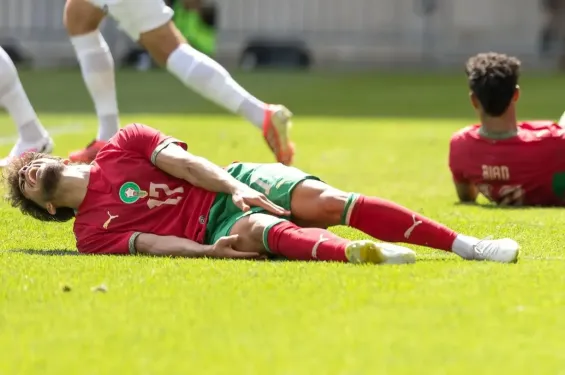
Morocco's World Cup campaign suffered an early setback before a ball had even been kicked. Just days before the Atlas Lions' Group C opener against Brazil, Abdessamad Ezzalzouli and Nayef Aguerd were ruled out of the tournament through injury.
Ezzalzouli picked up a knee injury during Morocco's final warm-up match, while Aguerd failed to recover in time from a lengthy rehabilitation process following groin surgery. Their absence has revived a familiar question: are these injuries simply bad luck, or part of a recurring pattern that has followed Morocco into major tournaments in recent years?
The list is a long one. Amine Harit missed the 2022 World Cup through injury, while Sofiane Boufal suffered a setback during AFCON 2024 and Romain Saïss battled fitness problems at AFCON 2025. Ahead of the latter tournament, Achraf Hakimi and Azzedine Ounahi also arrived carrying physical concerns.
The Toll of an Overloaded Calendar
For Sports journalists interviewed by Yabiladi, however, the explanation goes beyond bad luck. «It is an accumulation of matches and fatigue», said El Abadi, a French-Moroccan sports journalist at Canal+ and author of The History of African Football.
«Most of Morocco's key players compete in highly demanding European leagues, where they can play between 50 and 60 matches per season», he explained.

«Abde, for example, played a huge number of games this season and consistently pushed himself to the limit».
Aguerd's case, however, is different. «Over the past few years, he has suffered a number of recurring physical setbacks», El Abadi noted.
Netherlands-based Moroccan journalist Mustapha Esadik, author of Football Champions of Africa, points to the same factors.
«I think it mainly has to do with the packed calendar», he said. «Moroccan players in major leagues play a lot of matches: league, cup and European competitions». Added to that are international fixtures and the Africa Cup of Nations, often without any real breaks between seasons, Esadik argued.
«A player like Hakimi hasn't had a summer without a major tournament in recent years», he said, referring to the 2024 Olympic Games, the 2025 Club World Cup, two AFCON tournaments and now the 2026 World Cup. «Unfortunately, it comes as no surprise that there are risks of injury».
Ouahbi's Faith in Squad Depth
The injuries inevitably raise another question: does Morocco have the depth to absorb the loss of two key players on the eve of the tournament?
El Abadi no longer sees such absences as the kind of major setback they might once have been for Morocco. «Ouahbi has shown that he relies on a deep squad, with several players capable of stepping in when needed», he said.
He nevertheless acknowledged that Ezzalzouli's absence could require adjustments. «Certain on-field understandings had already been established with Abde, and those will now have to be rebuilt with his replacement».

For El Abadi, this reflects a philosophy Ouahbi had already demonstrated with Morocco's U-20 side: creating a system in which players can be rotated without the team becoming overly dependent on specific individuals.
Added to that, he said, is the fact that «the overall technical and physical level of Moroccan footballers has improved significantly».
A Test of the Atlas Lions' Maturity
Esadik, however, remains more cautious. «I fear there is now a significant gap between the strongest 15 players in the squad and the rest of the group», he said.
In his view, that means Morocco can afford very few additional setbacks. «Given the circumstances, the temperatures, the travel distances and the demands of the tournament, there is a chance the staff will need that squad depth», he explained. «That could affect the team's chances of achieving the best possible result».

Beyond the immediate sporting consequences, El Abadi believes these absences represent a test of maturity for the national team.
«For a long time, the team relied heavily on a handful of key individuals. Today, the challenge is to prove that the collective project is strong enough to withstand important absences, just as other major football nations do».
He points to Brazil and Spain as examples. Brazil will have to cope without Rodrygo, while Spain lost Fermín López before the tournament.
«Morocco now faces the same challenge: proving that the strength of the group is greater than the loss of any one player».