

 chargement...


Long before Dirou Niya, the story of Morocco’s World Cup songs began decades earlier. As the 2026 World Cup unfolds across the Americas, Moroccans are once again celebrating their seventh participation through music.
The internet is flooded with rhythms and chants praising Achraf Hakimi, Brahim Diaz, Yassine Bounou’s heroics and Noussair Mazraoui’s warrior spirit. It is the continuation of a long tradition. So let’s take a trip back in time and rediscover some of the earliest songs that accompanied the Mountakhab on its World Cup adventures.
L'Farik L'Watani Ya Wlidi
The story starts in Mexico 1986, Morocco’s second World Cup appearance and the tournament that saw the national team become the first African and Arab side to reach the Round of 16. A song was released to celebrate the qualification, although it made no mention of the team's relatively new nickname, the Atlas Lions, coined by national radio commentator Kamal Lahlou during a World Cup qualifier against Côte d’Ivoire in 1973.
It's titled L'Farik L'Watani Ya Wlidi (The National Team, Oh Son). No artist is credited. Like many popular songs of the era, it opens with a distinctly Moroccan sound, almost reminiscent of a Ghiwani tune, built around familiar traditional instruments and folkloric rhythms.
Yet, much like today's football anthems, it celebrates the players one by one.
The lyrics reference some of the stars of that historic squad, including defenders Abdelmajid Lamriss and Saad Dahane, as well as midfield maestros Mohamed Timoumi and Mustapha El Haddaoui. Without paying attention to the lyrics, one could easily mistake it for a wedding song, so festive and deeply Moroccan are its rhythms.
Issaba issaba
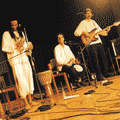
Another football-themed song can be found in the repertoire of the Rai group Frères Bouchnak. Titled Ryadah (Sport), it praises L'Farik L'Watani, the national team.
It is difficult to determine exactly when the song was released or which tournament inspired it, but its lyrics reference both footballers and athletes. Among them is Hamid El Hazzaz, who represented Morocco at the 1970 World Cup in Mexico, the country's first-ever appearance at football's biggest stage.
The song also mentions Badou Zaki, who would later captain Morocco's golden generation of the 1980s, alongside sporting legends Said Aouita and Nawal El Moutawakel.
Although not exclusively dedicated to football, the song's catchy refrain leaves little doubt about its sporting inspiration: «Issaba, issaba, daba tji daba» , «Goal, goal, it's coming now».
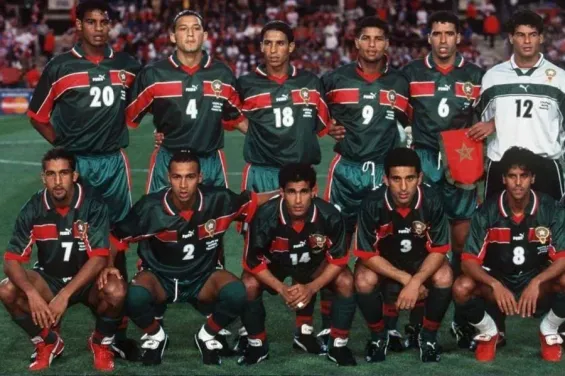
The third stop on our musical journey takes us to another golden era of Moroccan football: France 1998.
Morocco's qualification for the World Cup in France inspired yet another celebratory song. The identity of the singer remains uncertain, although several online commenters attribute it to one of the Frères Bouchnak. The song opens with the line: «Yallah yallah goulou nchallah, nessrou wlad bladi» («Come on, say Inshallah, may the sons of our country prevail»).
Most notably, it appears to be among the first World Cup songs to explicitly use the nickname Ossoud Al Atlas, the Atlas Lions.
This time, the lyrics celebrate the stars of Henri Michel's squad, including Salaheddine Bassir, Noureddine Naybet, Mustapha Hadji, Abdelkader El Brazi, Abdelkrim El Hadrioui and Raghib.
Hihou Mabrouk Alina
And finally, the best-known of them all.
«Hihou mabrouk alina, hadi l'bidaya, mazal mazal...»
Today, it has become a staple of Moroccan football celebrations. Yet its origins lie across the border in Algeria.
The song was originally performed by legendary Algerian singer Rabah Driassa and became associated with Algeria's historic victory over West Germany at the 1982 World Cup in Spain. Over time, it evolved into a celebratory anthem for major football triumphs.
In Morocco, Rai icon Rachid Briah adapted the song, rewriting the lyrics for the national team and giving it a livelier, more contemporary rhythm. His version celebrated Morocco's qualification for the 1986 World Cup in Mexico.
Nearly four decades later, the song still echoes through Moroccan streets every time the Mountakhab writes a new chapter in its World Cup story.