


 chargement...


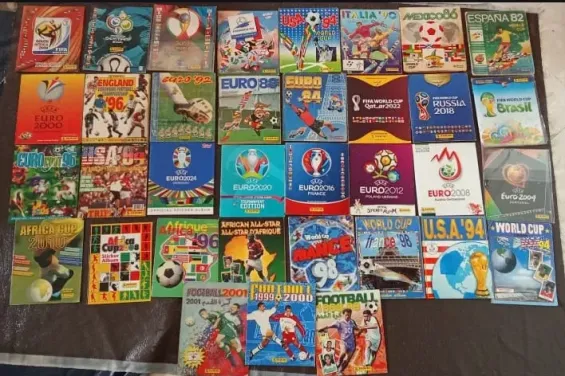
Once upon a time, World Cup fever came without social media, likes, comments or TikTok dances. Instead, it revolved around a slower-paced ritual: collecting and trading Panini stickers.
Released months before the tournament kicks off, the iconic collectible album features hundreds of stickers of players, coaches and national teams. Fans buy sealed packs containing random stickers and fill the empty spaces in the album, swapping duplicates with friends, or nowadays, online, in the hope of completing the collection before the opening match.
For many Moroccans, filling a Panini album was the highlight of the countdown to the World Cup. In a way, it was their own version of social media.
«I started collecting when I was seven years old. Every time my father came home from work, he would bring me a pack of stickers», recalls Ouadii, a lifelong Panini collector.
A childhood passion
The first albums he bought were the Euro 1992 and the 1994 World Cup editions. Since then, he has built a collection spanning World Cups, UEFA European Championships and even the few Africa Cup of Nations editions released by Panini.
He remembers those days vividly. «I collected stickers of Maradona, Van Basten, Roberto Baggio and Klinsmann, players who bring back so many memories», he told Yabiladi.
Among the Moroccan stars, two names stand out the most. «Noureddine Naybet and Mustapha Hadji both appeared in the 1994 and 1998 editions», he recalls, referring to the two World Cups Morocco qualified for.

But Ouadii points out a detail that many fans overlook. «Contrary to what many people think, World Cup Panini albums do not include all the players who eventually take part in the tournament».
The reason is simple: the albums are released around six months before the World Cup, shortly after the draw, rather than waiting for the final squads, which are announced only weeks before the competition begins.
Instead, the albums feature players who took part in the qualifying campaign. Morocco's 1994 edition is a good example. «The 1994 Panini album included Youssef Fertout and Lahcen Abrami, even though they were not part of the final squad that played at the World Cup».
Conversely, players who earned a late call-up after the qualifiers never made it into the album.
Hadji mania
For many Moroccans who grew up in the 1990s, the 1994 and especially the 1998 editions remain the most memorable.
Tarik, from Casablanca who did not own a Panini album yet enjoyed collecting the stickers and exchanging them for marbles, remembers one sticker everyone wanted. «It all started during the 1998 World Cup qualifiers, when Morocco played Egypt. Egypt had a very strong team, but Hadji scored an incredible bicycle kick that gave Morocco the win. From that moment on, everyone saw him as a legend».
.jpg)
The craze only grew during the 1998 World Cup after Hadji scored another spectacular goal against Norway.
Panini stickers, however, could also reflect the emotions of football. «People started throwing away Youssef Chippo's stickers after his own goal against Norway», Tarik recalls.
Morocco's elimination quickly shifted collectors' attention toward the tournament favorites. «Everyone wanted the Brazil stickers, Rivaldo, Roberto Carlos and Ronaldo, especially after they beat Morocco 3-0. We were convinced Brazil would win the World Cup».
But when France defeated Brazil in the final, Zidane suddenly became the player everyone wanted to collect, he recalled.
A lot of patience and plenty of friends
Collecting Panini stickers required patience, determination and, above all, plenty of friends to trade duplicates with.
For Ayoub, who grew up collecting Panini albums in his Rabat neighborhood, completing an album proved impossible.
«I remember the 1994 World Cup edition in particular. Unfortunately, I never managed to complete it. Every time I bought new packs, I kept getting the same stickers».
.jpg)
The problem, he says, was the neighborhood kiosk. «I tried trading them with friends and neighbors, but we all bought our sticker packs from the same kiosk. It turned out they all came from the same batch, so everyone ended up with the same duplicates», he joked.
Even so, he remembers those years fondly. «The players I remember most are Italy's Roberto Baggio, Brazil's Dunga and, for Morocco, goalkeeper Khalid Azmi, Bahja and Mustapha Hadji».
Above all, he remembers the excitement. «It was a real source of joy. There was no social media, so we would grab one dirham and run to the neighborhood shop to buy a pack of stickers».
For Ayoub, Panini albums were also educational. «You got to know the players' names, their national teams and the positions they played. It was a way of playing and learning at the same time».
A tradition passed down through generations
The tradition did not stop with the generation that grew up in the 1990s, nor was it reserved for boys. Sonia, a Moroccan now living in Málaga, remembers collecting Panini albums with her father and cousins.
«I collected three Panini World Cup albums: the 2006, 2010 and 2014 editions. My favorite players to collect were Zinedine Zidane, Ronaldo Nazário, David Beckham and Robin van Persie».

She still keeps the albums at home. Many others do too. «Many people in Morocco are still passionate about Panini. There are collectors who grew up with the albums and continue to buy both new and older editions», Ouadii says.
Some even search resale platforms such as eBay for vintage albums, sometimes paying high prices to complete their collections, he added.
The albums now feature Morocco's new golden generation. «Yassine Bounou has appeared in two editions, while Achraf Hakimi features in three, including the 2026 edition».
Unlike the old days, however, collecting Panini stickers has become significantly more expensive. «A pack of five stickers used to cost just one dirham, while the album itself sold for five dirhams», Ouadii says.

Today, the 2026 album costs 35 dirhams, while each sticker pack sells for 11 dirhams. «Completing an album can cost up to 5,000 dirhams, and even then, you may still not manage to fill every empty space», he said.
The challenge remains the same: too many duplicates. «When we were young, we exchanged stickers with friends and neighbors. Today, we trade online through groups of collectors who share the same passion».
Yet the magic remains unchanged. While many Moroccans cherish Panini as a childhood memory, collectors like Ouadii continue to live it.
«My goal is to own every edition», he says. «I would never sell them because I worked so hard to collect them».