


 chargement...


Between the 18th and 20th centuries, Morocco attracted numerous writers and travelers. The British adventurer Emily Keene became the Sherifa of Ouezzane, French ethnologist Odette du Puigaudeau documented nomadic cultures in Morocco, and American author Paul Bowles made Tangier his second home. In the 19th century, it was French naval officer Pierre Loti who became captivated by the region. His work is filled with admiration for Arab and Persian cultures, the Middle East, and North Africa.
Born in Rochefort-sur-Mer, France, Louis Marie Julien Viaud (1850–1923) is better known by his pen name, Pierre Loti. Though an aspiring musician in his youth, Loti never imagined he would dedicate most of his life to the navy. Gifted in drawing and the arts, he was admitted to the French Naval School at the age of 17 and entered service during a period of extensive French colonial military engagement.
Loti was deeply affected by the death of his older brother, Gustave, a naval surgeon who died during a mission to Poulo-Condor (in present-day Vietnam). His early naval postings led to his first long voyage and a promotion to first-class midshipman at just 19. A year later, he sailed to Easter Island and continued on to explore Tahiti.
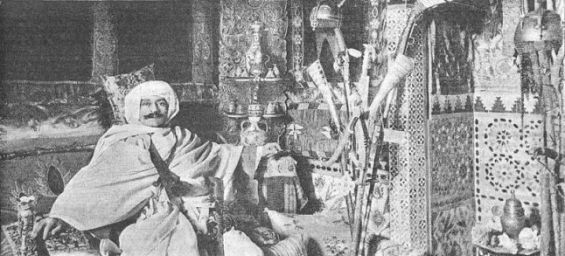
 Pierre Loti
Pierre Loti's missions generally involved creating sketches to accompany reports for the French Ministry of the Navy. To support his financially struggling family, he also sold his drawings to the weeklies L’Illustration and Le Monde illustré.
A Traveling Officer Enchanted by Morocco
Despite wearing a military uniform, Pierre Loti was detached from the colonialist mindset of his era and was never fully absorbed by the military culture tied to his missions. From childhood, fueled by a passion for art and writing, he maintained the habit of keeping a journal, though he never considered himself a writer. His first published work, Azyadé (1879), did not bear his name. His second work, Le mariage de Loti (1880), was published under the pseudonym «The author of Azyadé».
It wasn’t until 1881 that he officially adopted «Loti» as his literary pseudonym, inspired by a name given to him by the ladies-in-waiting of Tahitian Queen Pomaré IV (1827 – 1877). That same year, Roman d’un spahi was the first work to carry the signature of Pierre Loti. In addition, one of his missions took him to the Sino-French War (1881 – 1885). Promoted to the rank of lieutenant, he recounted the Capture of Hué (1883) in the columns of Le Figaro.
As his career progressed, Pierre Loti became a world traveler. He journeyed through Turkey, Japan, India, Persia, Jerusalem, Algeria, and Morocco. Captivated by the diverse cultures of North Africa and the Middle East, he claimed to possess «a half-Arab soul», immersing himself in local customs that ultimately shaped his way of life. His book Au Maroc (1890) richly documents his travels through the kingdom. In a subsequent work, Fès, which was drawn from Au Maroc, he recounts his reception at the French embassy and his meeting with Sultan Hassan I (1873 – 1894).
Both books offer a detailed account of the officer-traveler’s fascination, describing cities and regions, starting with the northern city. «From the southern coasts of Spain, from Algeciras, from Gibraltar, one can see over there, on the other side of the sea, White Tangier. It is very close to our Europe, this first Moroccan city, perched like a sentinel on the northernmost point of Africa; in three or four hours, steamships take you there, and a large number of tourists visit each winter», he writes in Au Maroc.

Seen from a distance, the city of Tangier «almost seems cheerful» to Pierre Loti, who observes the «villas built in the European style within gardens», contrasting them with buildings that have «remained much more Muslim in appearance» than the cities of Algeria. He also notes the «walls of snowy whiteness, its high crenellated kasbah, and its minarets clad in old tiles». Unlike many of his contemporaries, Loti strives to maintain a certain distance from the territory to which he feels he does not belong.
In his book, he writes that there will be no «considerations on Moroccan politics, its future, or the means to draw it into the modern movement». «First of all, it neither interests nor concerns me, and, above all, the little I think is directly contrary to common sense», asserts Loti.
«The intimate details that particular circumstances revealed to me about the government, the harems, and the court, I have even refrained from sharing (while approving them in my own mind), for fear they might provide fodder for gossip among some fools. If, by chance, the Moroccans who received me were curious to read me, I hope at least they would appreciate my discreet reserve».
A Reception in Fès
Pierre Loti remains cautious, avoiding any voyeurism. «And even in these pure descriptions to which I have confined myself, I am very suspect of partiality for this land of Islam. I, who, by some phenomenon of distant atavism or preexistence, have always felt my soul half-Arab: the sound of the little African flutes, the drums, and the iron castanets awaken in me unfathomable memories, charming me more than the most learned harmonies», he writes.

In Morocco, the author recalls encountering «only hospitable people—perhaps a bit inscrutable, but smiling and courteous—even among the common folk, in the crowds». «Every time I tried to say gracious things in return, I was thanked with that lovely Arab gesture, which consists of placing a hand on the heart and bowing, with a smile revealing very white teeth», he describes.
In his travel journals from Morocco, Pierre Loti notably recounts his departure from Tangier to Fès, passing through Ksar El Kébir, on mules and horses provided by Hassan I. He also describes the journey to the spiritual city, for a reception and a meeting with the sultan. Along the way, he recalls rivers and «goat paths, long marked by the passage of caravans».
The author becomes aware of his emotional attachment to the region, appreciating seeing it still shielded from American or European lifestyles. «My well-being is further enhanced by feeling very far from that neighbor of Huysmans [French writer and art critic, fond of travel and sleeping cars, ed.],—who is, after all, a masterfully painted type of the contemporary elderly gentleman, an important express traveler», he writes. He even goes so far as to praise the sultan:
«In my joy at thinking that this sort of character does not yet circulate in Morocco, I feel a first movement of gratitude towards the Sultan of Fez for not wanting sleeping cars in his empire, and for leaving the wild paths where one rides on horseback, cutting through the wind…»

At the end of the journey on horseback and mule to Fès, Pierre Loti's appreciation for Hassan I grows, and he ends up admiring him with a respect tinged with admiration. «I am grateful to him for being handsome; for wanting neither parliament nor press, nor railways nor roads; for riding magnificent horses; for giving me a long rifle adorned with silver and a large saber damascened with gold. I admire his high and serene disdain for contemporary agitations», he writes.
«Like him, I think that the faith of ancient days, which still makes martyrs and prophets, is good to keep and sweet to men at the hour of death. Why bother so much to change everything, to understand and embrace so many new things, since we must die, since necessarily one day we must expire somewhere, in the sun or in the shade, at an hour known only to God?»
Recognition in France
After his journey to Morocco, Pierre Loti headed to Algeria in 1891. That same year, he was elected by the French Academy to fill the vacant seat of novelist and playwright Octave Feuillet (1821–1890), who had passed away. At the heart of this prestigious institution, the sailor and now recognized author took his seat on April 7, 1892, delivering a long speech in tribute to Feuillet, not forgetting the hospitality that had impressed him in North Africa and the land of Islam.
In this address, he also reflected on his anonymous beginnings in literature: «The day after the appearance of these early works, filled with clumsiness and inexperience, I passed through Paris, between two long voyages. Already very surprised, and a bit charmed too, to learn that I had been read, I felt a true joyful surprise when, at my publisher's, I was handed a card from Octave Feuillet expressing his curiosity to know me and inviting me to visit him».

That year, two more works were added to Pierre Loti's bibliography: Le livre de la pitié et de la mort and Fantôme d’Orient. Meanwhile, he continued to serve in the naval forces. The year 1889 marked his promotion to the rank of frigate captain, and he became a ship captain in 1906. After 42 years of service, he retired on January 14, 1910.
Although Pierre Loti had laid down his uniform, he remained devoted to his travels, driven by the ambition to devote more time to his first passions: writing and travel. However, the reprieve was short-lived, as he donned his uniform again in 1914 to volunteer at the start of the First World War (1914–1918).
After a mission with the Italian army, Pierre Loti was demobilized in 1918 for health reasons. He continued to publish books, including Quelques aspects du vertige mondial, Court intermède de charme au milieu de l’horreur, and Les massacres d’Arménie. During his lifetime, his last publication was in 1921. The following year, the writer received the insignia of the Grand Cross of the Legion of Honor.
Pierre Loti died on June 10, 1923, in Hendaye, and a national funeral was held in his honor. His posthumous works were compiled and published by his son, Samuel Viaud. Un jeune officier pauvre was the first diary to be edited after his death, released in 1923. In 1925, Journal Intime 1878–1881 was published, followed by the third and final volume, Journal Intime 1882–1885, in 1929.
 The house of Pierre Loti
Since then, Pierre Loti's work has been immortalized with the conversion of his former home in Rochefort into a museum and exhibition space. The place embodies a concentration of the author's passions and fascinations with the Orient and North Africa, revealing the influences of the southern Mediterranean coast on the former sailor.
After many years of closure, the site will reopen its doors to the public in June 2025, allowing visitors the opportunity to discover the objects Pierre Loti brought back from his travels.