


 chargement...


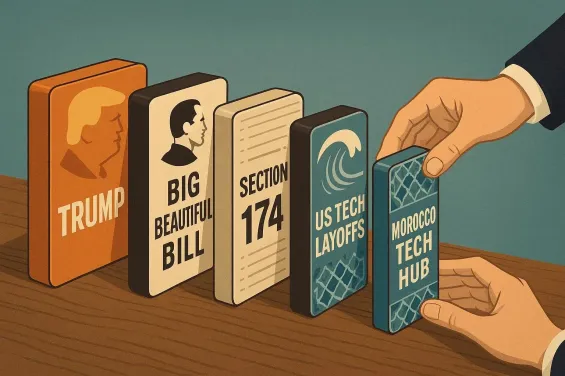
Since January 1, 2022, Section 174 of the 2017 Tax Cuts and Jobs Act (a Trump-era measure) has quietly come into force. This provision requires companies to amortize their R&D expenses over 5 to 15 years instead of deducting them fully in the year they occur. Overnight, R&D became a much more demanding cash flow item, not just for tech giants like GAFAM, but even more so for young startups. The natural adjustment lever? Employees, the biggest cost center. Layoffs, in this case, are driven not by technological disruption, but by accounting logic.
With some hindsight, it's clear that these cuts have been concentrated almost exclusively in the U.S., where most American tech R&D centers are located. And they target engineering teams far more than support functions, those same support roles we imagine AI might one day optimize.
Take Salesforce CEO Marc Benioff, for instance, who in 2024 even announced the forced retraining of engineers into salespeople. A move that makes perfect sense when viewed through the lens of the largely overlooked Section 174.
The Convenient Scapegoats: AI and Remote Work
For corporate storytelling, blaming AI, or the «post-COVID over-hiring» trend, is convenient. It offers a tidy narrative that distracts from the complexities of tax law. But AI is still in its infancy: only 1% of executives surveyed by McKinsey consider their GenAI deployment to be «mature». And the picture is even more conservative when we zoom in on Morocco and our primary partners in Europe.
Remote work? Already absorbed into the corporate fabric by 2020. What’s more relevant today are the new state-level subsidy rules designed to lure the headquarters of major U.S. companies. States that previously offered generous support are now grappling with the local economic fallout of widespread remote work. To combat this, they’ve started requiring physical employee presence for companies to qualify for subsidies. These jobs aren’t disappearing, they’re relocating.
Bottom line: It’s not the algorithm that’s in the driver’s seat, it’s politics and accounting.
The Real Impact and the Risk of a New «AI Winter»
According to the same McKinsey survey, 38% of CEOs expect no net change in workforce numbers due to AI over the next three years. Meanwhile, the tech sector continues to recruit for highly specialized roles, data scientists, MLOps engineers, and the like.
The media-friendly narrative «AI = optimization = layoffs» plays well with some CEOs, letting them talk up the miracle of AI while masking the real issue: their dependence on subsidies and tax breaks.
But the strategy is not without risk. It evokes memories of the Lighthill Report (1973), which slashed budgets and plunged AI research into a decade-long hibernation.
A similar climate of anxiety and rushed judgment about AI’s impact could slow investment, at precisely the moment when the world most needs AI talent.
Morocco’s Missed Window?
Oracle has just opened a major R&D center in Casablanca, in the presence of the Head of Government, 1,000 engineers strong. Morocco isn’t just a regional relay anymore; it’s becoming a global research hub for a key player in the AI revolution.
But the fiscal tailwind that helped shift budgets outside the U.S. has now abruptly stopped. On July 4, 2025, President Trump signed the One Big Beautiful Bill Act (OBBB), a landmark law cementing his alliance with Elon Musk.
The newly introduced Section 174A restores full, immediate tax deductions for R&D, but only if conducted on American soil. Projects abroad? Still amortized over 15 years. Just like that, the tax incentive that might have pushed CFOs toward Casablanca vanished as quickly as it appeared.
What Now? Anticipate, Don’t Endure
The way forward is anticipation, not resignation. Let’s build a Morocco Tech Radar, a permanent watchtower that spots these fleeting opportunities before they disappear: from Section 174 (2017) to OpenAI’s «Countries» program (2025). Once identified, we must act swiftly, with targeted incentives, large-scale skill development, a clear legal framework, and even a special zone backed by an offshore jurisdiction if needed.
Agile and proactive, we’ll no longer be at the mercy of the waves, we’ll choose the ones we ride.
By Younes Kouira, AI & Digital Strategy Expert