


 chargement...


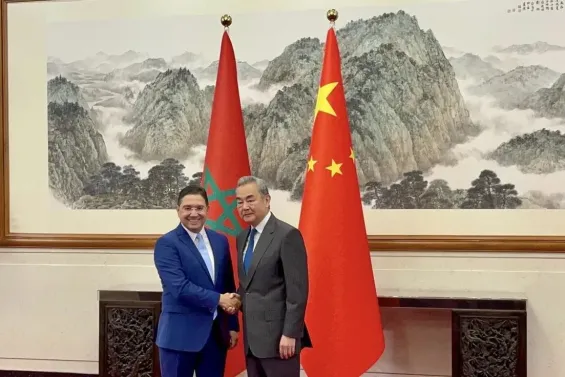
On Friday, September 19, in Beijing, Foreign Minister Nasser Bourita met with his Chinese counterpart, Wang Yi. Talks underscored «Morocco’s strategic role as a key regional platform and a natural bridge for Sino-African and Sino-Arab cooperation», a position reinforced by the kingdom’s geostrategic location, political stability, quality infrastructure, and diversified partnerships, according to Moroccan diplomacy.
The two ministers also stressed China’s importance as a major player in international cooperation and a key partner in Africa and the Arab world. They praised the strength of bilateral ties and agreed to explore new opportunities in strategic, high-value sectors such as infrastructure, industry, energy, digital technology, renewable energy, tourism, and higher education.
Bourita and Yi reaffirmed their commitment to boosting Chinese investments in Morocco, strengthening joint industrial ventures, and promoting co-development on a continental scale, particularly through tripartite cooperation in support of Africa.
Morocco is positioning itself as a hub for Chinese investment. Last June, Chinese chemical giant Tinci Materials Technology signed a $280 million (about 3 billion dirhams) investment agreement with the Moroccan government for an electrolyte project. Earlier in the year, China’s Gotion High Tech announced plans to build a gigafactory in Kenitra for electric battery production, requiring an initial investment of 14 billion dirhams and creating 17,000 jobs.
Sahara: China’s Reassuring Message
The Moroccan communiqué did not explicitly mention the Sahara issue. However, Bourita and Wang Yi discussed «regional and international issues of common interest», noting their convergence on principles such as respect for national sovereignty, territorial integrity, and the fight against separatism and extremism.
This stance is expected to reassure Rabat as the UN Security Council prepares its October resolution. As a permanent member, China plays a pivotal role in shaping the text, which Morocco hopes will break with past formulations. While Rabat is almost certain of backing from the United States, France, and the United Kingdom, it is working to ensure Beijing and Moscow adopt moderate positions and avoid using their vetoes.
Meanwhile, Morocco reaffirmed its commitment to the «primacy of multilateralism», a central theme of Beijing’s foreign policy amid tensions with Washington. Both ministers emphasized the importance of the United Nations and adherence to the UN Charter, including the peaceful settlement of disputes and non-interference in states’ internal affairs.
As a reminder, during his visit to Casablanca on November 21, 2024, Chinese President Xi Jinping told Crown Prince Moulay El Hassan that China was ready to continue working with Morocco to support each other on «core interests» and to deepen the Sino-Moroccan strategic partnership.
Morocco supports China’s territorial integrity. For its part, Beijing has consistently excluded the Polisario from its African Union meetings and has voted in favor of Security Council resolutions on the Sahara, abstaining only once, in 2018.