


 chargement...


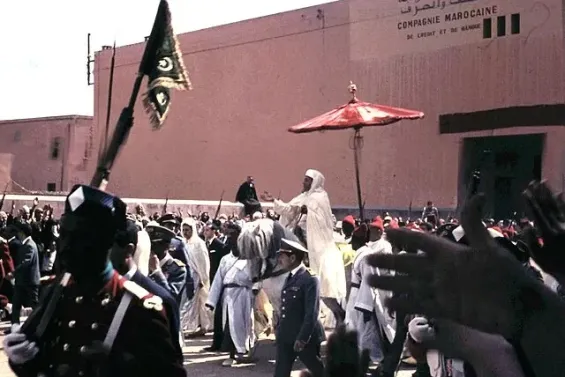
During the bay‘a ceremony, it’s a pop of color in a sea of white-clad elected and state officials pledging allegiance to the sultan. The royal parasol (midhalla), one component of this yearly rite, deeply rooted in Moroccan royalty, is not just an accessory.
This object is a long-standing royal emblem. It does more than shade the sultan during duties and ceremonies, it speaks. Before it became a staple of the bay‘a, the royal umbrella accompanied the sultan on public outings and appearances. However, it is neither uniquely Moroccan nor exclusively Islamic.
Citing medieval writers, French historian-anthropologist Jocelyne Dakhlia traces the tradition to the Fatimids in 10th-century North Africa. In «Pouvoir du parasol et pouvoir nu», she notes that in the Maghreb the parasol was later adopted by the ‘Ubaydids, heirs of the Fatimids, as «a luxurious object adorned with precious stones», likened to the «vault of heaven» or a «shield mounted on the end of a lance». In Morocco, however, it slowly «nationalized» under the Saadians in the late 16th century, notably during the reigns of ‘Abd al-Malik and al-Mansur, the dynasty’s most famous ruler.

As Aḥmad ibn H̱ālid al-Nāṣirī al-Salāwī recounts in The Saâdians 1509–1609, «An Ottoman-style guard, the Boyyaks, stood to the Sultan’s right and left; some carried long spears ahead of him». They also supplied the parasol-bearer, who shaded the Sultan’s head «as a large cloud might have done», and this bearer was «the highest-ranking officer after the Caïd Perviz».
Although using and possessing the parasol formed part of royal prerogatives and signaled legitimacy, owning or using one did not guarantee kingship. In succession crises, contenders rushed to gather the regalia : «horses, saddles, javelins, lances and parasol», Dakhlia writes. But chroniclers stressed that true legitimacy came from the bay‘a (pledge of allegiance) and acts like the solemn visit to Moulay Idriss. The message is clear: the parasol alone did not make a king, but no king was complete without it.
Delacroix and the Shereefian umbrella
If inside Morocco it was long just one emblem among others, European images amplified it. Eugène Delacroix’s 1845 Salon painting of Sultan Moulay Abd al-Rahman on horseback fixed the archetype: a white-robed sovereign crowned by a high, vividly colored parasol that «stands out… against an intensely blue sky». Delacroix’s earlier 1832 sketch barely hinted at a parasol, more a red smudge like a setting sun, yet in the finished canvas and later engravings, the parasol becomes central, drawing European attention to the object, as Dakhlia explains.

As the 19th century wore on, photographs and posters from the 1920s–30s show the parasol soaring above the sultan on horseback during religious feasts. The parasol even entered caricature: in Honoré Daumier’s «An Umbrella in a Difficult Position» (Actualités, no. 119, 25 Nov. 1859), drawn at the outset of the Spanish–Moroccan War, «the sultan of Morocco crouches alone under his umbrella as the masses of troops converge on him from both sides».

From the 1930s, after the shock of the Berber Dahir - a decree issued under the French Protectorate splitting «Arab» and «Berber» jurisdiction to weaken the Sultan’s religious/judicial authority- and the popular mobilization it sparked, the monarchy leaned more on its religious role. Under the Protectorate, temporal authority largely sat with the French administration, while the spiritual authority of the Commander of the Faithful remained the Sultan’s domain. During this period the parasol became discreet, as the sultan, «most often shown on foot, without a parasol, dressed in white, becomes more human in iconographic representations».

During the reign of King Hassan II, he jokingly—but shrewdly—returned to the symbol, writing in La mémoire d’un roi (The Memory of a King) that if the parasol were the emblem of Moroccan royalty, «many took shelter in its shade while I myself remained exposed to the sun».
Today, the parasol, which once accompanied Moroccan sultans in their outings and public appearances, is seen only at the bay‘a.