


 chargement...


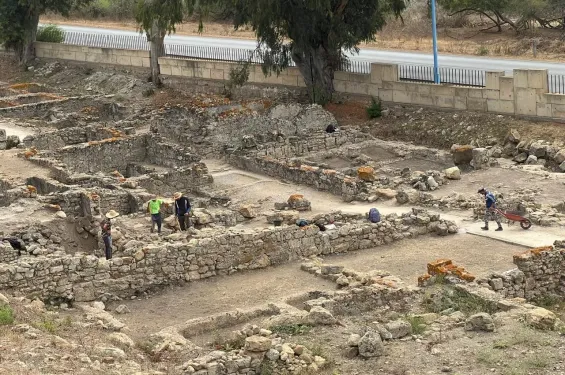
An ancient city founded by the Phoenicians in the 12th century BCE, Lixus, once a territory of the Carthaginian Empire located on the right bank of the Loukkos River, was a major hub of the Mauretanian-Roman Tingitan civilization. It stood as a pillar of economic and commercial life in the Mediterranean, renowned for its vast industrial infrastructure. At its height, Lixus hosted the largest complex of fish-salting factories in the Roman Empire, producing fermented fish sauces that were prized across the ancient world.
Over time, research has revealed that some of these units specialized specifically in sardines, as explained to Yabiladi by Mohamed Kbiri Alaoui, research professor at the National Institute of Archaeology and Heritage (INSAP), who co-leads the archaeological mission with his Spanish counterpart Darío Bernal Casasola from the University of Cádiz.
This finding is among the most recent discoveries, made possible through ongoing laboratory analyses involving Moroccan researchers from INSAP, Ibn Tofaïl University in Kenitra, and the National Foundation of Museums (FNM), alongside Spanish experts from Barcelona and Granada and German collaborators from Marburg University.
Defining Lixus’s role in ancient maritime trade
Sardines, still a staple of Moroccan and Mediterranean diets, were among the key products exported from Lixus more than two thousand years ago. According to the research team, these goods were shipped from the city’s factories to the Iberian Peninsula and even Pompeii, near Naples. Such evidence may help define the chronology of Lixus’s industrial district, establishing precise dates for the beginning and end of its production era.

Conducted since 2022 under the title «Lixus-Garum», with the support of Morocco’s Cultural Heritage Directorate, the research aims to shed light on the city’s economic dynamics and its connections to the Loukkos River, its port, and other nearby sectors. «These studies will allow us to better understand not only the city’s economy but also its relationship with its environment and trade routes», Mohamed Kbiri Alaoui explained.
Current geophysical research seeks to confirm whether amphora kilns existed at the site, large earthenware vessels used to store and transport goods such as wine, olive oil, and fish sauces. Amphora inscriptions have provided valuable clues: some mention young tuna (cordula) alongside sardines, suggesting the variety of species processed and traded.
«On the Spanish side, a major discovery was made in Almeria», Kbiri Alaoui revealed. «A shipwreck was found carrying amphorae stamped with painted signatures confirming their origin from Lixus».
Such discoveries help trace ancient trade routes linking Lixus to the wider Mediterranean, with the city’s name appearing on amphorae from the Mauretanian-Roman period found in various coastal regions. «These materials testify to the large-scale commercial distribution of fishery products from the Lixus area», he added.

Expanding the industrial area through new excavations
Excavations at the site have also revealed a previously unknown salting area in remarkably good condition. This new zone includes two additional factories, complete with preserved basins, entrances, passages, cleaning and preparation spaces. Samples taken from several locations revealed layers of salted fish and sauces still in their original position since antiquity, providing invaluable data for species identification.
«These elements are precious», said Kbiri Alaoui. «Laboratory analysis will allow us to determine exactly which species were exploited and commercialized». The team has also identified signs of organized industrial planning, each factory likely specializing in distinct fish types. In one section, researchers found secondary deposits resembling an ancient waste dump, which will be further examined through upcoming analyses.
Excavations in the northwest area of the site aim to clarify the connection between the salting units, nearby water cisterns, and the city’s defensive walls. The project has already quadrupled the known size of Lixus’s industrial district: «The data collected increased the mapped area fourfold», the archaeologist explained. «We now count 23 factories compared to the initial 10».

Combining archaeology and science
The ongoing mission employs a multidisciplinary approach combining advanced technologies such as geophysical and geomorphological mapping, molecular studies, and chemical analyses. These methods align with international research standards used at other major archaeological sites around the Mediterranean.
Ultimately, the research not only redefines the economic and industrial importance of Lixus but also highlights Morocco’s deep-rooted connection to Mediterranean trade and innovation.
Mohamed Kbiri Alaoui concluded with a call for greater national support for Moroccan archaeology: «It’s vital to encourage historical and national research in Morocco, to uncover new pages of our history that can only be reconstructed through fieldwork. Our archaeological heritage is of immense importance—its full richness is still unknown, and it deserves to be rigorously studied and showcased».