


 chargement...


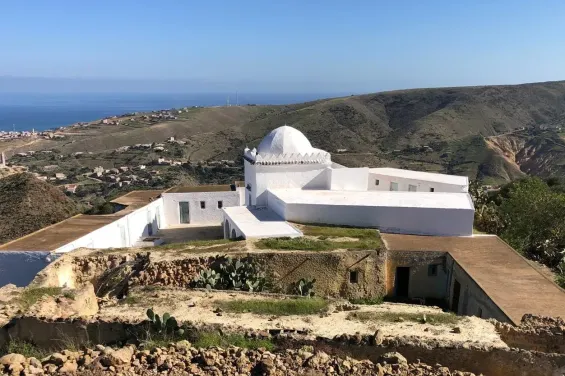
In the eastern Rif, the oral tradition of sung verses (izran) has developed around a local figure of sanctity: Sidi Chaïb Ouneftah. At the heart of Temsamane, near Al Hoceïma, the eponymous mausoleum is considered the cradle of this heritage, perpetuated mainly by women since at least the 13th century. Although scarcely documented, this spiritual and cultural landmark plays a central role in the transmission of this art, which carries historical, social, melancholic, satirical, or liberating narratives.
Surviving through time and resisting oblivion, celebrated in its ancestral form or combined with various modern musical styles, this artistic expression has evolved alongside changing customs among both women and men. Socio-political contexts have also influenced the izran. In the early 20th century, these songs extended beyond weddings and festive occasions. They became a vehicle for values of emancipation, attachment to the land and the tribe, the glory of resistance, and opposition to colonization.
«The local melodies of the region are often sung during the refrain Lalla Bouya, which appears in various forms in most izran», notes the publication Amazigh Musical Expressions in Transition by the Royal Institute of Amazigh Culture (IRCAM, 2017).
From the second half of the 20th century, and following independence, this musical tradition continued to be perpetuated by women and artists from the region, as well as immigrant workers in Europe, especially in Belgium.
These strong symbols explain why this historical and musical landmark was highlighted during the first edition of the Al Hoceïma Cultural Days on September 22 and 23, 2025, under the theme «When Culture Becomes the Memory of the Diasporas». In her book Under the Izran, the Heritage (2023), Belgian-Moroccan psychopedagogue and author Fatiha Saidi gathers direct testimonies about this oral tradition, which underscores the importance of this chief town.
 Sidi Chaïb Ouneftah / Ph. Fatiha Saidi
Izran and the Legends of Sidi Chaïb Ouneftah
In the background, this transmission helps to better highlight the genesis of the izran, where it all began. It is fair to say that the mausoleum of Sidi Chaïb Ouneftah has had several functions beyond its religious dimension. Contacted by Yabiladi, architect Mohamed Cheikh explains that, in the past, the learning of music was the great peculiarity of this place. This is one of the main reasons explaining the building's location on a mountain ridge, away from the village dwellings, unlike many other mausoleums.
Primarily of vernacular architecture, the building consists of architectural elements such as wrought iron, wood, and arches, with different datings over the centuries and several spaces serving various functions (accommodation for visitors, contemplation, gatherings during zyaras and musical meetings). According to Mohamed Cheikh, this composition also sheds light on the central place of this figure of sanctity in local social and cultural life, within which the stories about Sidi Chaïb Ouneftah enrich the legends.
Oral tradition holds that during his lifetime, this shepherd was known for his flute, which always accompanied him. He is said to have died at the age of 33 and is attributed with an aura that gives him a prophetic aspect, a miracle worker and savior of lives, with the ability to free captives. It is therefore no coincidence that musical practice was initially associated with women and this instrument during ritual gatherings on site. Combined with the bendir, it has remained a centerpiece of izran performances, developed within the mausoleum and spaces of mixed gatherings, conferring a secular dimension to the place.
 Interior of the mausoleum of Sidi Chaïb Ouneftah / Ph. Fatiha Saidi
Mohamed Cheikh tells us that over the centuries, families have flocked by the hundreds to this landmark, staying there for nearly a week to meditate, make offerings, implore God, but also to gather around communal meals, musical sessions, singing, and dancing.
«It is also said that when girls sang the izran well, the best among them would get married during the week! Beyond this festive character of the tradition, it is said to also be a vector of societal values», Mohamed Cheikh further relates.
«Every society has spaces for expression, transmission, and learning. The mausoleum has long played a central role, even with tribes spending up to two weeks there each summer. Entire families come with their supplies, and the celebration is grand, centered around the izran, which remains a key element».
A Cultural Legacy to Preserve
A combination of the art of eloquence and the ancestral practice of music at the local level, the izran thus embody the ability of a place of sanctity to develop artistic expression beyond the sacred character of a mausoleum, where people come to pray for prosperity, to have a child, or to celebrate a birth, a baptism, among other occasions.
Since then, the izran have been sung in different contexts while resonating more widely in the Rif and across the centuries, becoming an emancipatory performance. Later, this art was embraced and valued by the Moroccan immigrant community from the region, notably in Belgium.
 Mausoleum of Sidi Chaïb Ouneftah / Ph. Fatiha Saidi
«It is a heritage for all ages, among both women and men. We cherish it here as we cherish it in immigration, to the point where it is considered that one cannot be Rifian without knowing at least one izran song», comments Mohamed Cheikh, emphasizing the importance of preserving this legacy.
In the migratory context, the transmission itself informs us about families’ attachment to the land of their ancestors. «When women found themselves in the confined spaces of cramped European houses, very different from their spacious homes with patios in the Rif, they found refuge in the izran, meeting and exchanging them among themselves», Mohamed Cheikh tells us.
Since then, the izran have been taken up by working-class families in immigration, starting in the 1960s. The practice has been exported to larger circles during broader community, intercommunity, and cultural gatherings in Belgium, as well as in the Netherlands, Germany, France, and elsewhere.
While this dynamic has revived a centuries-old heritage, saving it from oblivion, Mohamed Cheikh stresses the importance of revaluing the cradle, which is crumbling over the years. «The mausoleum is located in an area known for its seismic activity. Even when it is not significant enough to be felt by the population, it impacts old buildings like this one, which remains poorly renovated and deserves attention», he concludes.