


 chargement...


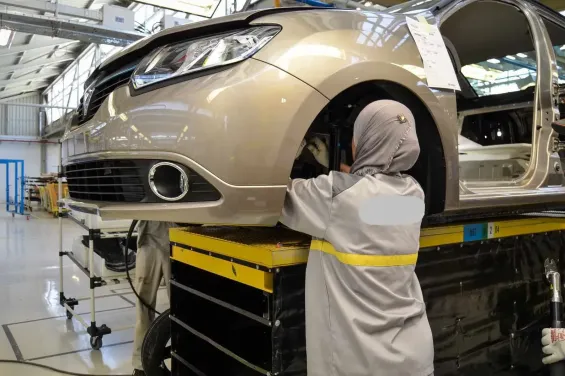
Morocco’s automotive industry has made remarkable progress over the past decades, transforming the country into Africa’s largest car exporter and a key player in the global automotive market. This success story, however, began more than sixty years ago. In 1959, Morocco laid the foundation of its automotive journey with the establishment of SOMACA (Société Marocaine de Constructions Automobiles).
The company was created on the initiative of the Moroccan government, with technical support from Fiat and its French subsidiary SIMCA. Morocco held 38% of the capital, while the two European partners each owned 20%. SOMACA’s mission was to assemble imported vehicle parts under the Complete Knock-Down (CKD) system, a first step toward developing local industrial capacity.
By 2002, the government’s initial attempt to privatize SOMACA failed, leading it to sell its shares to Renault for €8.7 million. This marked a major turning point, as SOMACA became an 80% Renault subsidiary, beginning assembly of the Logan in 2005.
A Turning Point: The Inauguration of Renault Tangier
The real leap forward came in 2012, when King Mohammed VI inaugurated the Renault Tangier plant, a project that redefined Morocco’s industrial landscape. Built under a 2008 partnership between the Kingdom, Renault, and Veolia Environnement, the site spans 300 hectares and employs 6,384 people (as of December 2024). The Renault Tangier plant produces today several key models for the Renault Group, including the Dacia Sandero 3, Dacia Jogger, Renault Express, and Mobilize Duo and Bento.
Following Renault’s success, Morocco attracted other Original Equipment Manufacturers (OEMs) such as Stellantis (Peugeot-Citroën), along with a growing network of Tier-1 suppliers producing components for major global brands. According to the Moroccan Agency for Investment and Export Development (AMDIE), the country now hosts 270 automotive suppliers across six regions, up from just 35 in 2000.
Tangier leads with firms like Valeo, Aptiv, Yazaki, Denso, and Magna, while Kenitra and Casablanca house suppliers such as Saint-Gobain, Leoni, and Sumitomo. Other regions, including Oujda, Fes–Meknes, and Agadir, also contribute to this national industrial network.
Industrial Growth and Export Success
This rapid expansion has given Morocco an annual production capacity of 960,000 vehicles and a local integration rate of 69%. In 2023, the country’s automotive exports reached $14.1 billion, reinforcing its position as a regional manufacturing hub. Between 2014 and 2021, the sector created over 180,000 jobs and achieved exports worth more than 80 billion dirhams, according to the Ministry of Industry and Trade.
Even during the pandemic, automotive exports generated 72 billion dirhams, while in 2021, Morocco became the second-largest car exporter to the European Union, according to the Organisation for Economic Co-operation and Development (OECD).
To sustain growth in the automotive industry, Morocco launched the 2014–2020 Industrial Acceleration Plan, which introduced an ecosystem approach to improve competitiveness and strengthen integration into global supply chains. Eight ecosystems have since been developed, covering wiring, interiors, batteries, motors, and dedicated programs for Renault and PSA. The plan also provides financial incentives, 275 hectares of industrial land, and training for 90,000 skilled workers.
Central to this strategy is the Institut de Formation aux Métiers de l’Industrie Automobile (IFMIA), launched in 2013, with campuses in Casablanca, Kenitra, and Tangier, plus a dedicated Renault training center. Working closely with major OEMs like Renault and Stellantis, IFMIA has trained over 50,000 professionals, achieving a 98% employment rate in multinational companies, according to the Ministry of Industry and Trade.
This dynamic industry is powered by a young and skilled workforce, with a median age of 29, compared to 38.5 in the US and 44 in the EU. Each year, Morocco produces 180,000 university graduates, including 19,000 engineers and 55,000 technicians specialized in automotive and mechanical industries. Notably, 42% of engineering graduates are women, and 44% of Moroccans aged 15–25 speak English, reflecting the sector’s international outlook.
Low Costs and Strategic Connectivity
Labor costs remain highly competitive, one of the key factors attracting foreign investors to Morocco’s automotive industry, averaging just $106 per vehicle, according to a 2025 Oliver Wyman report. This places Morocco among the world’s top low-cost automotive production centers, alongside Romania and Mexico, surpassing China in labor cost efficiency. Described as «the low-cost production center for French manufacturers», Morocco plays a role similar to Mexico’s for U.S. automakers, now hosting over half of French car production outside France.
This competitive advantage is reinforced by Morocco’s strategic location and extensive trade network, which provide a strong logistical edge. With world-class port infrastructure, notably Tangier Med, and a network of Free Trade Agreements (FTAs) granting access to a market of 2.5 billion consumers, Morocco is tightly integrated into global supply chains. Its proximity to Europe also allows for «1-day trucking access» to major EU hubs such as Spain, France, and Italy, ensuring fast and efficient delivery of vehicles and components, AMDIE shows.
Morocco is only building on this success, trying to grow capacity and attract more automakers. In the first half of 2025, vehicle production grew by 36%, with over 350,000 units manufactured, compared to 257,000 during the same period in 2024. As Industry and Trade Minister Ryad Mezzour announced in October, Morocco’s current capacity exceeds one million vehicles, with plans to increase it to 1.45 million, and ultimately to two million units, cementing its place as a global automotive powerhouse.
Just last week, Morocco and Renault signed an updated investment agreement, for 2025–2030, to launch hybrid and electric vehicle production by 2030, establishing an engineering and R&D center by 2025, creating 7,500 direct and indirect jobs.