

 chargement...


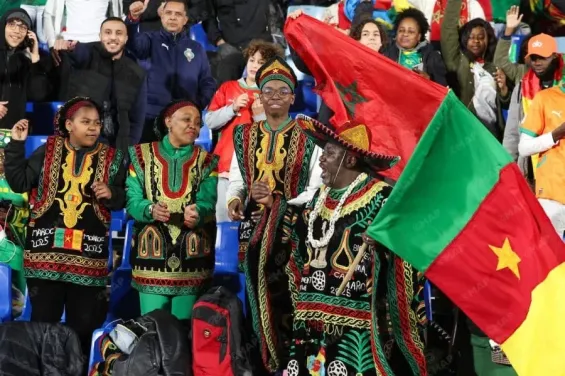
During major football events, sport becomes an especially powerful force for unity in diversity. During the Africa Cup of Nations (AFCON 2025), currently taking place in Morocco, this dynamic has once again brought to the surface the visible presence of immigrant communities from across the African continent, many of whom have now been established in the country for more than two decades.
Through exchanges in Moroccan dialect (darija) and shared moments of celebration, whether in the streets or inside stadiums, barriers fade, revealing a form of social mixing that reflects everyday coexistence. In this interview with Yabiladi, Mehdi Alioua, professor of sociology at Sciences Po–International University of Rabat (UIR) and a migration specialist, analyzes these expressions of diversity and what they reveal about Moroccan society.
According to the researcher, these dynamics reflect a deliberate shift in Morocco’s migration policy over the past ten to fifteen years. He points to medium- and long-term interactions that have taken root in a country that has gradually moved from being primarily a transit space to one of reception, settlement, and integration.
We cannot discuss the dimension of diversity in Morocco’s migratory landscape, in the context of AFCON 2025, without addressing the tournament itself. From a sociological perspective, how can we understand the unifying power of this Africa Cup?
This question has two key dimensions. According to sociologists and founders of the discipline, such as Émile Durkheim, celebration within society inherently calls for interaction among individuals. In nation-states, it often appears spontaneous, but is in fact a ritualized form of communion: everyone is expected to celebrate and to do so in a certain way, sometimes even under the threat of sanctions, as described by Marcel Mauss.
Even if this ritual is not fully codified, as it might be in so-called traditional societies, it has by no means disappeared. From this perspective, the Africa Cup of Nations, like all major sporting events, is no exception. It carries its own form of ritualization, clearly visible in the commitment of supporters, sometimes ultras, as well as in the festivities surrounding the matches, which require extensive preparation beforehand: tifos, face painting, team-colored outfits, costumes, and disguises.
This edition, moreover, has been particularly anticipated. Media outlets around the world are talking about it. Morocco is on display, and as with all major competitions, it begins with a ritualized opening ceremony. Beyond football, this becomes a celebration of a social fact, marked by what we might call the illusion of spontaneity.
It is about coming together and momentarily dissolving affiliations in favor of a universalism found across civilizations, near and far. These elements make AFCON 2025 a powerful catalyst for awareness of the social transformations currently taking place in Morocco, as established affiliations fade to make room for collective celebration.
In this context, we have observed the visibility of immigrant communities, some of whose members were born or raised in Morocco and who master darija and Arabic. Does this, in your view, reflect an evolution in the migratory phenomenon?
Wherever one goes, speaking the language of the host country is the first step toward integration. In Morocco, mastering the vernacular language, darija, is indeed an important factor. However, the issue is less rigid than elsewhere, because Morocco is a multilingual country and a true crossroads of migration.
Beyond this concept, which I have defended and theorized for more than fifteen years, Morocco is genuinely a land of confluences. We have multiple religions, diverse expressions of Islam and Judaism, and a wide range of languages that allow people to communicate. Our two official languages are Arabic and Amazigh, but we speak multiple varieties of both. Darija illustrates this well, as do Hassani, French, and Spanish.
All of this makes up contemporary Morocco, alongside the migratory experience of Moroccans abroad, some five million people, who speak many other languages while remaining an integral part of the Moroccan nation.
At the local level, darija serves as an entry point, but not mastering it is not necessarily a factor of exclusion. Unlike in other countries, where language can be a decisive barrier, Moroccans often switch between several languages when interacting with foreigners.
Today, some Moroccans are becoming more aware that children, young men, and young women from immigrant backgrounds speak darija perfectly, because they were born here, grew up here, or arrived at a very young age.
These individuals have been socialized alongside Moroccan children, particularly in working-class neighborhoods, as I have shown in my research since 2003. This cohabitation represents a stage in their trajectories, whether they ultimately stay in Morocco or attempt to migrate to Europe.
In the meantime, strong interactions take place through the local language: children play together, neighborhood bonds are formed, and language learning happens organically. Even intonation and gestures are acquired in this context, shaping both primary and secondary socialization.
Can we therefore speak of a gap between these long-standing realities and their limited representation, particularly on social media, where discourse is often less nuanced and sometimes discriminatory?
Xenophobic, racist, and hateful discourse online does not accurately reflect everyday social realities, even though such issues do exist in Morocco. What we see on screens is not a faithful or unfiltered representation of daily life. It is true that some Moroccans express discriminatory views in public, and these statements often provoke reactions, but they represent only a fraction of society. On social media, however, they appear disproportionately visible.
As a result, everyday racism in Morocco is often overstated, creating the impression that Moroccan society as a whole projects hostility toward foreigners, particularly those from sub-Saharan Africa. This is a misleading cognitive bias. It does not reflect reality.
A significant number of those spreading hateful discourse online do not even live in Morocco. Some are Moroccans abroad, others do not speak darija at all and express their racism in French or other languages. This phenomenon would merit deeper study, but one thing is certain: it does not allow us to conclude that Moroccan society is inherently racist.
Racism and xenophobia do exist and appear to be on the rise, though they remain difficult to measure scientifically. Still, we must be cautious of the distorting mirror of social media.
In the context of a ritualized celebration like AFCON, what remains most visible is a moment in which social and ethnic affiliations temporarily recede, making room for new forms of belonging forged through collective celebration. Supporting a team and expressing that support together reinforces this shared experience.