

 chargement...


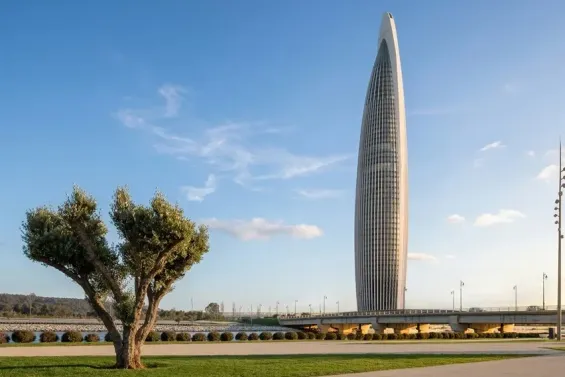
Between Rabat and Salé, the two cities blend into one another, especially around the Mohammed VI Tower. Rising 55 stories, this multifunctional landmark embodies the economic, tourism, and cultural dynamism of the twin cities as they look toward the future.
Described by its promoters as the «culmination of a personal investment» by Othman Benjelloun, the tower is part of the O Capital Group’s flagship projects at national and international levels. Through O Tower, Benjelloun commissioned Spanish architect Rafael de la-Hoz and Moroccan architect Hakim Benjelloun to design the project.
The tower includes 13 floors of offices, high-end apartments, the Waldorf Astoria Rabat-Salé hotel, as well as an observatory and exhibition spaces, showcasing advanced architectural and technical innovation.
Built to international standards
According to the project’s promoters, the engineering solutions were designed to address seismic risks in a complex geotechnical environment, while also accounting for wind and flood hazards. The structure’s stability relies on deep foundations reaching 60 meters, supported by 1,801 piles and 104 concrete barrettes.

Standing among Africa’s tallest towers, it is also a smart building, equipped with a «tuned mass damper» at the top. This system acts as an oscillator that moves in sync with the tower, absorbing its kinetic energy to reduce the effects of wind and seismic vibrations.
The tower’s summit is clad in curved glass panels and aluminum, forming a crown with lateral louvers and slim ventilation openings that also enhance its design and environmental performance.
Built on the «Shell & Core» concept, the tower concentrates all technical functions within a central core, creating large, light-filled open spaces on the north façade, complemented by a modular curtain wall. On the south side, a double-skin façade incorporates 3,900 square meters of high-performance photovoltaic panels, generating solar energy to help power the building, the promoters said.

In terms of energy efficiency, the building incorporates «numerous systems to reduce impacts on energy, water, and waste management», earning both LEED Gold and HQE Exceptional environmental certifications.
Local socio-economic impact and global reach
The project has generated 450 direct jobs and 3,500 indirect ones, and features nearly 7,000 artworks by 143 Moroccan and international artists. Its proximity to the Grand Theatre of Rabat further highlights its cultural significance.
As Rabat prepares to host the International Book and Publishing Fair (SIEL 2026), holds the title of UNESCO World Book Capital 2026, and gears up for major international events including the 2030 FIFA World Cup, the city’s dynamism is reflected in the tower’s ambitions. In this context, the structure positions itself as a key asset for future development, particularly in tourism and the cultural and creative industries.
Leila Haddaoui, Deputy General Manager of O Tower, said the project aims to anchor activities that support these sectors, contributing to the growing international profile of Rabat-Salé and the wider region.

During a press visit on Monday, Leila Haddaoui told Yabiladi: «This aligns with Morocco’s vision today, reflected in the major strategies led by the country’s highest authorities, promoting a Morocco that is open to major international events while remaining proud of its roots and identity.»
«We are committed to hosting such events. Our goal is to actively contribute to building the image of an ambitious Morocco, focused on the future while embracing its identity.»
Celebrating the heritage of Rabat-Salé
This vision is also reflected in the tower’s design, which blends traditional craftsmanship with sleek contemporary elements, bringing together Moroccan artisanship and international expertise under the direction of French interior designer Pierre-Yves Rochon.
The project brought together artisans from across Morocco, creating a sequence of «monumental doors, large-scale sculptures, mural frescoes, and finely carved plaster calligraphy» leading up to the Heritage Observatory on the 50th floor. This space offers «an interactive experience through panoramic windows», immersing visitors in the cultural heritage and landmarks of Rabat and Salé.

This digital scenography highlights key heritage sites on both banks of the Bouregreg. The 51st floor hosts the permanent exhibition «The Sky Speaks Arabic», which celebrates the astronomical knowledge of the Arab-Andalusian golden age and is open to «schoolchildren and dreamers from around the world».
«The observatory is open to the public by reservation, with tickets priced at 250 dirhams for adults and 80 dirhams for those under 18. Partnerships will be developed with institutions and associations to make this educational space accessible to as many people as possible,» said Leila Haddaoui.
The tower’s cultural and tourism mission is further reflected in the art gallery at its base, which invites visitors to «explore the vision, ambitions, and significance of this iconic building». Three thematic spaces present «an institutional manifesto in video format through six distinct perspectives».
The gallery also features a scale model highlighting the tower’s main components, along with samples and multimedia content on tablets detailing its technical features, illustrating the project’s blend of innovation and craftsmanship.