


 chargement...


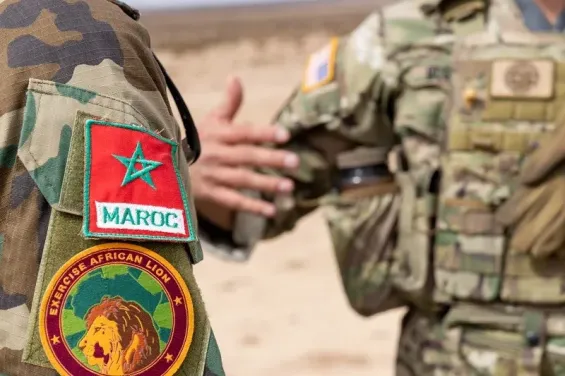
The disappearance of two U.S. soldiers during African Lion 26 has drawn renewed attention to one of the largest military exercises on the continent. While search and rescue operations are ongoing, initial reports suggest the two soldiers may have fallen into the ocean.
According to reports, the soldiers were on an evening walk in a training area when one of them is believed to have fallen from a cliff into the sea. Fellow soldiers attempted a rescue by forming a human chain, but strong waves swept two of them into the ocean. One soldier was rescued, while two others remain missing.
The soldiers were taking part in what is considered U.S. Africa Command’s largest annual joint exercise. Launched on April 27 and scheduled to run until May 8, the drills are being held across Ghana, Morocco, Senegal, and Tunisia, with Morocco hosting the largest share of activities.

This year’s edition brings together around 5,000 personnel from more than 40 countries, alongside over 30 U.S. industry partners. The program includes a wide range of operations, including live-fire drills, air and maritime training, special operations, and humanitarian missions.
Led by the U.S. Army Southern European Task Force, Africa (SETAF-AF), the exercise aims to strengthen collective security, test rapid deployment capabilities, and enhance coordination in multi-domain environments, while also integrating advanced technologies.
From Bilateral Drills to Continental Exercise
Originally launched in the 1990s as a biennial exercise led by U.S. European Command (EUCOM) and conducted by U.S. Army personnel in partnership with the Royal Moroccan Armed Forces, the drills later came under Marine Corps leadership and evolved into an annual event. With the creation of U.S. Africa Command (AFRICOM) in 2008, oversight of African Lion was transferred to the new command, paving the way for its expansion into a larger multinational exercise involving an increasing number of partner nations, including NATO allies.
Over the years, African Lion has grown significantly in both size and scope. The 2025 edition brought together around 10,000 troops from more than 50 countries, while in 2024 approximately 8,100 personnel from close to three dozen nations took part in operations across Morocco, Tunisia, Ghana, and Senegal.

Beyond its scale, the exercise has also expanded in terms of the scope of its training, incorporating activities ranging from command exercises and combined arms maneuvers to air and maritime operations, special forces training, and humanitarian assistance. More recently, it has taken on a growing technological dimension, with U.S. partners testing capabilities such as artificial intelligence, autonomous systems, counter-drone technologies, and advanced intelligence and surveillance platforms.
Disruptions Along the Way
Despite its scale, African Lion has seen only a limited number of notable incidents over the years.
One of the most serious occurred in 2012 during African Lion 12, when an MV-22 Osprey aircraft crashed in the vicinity of Cap Draa. The aircraft had just dropped off Marines at a training site and was conducting a routine flight when the accident occurred. Two U.S. Marines were killed and two others were injured. The wounded were treated on the ground before being evacuated to Germany for further care. An investigation was launched into the causes of the crash, while the exercise continued as scheduled.
The following year, the 2013 edition of African Lion was marked by a political incident. As U.S. forces were preparing to take part in the drills, Morocco requested their cancellation amid a diplomatic dispute with Washington over the Western Sahara issue. The tensions were triggered by a U.S.-drafted resolution at the UN, where the United States acts as penholder on the file, seeking to expand the mandate of the MINURSO mission to include human rights monitoring, which Morocco viewed as an infringement on its sovereignty.

After Washington revised the draft resolution, removing explicit reference to human rights monitoring, Morocco requested the resumption of the exercise. The drills ultimately went ahead in a reduced format, with only partial activities maintained after a large portion of U.S. forces had already been redeployed.
The 2020 edition of African Lion was ultimately canceled following coordination between U.S. Africa Command, participating forces, and African host nations. The decision was taken as a precautionary measure in response to international travel restrictions linked to the COVID-19 pandemic.
Initially scheduled to take place from March 23 to April 4, the exercise had already been scaled down earlier in March before being fully called off. Despite the cancellation, preparations for the following edition continued.
Over more than two decades, African Lion has evolved into a cornerstone of Morocco’s military cooperation with its partners, marked by steady expansion and only rare disruptions.