

 chargement...


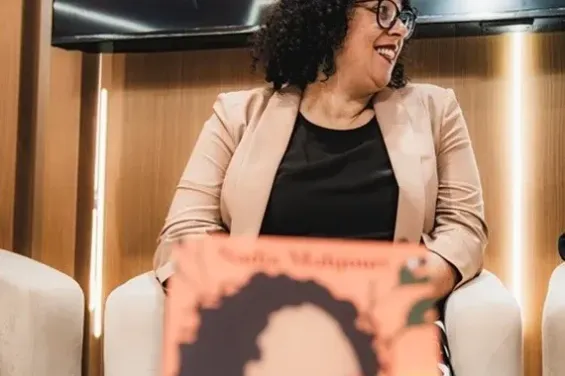
Growing up far from her Moroccan paternal roots, Nadia Mahjouri, whose mother is Australian, long held onto her parents’ wedding photo as a symbol of her dual heritage. The birth of her first child, carrying that same blend of identities, pushed her to reconnect more deeply with her Moroccan roots. Wanting to offer her child a fuller understanding of their heritage, Mahjouri embarked on a journey from Australia to Morocco to uncover untold parts of her family history.
That deeply personal, identity-driven journey sparked a broader reflection on what it means to belong to different worlds at once. It eventually led to her autobiographical novel Half Truth (Penguin), which Mahjouri presented during the 31st International Book and Publishing Fair (SIEL 2026) in Rabat. Invited as part of a program organized by the Council of the Moroccan Community Abroad (CCME), in partnership with the Australian Embassy in Morocco, the author discussed themes of belonging, identity, and interculturality through her debut work.
During a literary panel titled «A Moroccan Anglophone Literature?», alongside authors Saeida Rouass and Mhani Alaoui, the novel was described as «a contemporary narrative centered on a character navigating between family heritage and personal growth across Morocco and Australia». The book explores memory and the complexities of living between multiple cultures.

Writing as a Bridge Across Continents
Through her writing, Mahjouri explores the experience of «belonging to multiple cultures simultaneously» and how those identities shape personal development. Her participation, marking Australia’s first presence at SIEL Morocco, also reflects the growing diversity of Moroccan voices abroad, where multilingualism and cultural hybridity increasingly shape literary expression.
«When I first approached publishers in Australia with my manuscript in 2021, the feedback was that it had potential, but that I might need a smaller publisher willing to take on a story largely set in Morocco. Two years later, I found a major publisher who supported me, and I wasn’t alone: several Arab writers gained recognition and success in Australia during that same period», Mahjouri explained.
She described this as a «clear evolution» within Australia’s literary landscape, despite the relatively small Moroccan community in Sydney compared to larger Arab diasporas from Palestine, Lebanon, or Syria. However, she warned that «the rapid positive progress could reverse just as quickly as it appeared», stressing the importance of protecting diverse literary voices.
 Ph. CCME
«There is often an expectation that you will open up and share your traumas. My editor, on the other hand, was genuinely interested in discovering a new culture and learning more about Morocco. It was a story she didn’t know, a world she had never encountered before. So it became an exciting literary journey for her too, and I felt greatly supported throughout the project».
While acknowledging that being an author of Arab origin can come with certain expectations and even forms of censorship toward some voices, Mahjouri says she has not personally experienced this in Australia. She does, however, point to «forms of sexist and racial discrimination within the publishing industry» in other countries, particularly the United Kingdom.
Narrating Interculturality Beyond Labels
According to Mahjouri, writers from minority backgrounds are often expected to write about identity in ways that white authors are not. She believes the publishing industry underwent a shift after the murder of George Floyd, prompting many publishers across the Anglo-Saxon world to reconsider how they create space for more diverse voices.
 Ph. CCME
Yet she feels that momentum has weakened in recent years, creating «a reality that must be confronted and resisted rather than accepted». In that context, she argues that audiences often seek narratives centered on female suffering or the hardships of being mixed-race or Black, while emphasizing the importance for writers to remain true to themselves rather than writing solely for recognition or commercial success.
Reflecting on the reception of her work in Morocco, Mahjouri admitted she never expected to present her novel in the country. «It’s a huge surprise for me, and I’m deeply touched. I never imagined my book would find readers in Morocco, or even in Australia. Now, there is no greater dream for me than to see it translated into Arabic», she said.
The author added that an Arabic translation would allow her Moroccan family to read the book. While Half Truth is autobiographical and deeply personal, she revealed that her next novel will be historical fiction set in Morocco. «I want to dedicate myself to researching my country of origin even more», she said, describing her writing journey as part of a gradual rediscovery of her own culture.