


 chargement...


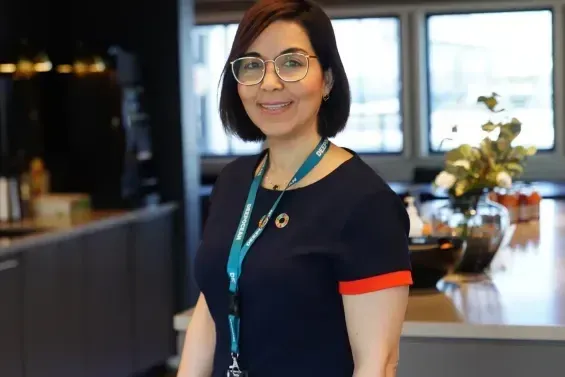
The remarkable journey of Moroccan–Norwegian expert Nadia Aarab began on the golden beaches of Agadir, where her father, a military officer, would often take the family to enjoy the beauty of the sea. It was there, in the city with some of Morocco’s most beautiful beaches, that her first awareness of the sea, nature, and environmental challenges took root.
“I come from a family where education is fundamental,” Nadia told Yabiladi. “My father was a military officer, and my mother closely followed the studies of my brother, my three sisters, and me,” she continued. That strong family environment became a key building block in shaping both her scientific and human outlook.
An outstanding academic path between Morocco and Europe
Nadia pursued her university studies at Ibn Zohr University’s Faculty of Sciences in Agadir, where she earned a degree in oceanography. But her scientific ambition soon led her further afield. In 2000, she moved to Marseille to prepare a postgraduate diploma at Luminy University and the Endoume Marine Station.
A turning point in her career came with her European doctorate, completed as part of a major research project bringing together 32 laboratories across Europe. The experience not only gave her high-level scientific training but also opened the door to travel and learning from different scientific cultures around the world.

After her doctorate, she went to Canada in 2004 for a one-year postdoctoral research position. But fate had another turn in store: a permanent job offer in Norway, a country she describes as “somewhat unusual,” with a different culture and climate, and where there was virtually no Arab community. “A new adventure,” as she puts it, but it was also the true beginning of an exceptional career.
Even before that, international recognition of Nadia Aarab’s talent was not long in coming. In 2003, she received the “Young Researcher” award in La Rochelle, France, followed by honors in Florida. Those promising beginnings were only a sign of what was to come.
In 2005, she joined the international research institute IRIS in Stavanger, southern Norway, as a research scientist. There, she refined her expertise in several fields: marine environmental sustainability, ocean governance, deep-sea mineral resources, and environmental monitoring of offshore activities.
“My experience in Norway was a real turning point. It enabled me to acquire advanced expertise, define my position as a scientist, and present my work at major conferences at both the European and global levels.”
But scientific theory alone was not enough to deepen her passion. The field had its own lessons to offer: underwater diving and scientific expeditions lasting weeks at sea.
“My passion was consolidated in the field, through underwater diving and oceanographic research campaigns that lasted several weeks at sea. These maritime missions taught me a great deal, both scientifically and professionally,” she said.
According to her, that step “represented a huge personal challenge: being on board a ship as the only woman there. Thank God, everything went wonderfully, and that unique experience only strengthened my passion.”
A historic achievement in the depths of the oceans
The year 2023 marked a milestone in her career. Nadia took part in an exploratory mission aboard a vessel dedicated to the search for marine minerals. “Today, I am honored and proud to leave my mark on Norwegian scientific history. In 2023, I participated in an expedition aboard an exploration vessel designed to search for minerals on the seabed at depths ranging from 2,000 to 4,000 meters. That mission led to a major discovery: within the research project I am part of, we proved the feasibility of extracting copper at such depths.”
“It is a great source of pride for me personally, but also a major collective success for DeepOcean, where I currently work, positioning the company at the forefront of the future of underwater exploration.”
Her research has not stopped there. It has also taken her to the other side of the world, where she conducted mineral research in the Cook Islands in the South Pacific.
Today, Nadia Aarab serves as Corporate Sustainability Director at DeepOcean, an international company specializing in subsea operations and marine services. In this role, she works on developing sustainability strategies, environmental policies, emissions reduction plans, and the energy transition.
She also oversees the integration of environmental and social governance standards into the company’s activities, which span several sectors: renewable energy, oil and gas, marine minerals, and marine services.
At the same time, she leads research on seabed minerals, allowing her to connect three worlds through concrete projects: “science, industry, and sustainability.”
A human being above all
Beyond titles and positions, Nadia Aarab is a mother of three who carries a deep love for Morocco and her Moroccan roots. Despite an accomplished international career, she maintains a close bond with her homeland.

She expresses that connection through her academic engagements with Moroccan universities, having recently visited the University of Agadir, as well as through humanitarian projects via the RAHMA cooperative.
She is also the founder of the international NGO Clean Shores, dedicated to raising awareness and combating ocean pollution. This year, she hopes to establish a branch in Morocco to expand awareness and protection efforts for beaches and oceans.
For her, the main environmental emergencies facing the oceans are clear: “climate change, pollution — plastic and industrial — and the loss of biodiversity. Rising water temperatures and ocean acidification are weakening marine ecosystems, while human activities, particularly industrial and maritime activities, are increasing pressure on the marine environment.”