


 chargement...


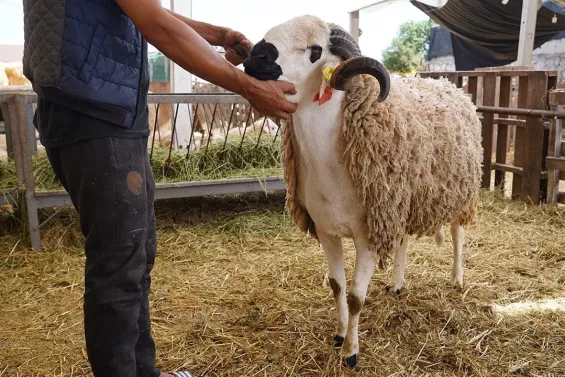
Eid al-Adha is around the corner, and Moroccans are already heading to livestock markets to purchase their sacrificial sheep for the season. From the mountains of the Middle Atlas to the plains of Chaouia and the southeastern plateaus, Morocco is home to several well-known local breeds that dominate Eid markets every year. Let’s take a closer look at some of them.
D’Man
The D’Man sheep breed is mainly found in the oasis regions of southeastern Morocco, particularly in the valleys of the Draa, Ziz, and Dades, as well as in the provinces of Errachidia, Zagora, Tata, Ouarzazate, Tinghir, and Midelt.
Unlike many Moroccan breeds raised on open pastures, D’Man sheep are traditionally kept in small numbers and raised in enclosed farms near oasis communities. They are generally fed alfalfa, hay, dates, and agricultural by-products from the oasis environment.
The breed is small to medium in size, with a fine, narrow head and long drooping ears. D’Man sheep can be black, brown, white, or multicolored. Both males and females are naturally hornless, while males are sometimes recognizable by small manes around the neck. Their wool is relatively light compared to other Moroccan breeds.

Timahdite
The Timahdite is one of Morocco’s best-known sheep breeds and is traditionally associated with the Middle Atlas and neighboring plateau regions. A hardy mountain breed, it is well adapted to cold climates and known for its ability to graze on mountain and forest pastures thanks to its strong build and thick wool.
Timahdite sheep, also known as Bergui, are medium-sized and recognizable by their brown or tawny-colored heads, while their wool and legs are generally white. Their long fleece helps protect them against rain, snow, and cold temperatures in mountainous regions.
.jpg)
Sardi
The Sardi is one of Morocco’s most famous and prized sheep breeds, particularly during Eid al-Adha, when it is often seen as the «prestige» sheep in many households.
The breed is mainly raised in the central plains of Morocco, particularly in regions such as Chaouia, Rahamna, Abda, Kelaa des Sraghna, Fquih Ben Saleh, and surrounding areas. Traditionally, Sardi sheep are raised in agropastoral systems.
The Sardi includes two main types: the Tadla type, historically found around Kasba Tadla and Oued Zem, and the Beni Meskine type.
Physically, the Sardi is easy to recognize by its white body and distinctive black markings around the eyes, muzzle, ears, and legs. Males are known for their large spiral-shaped horns.

Beni Guil
The Beni Guil is the emblematic sheep breed of eastern Morocco, raised mainly on the high plateaus stretching across provinces such as Oujda-Angad, Berkane, Figuig, Taourirt, Guercif, Jerada, Boulemane, and Taza. The breed takes its name from the Beni Guil tribe located between Figuig and Ain Beni Mathar, and is also locally known as «Daghma» or «Hamra».
Known for its endurance and ability to travel long distances, the Beni Guil is particularly well adapted to transhumance and harsh climatic conditions. The breed relies largely on natural pastures and is highly appreciated in Morocco for the quality and flavor of its meat.
The Beni Guil is a medium-sized sheep with a white fleece and a brown or chestnut-colored head, belly, and legs. Males usually have large spiral-shaped horns.
Several local varieties exist within the breed, including Harcha, considered the traditional and largest type, Tounsint, and Zoulay, which is smaller and found around regions such as Outat El Haj, Guercif, and Midelt.
.jpg)
Boujaad
The Boujaad is considered one of Morocco’s large sheep breeds and is sometimes referred to as the «yellow breed» because of its distinctive pale yellow or saffron-colored head. Formerly known as the Tadla breed, it was officially recognized by Moroccan authorities in 1994.
The breed is mainly raised in the regions of Khouribga and Beni Mellal, particularly across the phosphate plateaus around Oued Zem and the town of Boujaad, from which it takes its name.
Boujaad sheep are appreciated for their high meat yield and meat quality. They are also known for their dense white wool, considered high quality because it is generally free of impurities and colored fibers.
Physically, the breed ranges from medium to large in size. It has a white body with a pale-yellow head. Males usually have medium-sized spiral-shaped horns.

Saghro
The Saghro is a hardy mountain sheep breed native to the Saghro massif and neighboring areas of the High Atlas in southeastern Morocco. Raised mainly on open rangelands, the breed is known for its ability to adapt to arid climates, rugged terrain, and long seasonal movements in search of pasture.
The Saghro is particularly valued for its resistance to cold, rain, heat, and major temperature changes thanks to its thick fleece.
The breed is medium-sized with a relatively slender frame. Females are generally smaller, while males are larger and more robust. Saghro sheep are recognizable by their mostly white bodies and their brown-colored heads and ears. Males usually carry large spiral-shaped horns.

Siroua
The Siroua, also known as the Black Siroua, is a mountain sheep breed native to the Siroua massif, located between the Toubkal range and the desert in Morocco’s Anti-Atlas region. The breed is mainly found in the mountainous areas of Ouarzazate, Taroudant, and neighboring regions.
The breed is especially renowned for the exceptional quality of its wool, which is widely used in traditional Moroccan craftsmanship, notably in the famous Tazenakht and Aït Ouaouzguit carpets. Its wool is considered among the finest produced by Moroccan sheep breeds.
The Siroua is also appreciated for the flavor of its meat, attributed to the aromatic mountain pastures where it grazes, including thyme and artemisia.
Physically, the breed is small and hardy, with a slender frame and a uniformly black fleece made up of long and dense wool that protects it from harsh mountain conditions. Males are generally larger and carry spiral-shaped horns.

Tamlalet
The Blanche de Montagne, locally known as «Tamlalet», meaning «the white one» in Amazigh, is a mountain sheep breed from the High Atlas known for the quality of its wool. It is considered one of Morocco’s main wool-producing breeds and plays an important role in the livelihoods of families living in remote mountainous areas.
The breed is mainly found in the mountains of Ouarzazate, Taroudant, and neighboring regions, where it shares the same cradle as the Black Siroua breed. Well adapted to harsh mountain environments, the Blanche de Montagne is known for its endurance, its ability to travel long distances during transhumance, and its adaptation to arid and rugged terrain.
Physically, it is a relatively small breed with a uniformly white fleece made of long and dense wool that protects it against cold and difficult weather conditions in the High Atlas. Males generally carry spiral-shaped horns.