


 chargement...


How did the idea of organizing a Drone Soccer tournament in Morocco come about?
The idea grew out of our desire to build a bridge between technological innovation, education, and international cultural cooperation. Drone Soccer, which originated in South Korea, embodies a modern vision of science, technology, engineering, arts, and mathematics, offering an experience that combines creativity, cutting-edge technology, and teamwork while giving young people the opportunity to develop practical skills in an enjoyable and innovative way.
At the French International Lycée Louis Massignon «LFILM Casa-Anfa», we wanted to place this initiative within a broader effort to strengthen dialogue between Morocco and the Republic of Korea, particularly in the fields of education, innovation, and youth. The support of the Korea International Cooperation Agency (KOICA), along with the cultural representation of the Embassy of the Republic of Korea in Morocco gave this first edition a unique human and diplomatic dimension.
.jpg)
Together with my colleague and project partner, Mr. Robertson, we wanted to create an event that combined cultural openness with a sporting and technological dimension, making Morocco the first African country to host a student tournament dedicated to Drone Soccer. This ambition was supported by Abdessalam Mekouar, president of the Royal Moroccan Federation of Drone Soccer, as well as by the school’s administration. From the outset, we were keen to open the initiative to a wide range of Moroccan schools, from Tangier to Laayoune and Dakhla, within a framework that promotes friendship, innovation, and cultural exchange.
The event is the first of its kind in Morocco and Africa in a student setting. How did the preparations begin, and how long did they take?
Preparations for the tournament took several months, especially since it was the first event of its kind to be organized in Morocco and indeed in Africa within a student framework. Work had to be carried out almost from scratch, including coordination between schools, technical preparations, team training, logistics, safety procedures, communication, and cultural partnerships. We were also determined to give the event a strong identity that highlighted both educational innovation and the ties between Morocco and the Republic of Korea.
What was the atmosphere like during the first edition of the tournament, and how did students and participating schools respond?
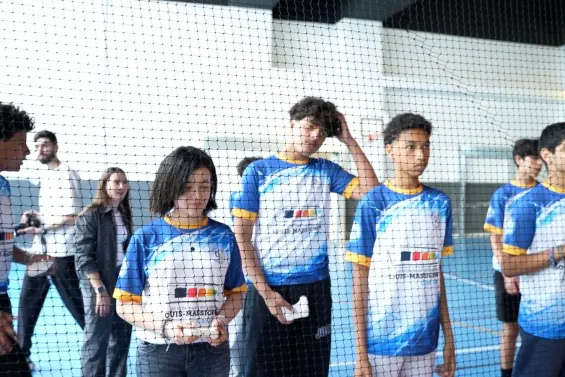
On May 15, 2026, at the French International Lycée Louis Massignon in Casa-Anfa, we welcomed nine teams representing different schools from Morocco’s education system and the French education network, all practicing this emerging sport. They included Yacoub El Kindi School in Tangier, as well as institutions from the OSUI Maroc network, such as Malraux in Rabat and Massignon in Bouskoura.
.jpg)
The matches ran from 10:30 a.m. to 4 p.m. in an atmosphere where competitive spirit blended with innovation and teamwork. We felt great enthusiasm among both participants and attendees for this first edition, especially since the sport is still relatively new in Morocco. The encounter between Moroccan and Korean cultures also gave the event a special resonance, reflecting the historical ties and many points of convergence between the two countries.
The students quickly realized they were taking part in something that went beyond a simple sporting competition. It became an opportunity to celebrate technology, international cooperation, and openness to the world. Throughout the day, during the matches, cultural workshops, and informal exchanges, the atmosphere was filled with energy and excitement.
What were the main challenges and difficulties you faced in organizing this event, given that it was the first of its kind?
The biggest challenge was introducing a sport that is still largely unfamiliar in Morocco. We had to explain the concept of Drone Soccer, train the students, and establish a professional framework for a new technology-based e-sport that many participants had never encountered before.
But the challenge was not only sporting and technical. It was also about turning the event into a genuine space for cultural exchange and international cooperation, rather than simply a sports tournament. This required convincing key institutional partners, such as the cultural representation of the Embassy of the Republic of Korea in Morocco and KOICA, to support an educational project without precedent in the Kingdom. This human, diplomatic, and cultural dimension demanded a great deal of coordination, precision, and commitment, and I am very pleased with what we achieved.
.jpg)
In your view, do Morocco and Africa have the conditions and potential needed to develop Drone Soccer in the coming years?
Absolutely. Morocco has dynamic young talent that is highly open to modern technology, and Drone Soccer can become an important educational and technological tool because it combines innovation, teamwork, and scientific culture in a format that is engaging and motivating for young people. I also believe that this type of project can strengthen international cooperation, especially between Morocco and countries that place strong emphasis on innovation and technological education. Africa as a whole has enormous potential in this field.
.jpg)
After the success of this first edition, what projects or next steps are you working on to develop Drone Soccer in Morocco?
Our goal now is to build on this momentum over the long term by developing initiatives linked to Drone Soccer, introducing more young people to careers in aviation and technology, and expanding the experience to include a greater number of schools across Morocco. We also aim to continue building bridges between technology, culture, and international cooperation, particularly with the Korean partners who played a key role in the success of this first edition. This experience has shown that a technological project can also become a genuine platform for dialogue between cultures and young people around the world.