

 chargement...


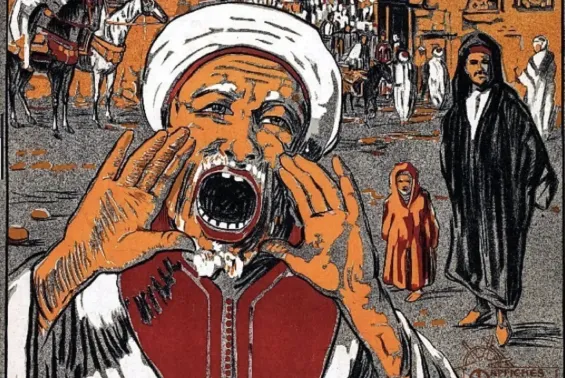
«Visit the Mysterious Fez», «Rabat All Year Long» or «Enjoy the Fruits and Early Harvests of Morocco». These slogans appeared on beautifully illustrated posters that today might simply be described as vintage advertisements. Produced for shipping companies, railway operators and tourism offices, they encouraged European travelers to discover Morocco's cities, landscapes and traditions. Far more than simple advertisements, they were works created by renowned artists such as Jacques Majorelle, Joseph de La Nézière and Maurice Romberg.
Between 1906 and 1956, hundreds of such posters were produced. Nearly three-quarters were linked to tourism and trade fairs. Yet behind their artistic beauty lay something more powerful: a carefully constructed image of Morocco that would shape foreign perceptions of the country for decades.
.jpg)
According to historian Pascal Blanchard, author of Morocco in French Poster Art (1906-1956): Between a Medieval World and an Ideal Colony, these posters were not merely tourism advertisements. They were designed to make Europeans dream about Morocco while presenting the country as a destination of mystery, discovery and escape.
«The primary mission of the poster on Morocco was to make people forget that the country was a colony», Blanchard writes.
Unlike Algeria, where colonial achievements and French power were often openly celebrated, Morocco was portrayed as a land seemingly untouched by politics. The conquest, colonial administration and nationalist movements were largely absent from the imagery, replaced by scenes intended to attract travelers, he argued.

Le Maroc typique
Yet the Morocco presented in these posters was far from spontaneous. Behind the imagery lay a broader colonial project aimed at defining what visitors should see as the country's authentic identity.
Historian Aomar Boum argues that the posters formed part of a wider tourism strategy that sought to define and market an «authentic Morocco» to European visitors. Through guidebooks, transport companies and tourism offices, French authorities promoted a particular image of Morocco built around kasbahs, medinas, Atlas landscapes and traditional crafts.
«The idea was to redefine 'traditional Morocco' (le Maroc typique) for tourism, conserve it, and promote it for French and foreign tourists», Boum explains.
One early poster produced for the Compagnie de Transport au Maroc (CTM) illustrates this approach. It placed Amazigh kasbahs at the center of the composition, framed by the Atlas Mountains, while camels were used to reinforce the destination's exotic appeal.

The result was a Morocco that appeared frozen in time. Minarets, palace walls, medinas and desert landscapes dominate the posters, presenting the kingdom as a place suspended between history and legend rather than a rapidly changing society, Blanchard notes.
«It is a place of relaxation, discovery, pleasure and travel, a world where politics has no place», he writes.
Morocco's forms and colors
Few artists did more to shape that image than Jacques Majorelle. Although he created only around ten tourism posters, Blanchard considers him the most influential figure in the visual construction of colonial Morocco.
«More than any other artist, he fixed the forms and colors associated with Morocco», the historian argues.

Majorelle's depictions of Marrakech, the Atlas Mountains, kasbahs and traditional markets helped establish many of the visual codes that would later be repeated across tourism advertising and continue to influence representations of Morocco today.
Yet while architecture occupied center stage, Moroccans themselves often remained in the background. Men appeared as horsemen, market vendors or anonymous crowds, while women were frequently portrayed through exoticized imagery.
«The other does not exist in the poster as an actor of his own destiny», Blanchard writes.

In many cases, Moroccans served primarily to reinforce the atmosphere of exoticism sought by tourism promoters. The country was presented as a spectacle to be observed rather than a society with its own political and social realities.
Decades after the end of the Protectorate, many of the same visual codes remain familiar. Medinas, kasbahs, colorful souks and desert landscapes continue to dominate tourism campaigns. The posters may belong to another era, but the Morocco they helped imagine and market to foreign audiences remains remarkably recognizable today.