


 chargement...


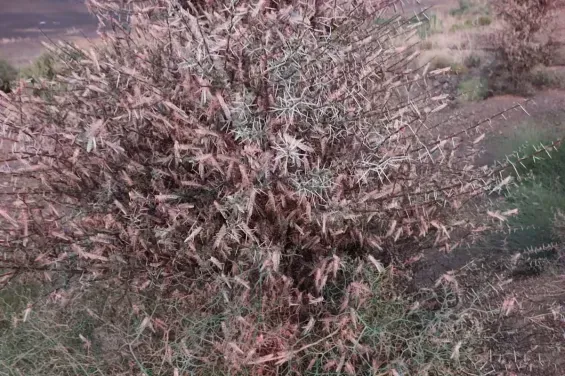
Several areas of the Melaab commune in Errachidia province are facing growing concern over the spread of desert locusts, which have begun attacking oases and farms at a critical stage of the agricultural season. The infestation has raised fears of significant losses that could affect the date harvest and the livelihoods of hundreds of families across the region.
The outbreak comes at a particularly difficult time for southeastern Morocco, where communities have spent years grappling with drought, water scarcity and rising production costs. Agriculture remains the main source of income for a large share of the population.
Against this backdrop, Khalid Baghad, a municipal councilor and civil society activist in Melaab, said several areas across southeastern Morocco, particularly in the provinces of Errachidia, Zagora and Tinghir, are currently experiencing invasions of desert locust swarms affecting oases and farmland. He noted that the insects have especially targeted palm groves, including the highly valued Medjool variety.
Fears for the date harvest
Speaking to Yabiladi, Baghad said the localities of Akhit, Ait El Hou, Akrouz and Bouydoud, all within the Melaab commune in the Tinejdad district, are among the areas affected. Some of these localities rank among the region’s leading date-producing zones.

He stressed that the threat posed by desert locusts extends far beyond the destruction of seasonal crops. According to him, the infestation represents a direct risk to the local economy and to the social and environmental stability of oasis communities, given the insects’ ability to devastate vast areas of farmland and fruit trees in a matter of days.
«If the locusts continue to spread, this could lead to a decline in agricultural production, lower farmers’ incomes and higher costs for rehabilitating damaged farms, in addition to threatening the palm groves that form the backbone of the oasis economy».
Baghad also warned of potential social consequences, noting that the destruction of crops and loss of income could force some families to leave in search of alternative livelihoods, further accelerating migration toward cities or abroad at a time when the region is already facing severe climate pressures.
«Any delay in intervention could worsen the losses»
On the environmental front, he said the locusts threaten the fragile balance of oasis ecosystems by destroying vegetation cover that helps stabilize soil and slow the advance of sand. This, he warned, could intensify desertification and negatively affect local biodiversity.
He added that local stakeholders have contacted several institutions, including the Regional Office for Agricultural Development in Draa-Tafilalet, the National Food Safety Office (ONSSA) and local authorities, in an effort to secure a rapid response.
For his part, Yahya Boulmane, president of the Merroutcha Bio cooperative in the Melaab commune, sounded the alarm over the situation and called on all relevant authorities, particularly the Ministry of Agriculture, to intervene urgently to halt the spread of the infestation threatening several villages in Errachidia province.
.jpg)
Speaking to Yabiladi, Boulmane said the locusts are already causing significant damage to crops. He noted that farmers, after years of drought, had been hoping for a stronger season following the recent improvement in agricultural production.
«But the continued spread of locusts could turn this promising season into a real crisis threatening the stability of local communities. There is an urgent need to act quickly to save what can still be saved and protect farmers’ crops, which are their main source of livelihood».
Local stakeholders say the situation requires urgent mobilization from all concerned parties, including intensified monitoring and field-control operations, the deployment of technical teams to assess the damage, and the consideration of support and compensation mechanisms for affected farmers. Such measures, they argue, are essential to preserving the oases and safeguarding the region’s economic and social stability. As they warn, «any delay in intervention could lead to even greater losses».