


 chargement...


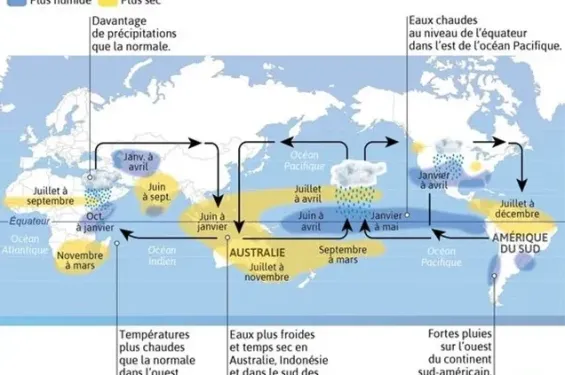
After months of abundant rainfall that helped erase the effects of seven years of drought, Morocco could be heading into a new period of water stress driven by the return of El Niño. On Tuesday, the World Meteorological Organization (WMO) warned that «conditions characteristic of an El Niño episode are emerging» worldwide as a result of unusually high temperatures in the tropical Pacific. According to the agency, the phenomenon is expected to «influence temperature and rainfall patterns» globally, increasing the risk of extreme weather events in the coming months.
In its latest briefing, the WMO explains that El Niño, through the warming of ocean waters, «leads to an increase in global temperatures and promotes more extreme weather patterns and rainfall regimes», with above-average temperatures forecast across most regions from June to August. In Morocco, unusually high temperatures have already been felt since spring, raising questions about how strongly the kingdom could be affected.
Contacted by Yabiladi, climatologist and Hassan II University professor Mohamed Said Karrouk said the phenomenon is no longer unfamiliar to Morocco. «The weather conditions we have been experiencing recently are often described as extreme. In reality, they are neither extreme nor exceptional. They are the characteristics of a new, warmer climate that has been in place since at least 2010», he said.
A changing climate since the late 1980s
Speaking to our newsroom, Prof. Karrouk noted that «we are living in a climate very different from the one we knew before, particularly since the late 1980s». According to him, this new climate is characterized by a much larger planetary energy surplus than in previous decades.
«As a result, temperatures rise directly in response to this growing energy imbalance», he explained.
«We speak of rising temperatures because they are directly linked to anthropogenic greenhouse gas emissions. But it is important to understand that this is not the only factor involved».
 Source: WMO
«Other processes are also at work, particularly changes affecting continental and oceanic surfaces. Because of rising temperatures, these surfaces have absorbed enormous amounts of energy and now act as much larger reservoirs than before, placing us under entirely different climatic conditions».
The researcher argues that, on a warmer planet fueled by a climate system carrying far more energy than before, everything changes: temperatures, the water cycle and rainfall patterns. «As temperatures rise and the land absorbs more energy, the atmosphere also receives huge quantities of water vapor through evaporation, becoming another thermal reservoir within the climate system», he explained.
Against this backdrop, major climate drivers such as El Niño evolve as part of the system’s natural functioning. «This oceanic weather phenomenon occurs in the Pacific Ocean, when warm surface waters accumulated in the western Pacific around the Indonesian archipelago shift eastward along the equator toward the American continent», Karrouk said.
«This warm water, previously concentrated around Indonesia and responsible for rainfall there, spreads across a much wider area of the equatorial Pacific. The contact zone between the atmosphere and the ocean expands, allowing this surface energy to be released over a far larger geographical area».
According to him, this process injects additional energy into the atmosphere. «These conditions add extra energy to the climate system, generating global impacts, including excessive temperatures, particularly across the Northern Hemisphere», he said.
Karrouk also pointed to a recent and significant development: ocean waters have warmed to depths of around 100 meters, further amplifying El Niño episodes.
 Source : Mohamed Said KarroukSource: Mohamed Said Karrouk
«The fact that this energy is being added to existing energy reserves is why the phenomenon is often described as a ‘Super El Niño’. The term is not scientific, but it illustrates the scale of the event compared with its usual intensity. These conditions impose higher temperatures across the entire climate system, including in Morocco».
A high risk of drought returning
According to the researcher, the rise in atmospheric temperatures linked to El Niño is largely oceanic in origin. «But another key element must be taken into account: the water cycle and rainfall conditions», he said.
Drawing on research he conducted in the 1990s, Karrouk argues that Morocco is affected by El Niño through its influence on the Azores High. «The Azores anticyclone is fed at higher altitudes by energy originating from the equatorial zone, and it has become stronger than before», he explained.
«A stronger anticyclone creates persistent stable conditions, preventing rainfall systems from developing. Based on the historical data series I analyzed, most El Niño episodes affecting Morocco have been accompanied by drought».
According to Karrouk, the episode highlighted by the WMO is therefore likely to increase the risk of drought returning to the kingdom.
«Today, if we are certain that El Niño is developing, the WMO's role is to monitor it and explain how it is evolving. In Morocco, its effects are likely to be reflected not only in higher temperatures, as elsewhere around the globe, but also in a return of drought due to the strengthening of the Azores High».
.jpg)
The climatologist describes the relationship between El Niño-Southern Oscillation (ENSO) events and drought in Morocco as a cause-and-effect mechanism. The additional energy transferred toward subtropical latitudes, including North Africa, reinforces the Azores High and alters atmospheric circulation patterns.
Having first presented this theory at the International Geographical Congress in the early 2000s, Karrouk refers to it as an «energy-based approach».
According to him, these conditions also favor the establishment of a positive phase of the North Atlantic Oscillation (NAO), characterized by a stronger-than-normal Azores anticyclone.
«This prevents cold air masses from reaching our region. Without those colder air masses, atmospheric water vapor cannot condense, and the conditions required for rainfall simply do not materialize», he concluded.