


 chargement...


How can so many missteps be explained before the 2026 World Cup has even begun?
My first answer would be that the United States is not a football country. Have we ever seen anything like what is happening now at a World Cup? No. There were problems in Brazil in 2014, but those were linked to domestic protests. There were controversies in Argentina in 1978 under the military dictatorship. Here, however, we are dealing with something entirely different.
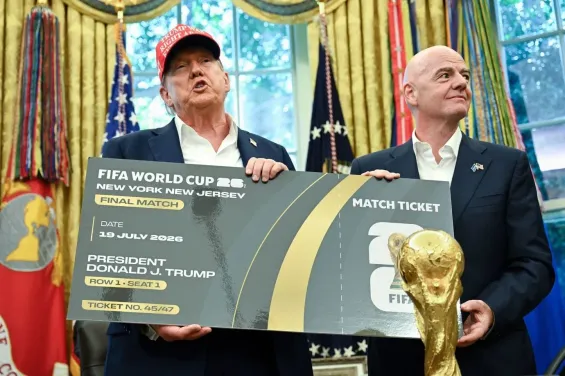
Visa bottlenecks, the introduction of visa bonds for nationals of certain countries, increasingly restrictive security policies, ICE operations, Congolese supporters reportedly blocked because of Ebola concerns, and the broader climate shaped by tensions with Iran, all of this reflects a reality in which FIFA and its president, Gianni Infantino, have effectively allowed Donald Trump’s policies to take precedence, largely for economic reasons.
The governing body knows it stands to make enormous profits from this edition of the World Cup, but it has shown little willingness to defend the interests of football, its nations, players and supporters. It quickly became clear that the bottom line mattered more than anything else. One only has to recall the World Cup draw last December, when Gianni Infantino presented Donald Trump with a so-called peace prize, an award that did not exist before and will probably never exist again.
Visa-related issues have affected players, team officials and even a Somali referee, all because of decisions taken in Washington. That is deeply troubling.
We are witnessing something unprecedented in World Cup history. Previous tournaments have seen diplomatic tensions, political criticism and occasional visa difficulties for supporters or journalists. But seeing players, and, above all, a referee officially appointed by FIFA, prevented from participating because of a sovereign decision by the host country is extraordinary.
What makes it even more striking is that this is happening in the United States, a country long considered capable of welcoming delegations from all over the world without difficulty. Yet, as recent years have shown, the «American dream» of the 1980s and 1990s is well and truly over.
 Saïd El Abadi / DR
Neither FIFA nor CAF offered meaningful support to the Somali referee. This is particularly ironic given that Infantino himself warned in 2017 that facilitating visas was a prerequisite for hosting a World Cup.
This situation amounts to nothing less than a disgrace. When FIFA awards hosting rights, it typically requires government guarantees ensuring access to the country for teams, officials, referees, partners, media representatives and supporters. The principle is not that everyone automatically receives a visa, but that accredited participants are granted reasonable access. Historically, such guarantees have been a key part of any World Cup bid.
What makes the case of Somali referee Omar Abdulkadir Artan especially troubling is that he had been officially selected by FIFA and reportedly already held a valid visa, yet was ultimately deemed inadmissible. This raises serious questions and appears, at the very least, to reflect discrimination against a country that the U.S. president had previously described in derogatory terms as «backward».
For months, Gianni Infantino repeatedly reassured the football world, insisting that qualified teams and their supporters would be able to travel and that immigration procedures would run smoothly.
As for CAF, its silence once again highlights its inability to assert itself on the international stage. We have already seen this weakness when the Africa Cup of Nations is pushed into the background by the Club World Cup, or when European clubs dictate the terms under which African players can join their national teams before AFCON tournaments.
The reaction from the media, international delegations and Western governments has also been markedly different from what we witnessed in the cases of Russia and Qatar.
Both countries faced boycott campaigns, intense media scrutiny and symbolic protests. No comparable pressure has emerged against the United States.
This is as much a geopolitical issue as it is a sporting one. The United States occupies a unique place in the Western-led international order. It is a close ally of most European countries, a member of NATO, a major economic partner and a central actor in the global media landscape. As a result, Western governments are generally far more reluctant to contemplate boycotts or diplomatic confrontations with Washington than they would with other host nations. Criticism of the United States is certainly possible, but the political cost of launching a boycott campaign would be far greater and the consequences potentially severe.
At the same time, the situation reflects broader dynamics within our societies. From a media perspective, there is clearly a double standard at play. Certain issues generate far greater outrage when they occur in countries perceived as lying outside the Western sphere than when they occur within it. It is difficult to ignore the contrast between the calls for boycotts and highly visible symbolic gestures that accompanied the World Cups in Russia and Qatar, and the relative absence of comparable movements regarding the United States despite the controversies surrounding visas and access to the country.
How one interprets that contrast ultimately depends on one's perspective. Some see it as the inevitable consequence of American geopolitical influence; others view it as a form of discrimination.