


 chargement...


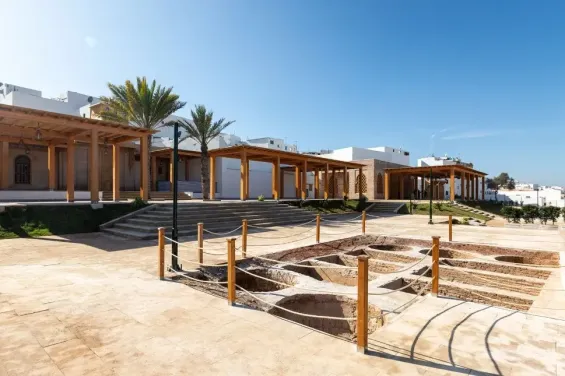
Now completed, the redevelopment of Rabat’s tanneries has finally given the site a setting worthy of the history it tells. It brings to an end nearly a century of neglect, during which the area was successively transformed into makeshift housing and later a dumping ground. Today, Diour Dbagh has been reborn thanks to years of rehabilitation work and a preliminary archaeological assessment. The site now bears witness to the deep roots of leatherworking in the economic fabric of the former imperial city, which shared this know-how with Fez and Marrakech, whose medinas are home to larger and better-known tanneries.
Spiritual, artisanal, political and intellectual centers, these cities were long among the beating hearts of traditional leather craftsmanship, bringing together every stage of the trade, from tanning hides to the manufacture of babouches, traditional bags, tarbouches, belts and poufs. In Rabat, Diour Dbagh embodies this heritage, whose golden age in present-day Morocco came during the Almohad period (1121–1269). Located in the northeastern part of the medina, the tanneries overlook the mouth of the Bouregreg River.
For generations, master craftsmen relied on traditional methods, lime, pigeon droppings and tannins, to supply the local leather trade. The official platform dedicated to discovering, promoting and transmitting the region’s historic heritage, Rabat Sites, notes that Diour Dbagh «constitute a place of memory that helps keep alive the traditional know-how linked to Morocco’s leather industry».
Indeed, the site «earned an enviable reputation for the quality of its various products, to the point that the term Morocco leather still refers today to the preparation of fine, dyed leather and its use in making various items, such as bookbindings, shoes and harnesses», the same source recalls.

A site steeped in history, yet still poorly documented
Although Diour Dbagh has never been precisely dated, historical accounts agree that it was in use before the 20th century, though later than the tanneries of Fez and Marrakech, which were already active between the 9th and 11th centuries. Published in 2024 in the journal Hespéris Tamuda, the archaeological assessment conducted ahead of the rehabilitation project offers several clues.
Carried out by Ahmed Saleh Ettahiri and Asmae El Kacimi (INSAP, Rabat), along with Hicham Rguig (Cadi Ayyad University, Marrakech), the study concludes that «there is no longer any doubt that the old tanneries of Rabat predate the construction of the river wall and Bāb al-Baḥr, meaning they date from before 1204 AH/1789». However, «the question of their great antiquity must be considered in light of the constraints governing the urbanisation process, as complex and dynamic as that of Ribāṭ al-Fatḥ», the researchers write.
Historian Jean-Louis Miège, who was born in Rabat in 1923, also compiled «unpublished documents on the crafts of Rabat and Salé in the mid-19th century» in a study published in the Bulletin économique et social du Maroc (BESM). His research shows that the tanneries of Rabat and Salé processed cow, goat and sheep hides. At the time, around 150 workshops specialized in babouches, while eight workshops manufactured some 400 saddles annually.
Rabat’s tanneries are also documented during the years following the establishment of the French Protectorate in 1912. As Rabat became the kingdom’s political and administrative capital, replacing Fez, urban expansion was accompanied by sanitation policies aimed at removing polluting activities and foul-smelling industries from the city center. According to the archaeological assessment, Diour Dbagh had already lost more than half of its tanners by the early 20th century. Between 1912 and 1918, their number is believed to have fallen from 500 to 300.

The decline of the tanners is partly explained in historian Abdelaziz El Khamlichi’s book, The City of Rabat in the 19th Century (1818–1912): Aspects of Social and Economic Life, which also examines the city’s urban development. He notes the strong presence of mosques, sanctuaries and zawiyas in a city whose population remained relatively stable throughout the 19th century and did not exceed 25,000 inhabitants.
Until the Protectorate, Rabat was divided into eleven districts, in addition to the Kasbah of the Oudayas. Its industrial production rivaled that of Fez and Marrakech, particularly in textiles and leather. Beyond the tanneries, the area included numerous orchards and agricultural lands belonging to the state, waqf endowments, notables and foreign owners, with Sultan Moulay Abdelaziz possessing some of the finest estates. Yet this wealth was not enough to sustain long-term economic growth.
Recurring droughts deepened the industrial crisis, highlighting the close relationship between manufacturing and agricultural production. Other factors contributing to the decline included foreign monopolies on exports, heavy taxation and compulsory donations imposed on local elites, all of which weakened the artisan class.
A redevelopment that preserves memory
Historical accounts covering a broader period indicate that the tanneries were relocated to what were then the outskirts of the city during the 1930s. The abandoned facilities subsequently became a shantytown, a situation that persisted until evictions began in 2006. Decade after decade, the area continued to deteriorate until rehabilitation efforts finally began in 2022. The project started with a major clean-up and disinfection operation.

The site also attracted scientific interest through the archaeological assessment, which underscored the importance of documenting it in order to «better understand Moroccan tanning workshops, in their material form and internal dynamics», while also improving knowledge of «the contexts of structures with similar functions that may be discovered in the future».
Researchers also examined «the decision taken in the early 1930s to relocate these tanneries after at least two and a half centuries of existence on the urban margins of residential neighbourhoods, yet still within the walls of Rabat’s medina». In their study, they explain how this context gradually gave rise to a shantytown that became «the most marginalised space in the heart of the medina: a poor migrant population, drawn by the advantages of proximity to the city centre and access to low-cost housing; a site excluded from the pedestrian routes of the city’s residents and visitors».
In this sense, the redevelopment project launched in 2022 has put an end «to a situation containing the seeds of conflict between the historic site and its urban environment», while strengthening «its protection against all kinds of potential land speculation in the very heart of the capital».
Today, the former tanneries house exhibition and tourist spaces that preserve and showcase the memory of one of Rabat’s oldest crafts.