


 chargement...


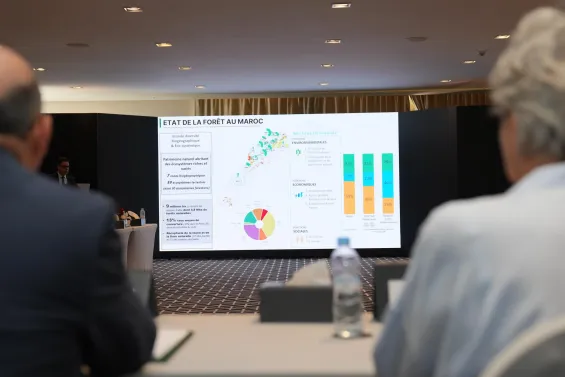
Morocco is losing an estimated 17,000 hectares of forest cover annually, while the economic potential of its productive forests remains largely untapped and several forestry sectors continue to underperform in export markets.
Speaking on Thursday at a workshop on the «Forests of Morocco 2020-2030» strategy, organized by the National Agency for Water and Forests (ANEF), the agency's secretary-general, Issam Ahebri, also pointed to the overuse of firewood and excessive grazing in forest areas as major challenges.
Warning against maintaining the status quo, Ahebri said that by 2050, Morocco could face «an environmental, social and economic disaster», marked by accelerated forest degradation, losses estimated at 5 billion dirhams, rising timber imports and increasing poverty among communities living in forest areas.
Launched in 2020, the Forests of Morocco 2020-2030 strategy seeks to reverse this trend by modernizing the forestry sector, promoting the sustainable management of natural resources, and placing rural communities at the heart of forest governance and development.
According to Ahebri, the new model recognizes local populations as key partners while managing forests according to their different functions, whether productive, conservation-oriented or partnership-based. Having shown promising results during its first five years, the strategy will enter an accelerated implementation phase from 2026, built around four main pillars.
.jpg)
Modernizing forest infrastructure
The first pillar focuses on upgrading infrastructure, developing inland fisheries, establishing regional aquaculture hubs and strengthening resilient aquaculture value chains.
Among the flagship projects is PADIDZOF, financed by the African Development Bank (AfDB) and implemented in five regions: Tangier-Tetouan-Al Hoceima, Rabat-Salé-Kénitra, Fez-Meknes, Marrakech-Safi and Souss-Massa.
A second initiative, Inclusive and Sustainable Forests, supported by the European Investment Bank (EIB), covers Fez-Meknes, Beni Mellal-Khenifra, Drâa-Tafilalet and the Oriental region, while the Food and Agriculture Organization (FAO) is supporting the development of Morocco's inland fisheries and aquaculture strategy for 2023-2030.
The second pillar aims to restore 600,000 hectares of forest ecosystems by 2030, particularly in mountainous regions, through the use of native species better adapted to climate change.
The reforestation program focuses on three priorities: restoring natural forest ecosystems, expanding replanting efforts and strengthening plantations intended for both environmental protection and timber production.
A second component seeks to diversify forest species and increase nursery capacity to improve the quality and availability of seedlings, while a third promotes modern planting techniques through mechanized soil preparation, the Waterboxx irrigation system and drone-based monitoring.
.jpg)
Reforestation gathers pace
According to Ahebri, ANEF launched 810 reforestation projects covering nearly 54,300 hectares across 331 communes during the 2025-2026 campaign. By comparison, annual reforested areas averaged around 31,000 hectares between 2020 and 2023, before rising to 44,000 hectares in 2024-2025.
«We are now entering the acceleration phase», Ahebri said, adding that Morocco aims to reforest 100,000 hectares annually by 2029-2030.
Since the launch of the strategy, ANEF has initiated projects covering around 200,000 hectares, representing 68% of the target set for the 2021-2025 period and around one-third of the overall 2030 objective.
To improve monitoring and project management, the agency introduced a georeferenced digital mapping platform in 2025, allowing reforestation projects to be tracked and updated in real time.

Innovation and seed sovereignty
Ahebri also highlighted several technological advances supporting the strategy. The Waterboxx system, which captures and regulates water to improve seedling survival in arid environments, has already been deployed across 1,850 hectares with a success rate exceeding 90% after successful trials in Souss-Massa. Another 1,600 hectares are scheduled to be added in 2026, bringing the total to nearly 3,500 hectares.
Digital monitoring using drones and LiDAR technology is also improving plantation oversight and quality control.
The strategy also places particular emphasis on Morocco's forest seed sovereignty. To date, 104 seed sites have been identified and secured for six major forest species: Atlas cedar, cork oak, Atlas cypress, thuya, maritime pine and Aleppo pine. The program will continue in 2026 with the gradual inclusion of additional native species.