


 chargement...


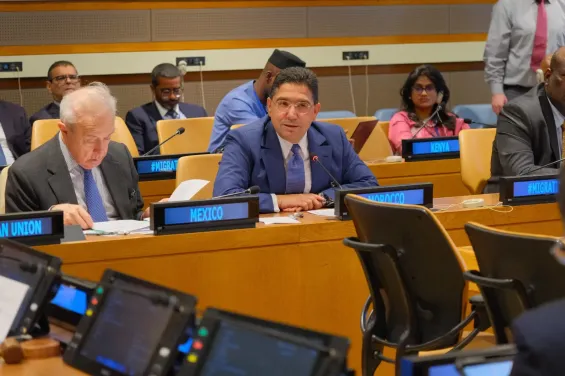
On the sidelines of the 80th session of the United Nations General Assembly in New York, the Moroccan Minister of Foreign Affairs participated in a high-level strategic dialogue on migration, themed: «Migration at a Crossroads: A Strategic Dialogue for a Changing World».
Nasser Bourita seized this global platform to outline the foundational principles of Morocco's migration policy, which has been in effect since September 2013. He emphasized that «the Kingdom's approach is clear and coherent, guided by the High Orientations of His Majesty King Mohammed VI, who is recognized as an African Leader on migration issues».
King Mohammed VI was entrusted by the African Union to articulate the continent's perspective on migration during the AU-EU summit held in November 2017 in Abidjan, where he sought to address and correct prevalent misconceptions about migration in Europe.
Echoing the royal vision, Bourita highlighted that «Morocco, as a country of origin, transit, and destination, champions an approach rooted in solidarity, shared responsibility, and collaborative solutions». He lauded «the Moroccan-Spanish partnership as a testament to a pragmatic and effective strategy».
Morocco's warnings
The minister stressed that the kingdom's migration policy aligns with «the African Agenda on Migration, endorsed by the African Union as a continental reference framework». It also draws on «Morocco's unwavering commitment to implementing the Global Compact for Safe, Orderly and Regular Migration, adopted in Marrakech in December 2018», which was endorsed by the UN General Assembly that same month.
With its leadership role, Morocco hosts the African Migration Observatory's headquarters in Rabat, officially inaugurated on December 18, 2020 on the International Migrants Day.
In his address, the minister warned that migration «is too often politicized and reduced to mere slogans, while migrants are in fact a vital economic and social force». He also pointed out that «the multilateral system, which is supposed to bolster states' efforts, is hampered by a discrepancy between its mandate and the limited resources allocated to it».
He cautioned against «the risk that the upcoming review meeting of the Global Compact for Safe, Orderly and Regular Migration might devolve into just a 'procedural exercise' rather than a genuine opportunity to enhance the concerted governance of migration».
During his speech at the AU-EU summit in November 2017 in Abidjan, King Mohammed VI had already challenged some «unfounded truths» about African migrants, asserting that African migration «is not intercontinental, but primarily intra-African: out of 5 Africans who move, 4 remain in Africa».
He further clarified that «irregular migration is not predominant, constituting only 20% of international migration; migration does not impoverish host countries, as 85% of migrants' earnings remain in those countries. Moreover, the traditional distinctions between countries of emigration, transit, and settlement are increasingly blurred».




 Fil Info