

 chargement...


The 2003 Casablanca terrorist attacks exposed structural weaknesses in Morocco’s religious landscape, according to a recent report by the Strategic Dialogue Institute titled «Religious Diplomacy in Morocco: Soft Power, Sovereignty, and the Politics of Faith». The study examines the role of religious diplomacy in the Kingdom.
The report argues that the attacks prompted Moroccan authorities to launch a far-reaching reform program aimed at centralizing religious authority, expanding the country’s religious influence, and promoting a moderate, centrist discourse.
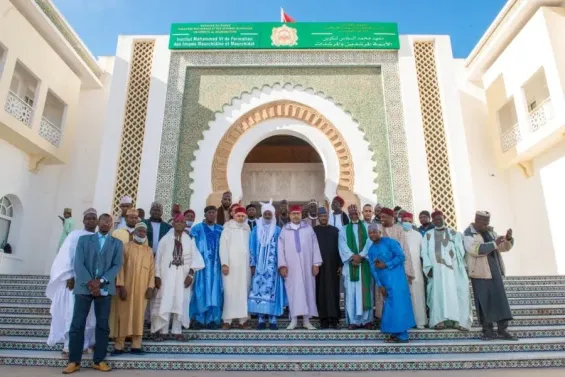
These reforms were not limited to the domestic sphere. They were gradually extended beyond Morocco’s borders, particularly to sub-Saharan Africa and Europe, through institutions such as the Mohammed VI Institute for the Training of Imams, Murshidin and Murshidat and the Mohammedan League of Scholars.
The study outlines the foundations of Morocco’s religious model, which rests on the Maliki school of jurisprudence, the Ash‘ari creed, and a tradition of spiritual Sufism. It notes that this model, emphasizing moderation, tolerance, and spiritual depth, stands in contrast to more rigid or politicized interpretations of Islam, including certain Salafi currents.
The report also highlights the distinctive nature of Moroccan Islam in the close relationship between religion and the state. In Morocco, the king holds the dual role of head of state and «Commander of the Faithful», a configuration that allows religious authority to reinforce political legitimacy and enables the state to project religious influence both domestically and internationally.
External influence
The report observes that religious diplomacy has gained increasing prominence in recent decades as a quasi-official strategic instrument in international relations. Morocco is presented as a leading example of this trend, where religion, influence, and foreign policy are closely intertwined.
In Morocco, religion has long served as a pillar of national unity and political stability. It is not merely a cultural or spiritual reference, but a central component of governance, the institute notes. The king’s role as Commander of the Faithful is described as pivotal, combining religious authority with political leadership, unlike in many Muslim-majority countries where religious and political institutions operate separately.
The report notes that Morocco is not alone in using religious diplomacy as a tool of influence. Algeria relies on Sufi networks to counterbalance Moroccan outreach, Egypt draws on the scholarly authority and global standing of Al-Azhar, and Turkey deploys its Directorate of Religious Affairs to fund mosques and support religious education abroad as part of its broader geopolitical vision.
According to the report, Morocco’s religious diplomacy in Africa forms part of a broader soft-power strategy that blends theological positioning with geopolitical objectives. The aim is to establish Morocco as a religious, and by extension political, reference point on the continent.
Through imam training programs, the establishment of religious institutions, and engagement in interfaith dialogue, Morocco seeks to counter extremist ideologies, promote regional stability, and build strategic alliances. These efforts, the report notes, go hand in hand with expanding political influence, economic partnerships, and cultural leadership.
This approach has contributed to strengthening Morocco’s relations with African countries and securing broad diplomatic support, including efforts to isolate the Polisario Front. The king’s direct involvement, through inaugurating mosques, distributing Qur’ans, and receiving religious leaders, adds symbolic weight and clarity to this form of diplomacy.
Strengths and challenges of the Moroccan model
The report concludes that the strength of the Moroccan model lies in the coherence of its religious framework. A unified religious authority, it argues, limits interpretative fragmentation and enables coordinated planning in religious education, preaching, and media. Institutional integration, from centralized fatwa issuance to structured religious education and media oversight, reinforces this coherence, alongside the symbolic authority of the Commander of the Faithful, whose position carries both domestic legitimacy and international credibility.
At the same time, the report underscores several challenges. It points to tensions between the state’s official promotion of «moderate Islam» and the narratives of jihadist groups that instrumentalize religion to justify violence. It also notes that the normalization of relations with Israel sparked societal debate, with critics viewing it as a departure from principles of justice and solidarity with the Palestinian cause, raising questions of legitimacy and public acceptance of Morocco’s foreign religious policies.
Finally, the report warns that the centralization of religious authority, while providing coherence, may also limit interpretative pluralism and constrain alternative readings of religious texts. The core challenge, it concludes, lies in striking a balance between strategic interests and genuine religious engagement, ensuring that Morocco’s external religious presence is not perceived solely as a pragmatic or opportunistic tool.