


 chargement...


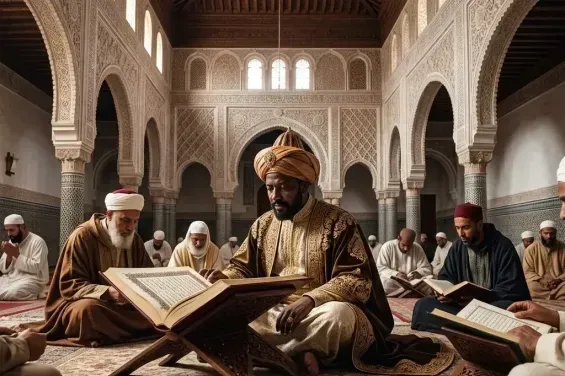
The rise of the Saadian state was closely tied to the call for jihad and the defense of Morocco’s frontiers against Crusader expansion, making religion a central pillar of its political project. Ramadan, therefore, became an important occasion during which the Sultan reaffirmed his role as Commander of the Faithful and protector of the faith.
The reign of Ahmad al-Mansur al-Dahbi (1549–1603) marked the golden age of the Saadian dynasty. His name is closely associated with Morocco’s victory at the Battle of Wadi al-Makhazin (1578). Under his rule, the country experienced greater stability than during the reigns of his predecessors. Domestically, al-Mansur sought to strengthen ties with Moroccan scholars and jurists, earning him the title «Caliph of Scholars and Scholar of Caliphs», as he was well-versed in numerous religious and scientific disciplines.
During Ramadan, al-Mansur organized special nightly gatherings marked by distinctive religious rituals. In Al-Istiqsa li-Akhbar Duwal al-Maghrib al-Aqsa, historian Ahmad bin Khalid al-Nasiri describes how these Ramadan sessions centered on the reading and study of Sahih al-Bukhari, regarded by Sunni Muslims as the most authentic book after the Quran.
Al-Nasiri explains that throughout Ramadan, scholars would complete the recitation of Sahih al-Bukhari, with jurists and prominent scholars reading daily from a manuscript divided into thirty-five volumes. These gatherings were not merely ceremonial. They served as spaces for in-depth study and discussion of prophetic traditions and religious matters.
Abu Faris Abdul Aziz al-Fishtali, historian of the Saadian state, writes in Manahil al-Safa that al-Mansur was devoted to performing Ramadan prayers and reviving its blessed nights with supplication. He selected distinguished Quran reciters and encouraged leading scholars to join him in major urban centers. According to al-Fishtali, the Sultan would stand in prayer with them throughout the nights of Ramadan and, each morning, attend sessions devoted to the narration and interpretation of Hadith, particularly Sahih al-Bukhari.
The sessions were interactive. The judge would personally narrate portions of the text, often two pages at a time, then engage scholars in debate and interpretation. When the session ended, the judge would continue the reading privately, resuming with a new volume the following day.
Al-Mansur was also known for distributing generous alms at the end of Ramadan. According to Manahil al-Safa, this became an established tradition, eagerly anticipated by those in need.
An Heir Unlike His Father
After his victory at Wadi al-Makhazin, al-Mansur appointed his son Sheikh al-Ma'mun as heir and ruler of Fez. However, reports from the capital, Marrakech, suggested that his son did not follow his father’s path. Al-Istiqsa portrays al-Ma'mun in highly critical terms, describing him as morally corrupt, indulgent in alcohol and frivolity, and negligent in religious duties.
Following the death of Ahmad al-Mansur, the Saadian state entered a period of decline marked by internal power struggles among his sons. The country effectively split between Marrakech and Fez, leading to wars that weakened central authority and triggered unrest, revolts, and the rise of semi-independent emirates.
Al-Ma'mun relied on his son Abdullah in his struggle against his brothers. Yet Abdullah, too, is described in Al-Istiqsa as disregarding religious obligations, openly breaking the fast during Ramadan and engaging in immoral behavior. The chroniclers depict a stark moral contrast between the disciplined religiosity of al-Mansur’s reign and the excesses of his successors.
One Man Prays on the Night of Power
In 1631, Abdul Malik bin Zidan, another son of al-Mansur, was killed. According to Al-Istiqsa, the turmoil that followed led to widespread instability, particularly in Fez. The Saadian authorities ordered the closure of the Al-Qarawiyyin Mosque, and both Friday prayers and Taraweeh were suspended for a period.
Sources recount that during this time of unrest, only one man performed prayers in the mosque on Laylat al-Qadr (the Night of Power), due to the severity of the violence and fear gripping the city.
Other historians, including Muhammad bin al-Tayyib al-Qadiri in Nashr al-Mathani and Al-Taqat al-Durar, confirm this episode. They describe how civil strife among the people of Fez led to the suspension of congregational prayers and the closure of Al-Qarawiyyin. Muhammad Abdul Hayy al-Kattani, in Madi al-Qarawiyyin wa Mustaqbaluha, also recounts the same events, emphasizing the dramatic halt of religious life during that period of conflict.
The manifestations of Ramadan during the Saadian era thus reveal a striking historical contrast: from nights filled with knowledge, prayer, and scholarly debate under Sultan Ahmad al-Mansur al-Dhahabi, to a period of turmoil in which Taraweeh prayers were suspended and the doors of Al-Qarawiyyin Mosque were closed due to war and internal strife.