


 chargement...


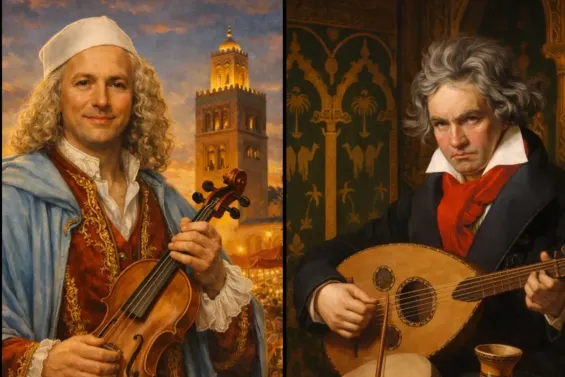
If Ludwig van Beethoven were Moroccan, he might have composed his Für Elise, a gentle, emotional piece expressing love, nostalgia, and a hint of sadness, in the style of Aita, raw and deeply expressive, narrating sorrow and struggle. If Wolfgang Amadeus Mozart, Antonio Vivaldi or Frédéric Chopin were Moroccan, their melodies might carry echoes of Gnawa, Chaabi, reggada, deqqa marrakchia or Ahwach.
This is not just an imagined scenario, it is one that Moroccan violinist Youness El Khazan brings to life. In videos shared on Instagram, the seasoned musician reinterprets classical masterpieces through Moroccan sounds, orchestrating them with live instruments. At its core, his work suggests that music is universal, and can be translated into Moroccan.

«I timidly started this project back in 2018. I called it Moroccan Mozart», he told Yabiladi. What began as a personal experiment has since evolved into a distinctive musical approach that bridges worlds. For El Khazan, the idea has always been to show that «Moroccan civilization, with its African, Amazigh and Hassani roots, can form a bond with many melodies».
Trained in music but largely self-taught in his creative journey, El Khazan built his approach through both discipline and instinct. A violinist and former music teacher, he has performed on major productions, including Studio 2M, Starlight and Coke Studio.
Matching classical music to Moroccan genres
In his videos, his creative process unfolds somewhere between intuition and precision. «When I choose a classical piece, I imagine its spirit, what Moroccan genre could match it», he explains. From there, the piece is rewritten, not to distort it, but to reframe it, staying as faithful as possible to the original while adding what he calls a «Moroccan soul».
Each composition is then rebuilt through live instrumentation. Nothing is artificial: «they are all instruments played by real musicians… not programmed». The result is layered, orchestral, and meticulous, with some pieces requiring up to «10 days of work».
The choice of fusion is also never random. For Für Elise, he turned to Aita, drawn by its narrative nature, «Aita is about telling a story». For Mozart, he leaned toward reggada, carried by its «happy and energetic» rhythm, rooted in Morocco’s eastern regions.
Chaabi revival
Beyond the technique, the project reflects a broader shift in how Moroccan music is perceived. «At some point, there was this idea that Chaabi music was looked at from above», he notes. But that perception, he believes, is changing.

Through the response to his work, especially from younger audiences, he has witnessed that shift firsthand. «I was surprised by the feedback… I did not expect young people to be interested in classical symphonies and Chaabi music». For him, this growing interest confirms something deeper: music continues to transcend boundaries, generations and genres.
At the same time, his work positions itself against the growing presence of artificial intelligence in music. «AI remains artificial… it only mimics», he says, insisting that true creation comes from human experience. Music that is made by people, he argues, «touches the heart» in a way that machines cannot.
Looking ahead, El Khazan envisions taking the project beyond screens. His ambition is to bring it to the stage : «an orchestra of classical music in the Moroccan way». But such a vision requires scale: «we are talking about more than 30 musicians», he notes, pointing to the need for support and sponsorship.
Meanwhile, the creative journey continues. He is currently working on Chopin, «trying to make him Moroccan».
Through it all, one idea remains constant: Morocco’s musical richness is not meant to remain confined, it is meant to be shared. And perhaps, through this fusion of Mozart and Aita, reggada and Beethoven, that diversity is already finding new ways to be heard.