

 chargement...


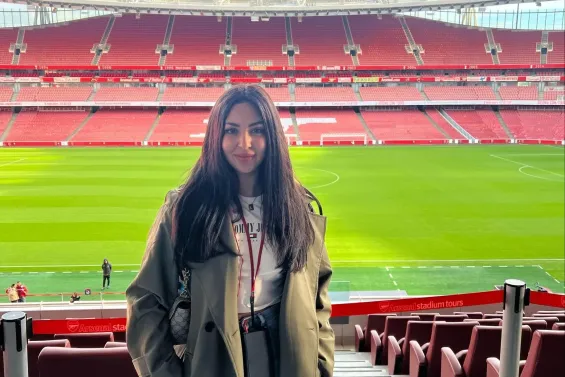
Long before covering Arsenal, Manchester City, or Morocco’s 2022 World Cup journey, football was already shaping Leyla Hamed’s childhood between Spain and northern Morocco. Born in Malaga to Moroccan parents from Ceuta, Leyla’s first connection to football came through her older brother.
«He loved football, watched it constantly, played all the time, and was part of Malaga’s youth academy», the international sports journalist told Yabiladi. Looking up to him, Leyla found herself «deeply interested in football too».
That interest later turned into something much deeper, especially during one of the most difficult moments of her life. At just 16 years old, Leyla was diagnosed with diabetes, «a turning point in my life», as she describes it. «I almost fell into a coma and had to spend nearly a month in the hospital», she recalled.
Luckily, her hospital room had international sports channels broadcasting football from around the world: Premier League, Serie A, Ligue 1, «everything», she said. «Football became the thing that kept me going during that difficult period. When I left the hospital, I told myself I wanted to do something connected to football because it brought me joy even during dark moments», she said.
Breaking Into Football Journalism
That path eventually became journalism. After graduating from high school, Leyla moved to Madrid, where she studied journalism at the Universidad Complutense de Madrid (UCM). During her second year at university, she began combining her passion for football and reporting through Twitter.
«I created my own account where I translated La Liga news into English, and somehow I became relatively well known online, even though I was still very young», she recalled.
.jpg)
Young and deeply passionate about football journalism, Leyla soon started receiving offers «to write blogs» and became a trusted source for Premier League fans in England looking for information about Spanish football. «Because of my connection to Malaga and my interest in Arsenal, I often translated updates about players like Santi Cazorla and Nacho Monreal when they were at Malaga», she said.
After completing her bachelor’s degree, Leyla enrolled in a master’s program linked to the Real Madrid School before securing an internship with Real Madrid Basketball. «It wasn’t football, but it was still part of the institution», she remarked.
Still, Leyla knew that breaking into the male-dominated world of sports journalism would not be easy. «There were very few women in football media in Spain at the time, and the few who were there often weren’t taken seriously», she regretted.
Eventually, due to Spain’s financial crisis, Leyla had to return to Malaga. Frustrated and discouraged, she found herself steering away journalism for a while. «I worked for a while in fashion retail and even stepped away from journalism for some time because I was losing hope», she recalled.
.jpg)
But that break did not last long. During the COVID-19 pandemic, when football stopped and people spent more time online, Leyla returned to Twitter and resumed writing about football. That decision eventually opened doors in London.
«I worked with Marca’s English edition covering the Premier League, and later I joined The Athletic. That’s really when my career grew significantly», she said. Leyla went on to work around some of Europe’s biggest football clubs, including Arsenal, Manchester City, and Chelsea. «It honestly felt like living the dream», she remembered.
Football Beyond the Pitch
Over time, however, her perspective began to shift. The turning point came during Morocco’s historic run at the 2022 World Cup in Qatar. «Seeing Moroccan diaspora players reconnect with their roots, their parents, their culture, that deeply inspired me. And I realized I wanted to tell stories beyond tactics and match reports», she explained. That is when she emersed into documentaries and more human-centered stories about players from Morocco and the wider MENA region.
«I worked on documentaries about Sam Morsy, Mohamed Salah, and now Hakimi. For me, this work is about giving something back to my community and inspiring younger generations», she said.
Over the past three years, Leyla has worked freelance with outlets including TRT World, Al Jazeera, Marca, and Copa90, focusing on projects that genuinely make her happy.
.jpg)
That emotional connection she felt during the Qatar World Cup, Leyla believes, resonated globally. According to her, Morocco’s 2022 World Cup run changed perceptions not only because of the team’s performances, but also because of the identity it projected. «Some journalists simply could not understand how deeply connected these players are to their families, values, and roots, especially players from the diaspora».
Another tournament that deeply marked her was the latest AFCON hosted in Morocco. For Leyla, it revealed another image of the country, one many people outside Morocco rarely get to see. She recalled an atmosphere that extended far beyond the stadiums, from Rabat to Tangier and Casablanca, where local residents welcomed supporters from across the continent.
AFCON, the World Cup, and Pride in Moroccan Football
Like many Moroccan supporters, however, Leyla believes the AFCON experience was overshadowed by the controversy surrounding the final. Commenting on decisions made that night, she argued that «CAF could have handled several incidents during the tournament much better». «Moroccan fans deserved to celebrate the trophy in their own country, in a packed stadium, in Rabat, that same night», she said.
.jpg)