


 chargement...


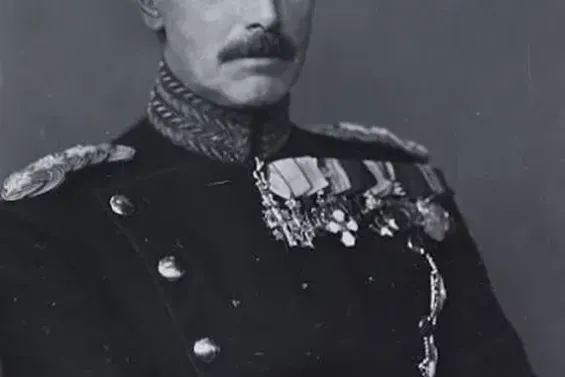
In a rare tale intertwining noble heritage and the rigors of military life, Prince Aage of Denmark, Count of Rosenborg, emerges as one of the most compelling European figures of the early 20th century. Not just a prince who relinquished his title, he was a soldier who battled in Morocco, earned prestigious honors, and ultimately found his resting place with the Foreign Legion, to which he dedicated his life.
Prince Aage Christian Alexander Robert was born on June 10, 1887, at the Yellow Palace in Copenhagen. He was the eldest son of Prince Valdemar of Denmark and the grandson of King Christian IX. His lineage included French ties through his mother, Princess Marie d’Orléans, granddaughter of King Louis Philippe I, founder of the Foreign Legion in 1831. This blend of Danish and French royal blood fueled his early fascination with military life, especially after a 1901 meeting with Danish officer Christian Selchau-Hansen, who served in the French Foreign Legion. This encounter turned his aspirations into a lifelong pursuit, taking him from opulent palaces to Morocco's rugged landscapes.
In 1914, Prince Aage made a fateful decision when he married Matilda Calvi di Bergolo from an Italian aristocratic family, without the Danish king’s approval. Consequently, he renounced his princely status and the title of «Prince of Denmark,» becoming the «Count of Rosenborg.» Yet, his military ambitions remained undeterred. After serving in the Danish army, he received permission in 1922 to join the French Foreign Legion as a captain.
.jpg)
Morocco: The Main Theater of Operations
Prince Aage arrived in Morocco amid France's extensive military campaigns to consolidate control over ungoverned areas. Assigned to the 2nd Foreign Infantry Regiment, he engaged in operations in the Middle Atlas against tribes like the Ait Seghrouchen, Marmoucha, and others resisting colonial expansion. His involvement in battles at Bou Arfa, Bou Khamouj, El Mers, Ait Makhlouf, Imouzzer, Mount Idlan, and Ait Baza earned him his first military citation from the French command.
In 1924, he joined the Legion's First Mounted Company and participated in operations in the Ouergha Valley. During the Rif War, led by Mohamed Ben Abdelkrim El Khattabi against colonial forces, he served at the French forces' headquarters in Rabat while remaining active in the field. At the 1925 Battle of Bibane, his role in relaying orders earned him a second citation from the French army.
Prince Aage's writings reflect on the substantial losses on both sides during the Rif War, praising Moroccan and French soldiers' courage. «To be perfectly frank, France did not care how many times Abd el-Krim defeated the Spaniards,» he noted. «Without Britain's fear of France gaining complete influence in Morocco, there might never have been a Spanish zone of influence. France was also aware that a devastating defeat could force a complete Spanish withdrawal.»
The prince recognized the Moroccan belief in defending their freedom, yet from his perspective, viewed French administration as pragmatic, exploiting natural resources to benefit the local population while reducing tribal conflicts. Nonetheless, he acknowledged France's motivations were not purely altruistic, expressing limited regard for the Spanish colonial approach.
Prince Aage's involvement in French military efforts in Morocco spanned years. In 1929, he participated in operations in Tadla and battles like Azarar-Fal, Bou Adiane, and Bou Angzir, aimed at strengthening French control over Morocco's interior. In 1934, he joined Colonel Trinquet's mechanized group for campaigns in the Anti-Atlas, marking the final stages of establishing French colonial dominance.

In 1935, he was promoted to battalion commander and assigned to the 3rd Foreign Infantry Regiment in Fez before leading the 1st Battalion in Ksar es-Souk, modern-day Errachidia.
The End in Taza and a Twice-Moved Resting Place
On February 29, 1940, at age 55, Prince Aage passed away in Taza from pneumonia. He received a solemn military funeral in Casablanca, but his wish was to lie among his Foreign Legion comrades. In March 1947, his remains were moved to Sidi Bel Abbès in Algeria, the Legion's historic capital, with his son and brothers attending. After Algeria's independence in 1962 and the relocation of the Legion's headquarters to France, he was reinterred in Puyloubier near Marseille, alongside General Paul Rollet, the «father of the Legion.»
Throughout his vibrant military career, Prince Aage earned numerous international accolades, including France's Legion of Honour, the Croix de Guerre, and Denmark's Order of the Dannebrog. Notably, he received Morocco's Alawite Order, officer class. He also left a literary mark with his 1936 book «A Royal Adventurer in the Foreign Legion,» chronicling his North African military experiences.
The Danish prince observed that «the Moroccans have remained, and their Amazigh blood has stayed almost pure, while the great civilizations that invaded the country left behind only crumbling ruins as testimony to the failure of those conquests.» He added, «Today, the French are pinning their imperial hopes on Morocco's future,» considering it «reasonable to assume that they will ultimately meet the same fate as their predecessors.»
Thus, Prince Aage remains a distinctive European royal figure linked to Morocco's history during the French Protectorate. While French military writings celebrate him as one of the Foreign Legion's esteemed officers in Morocco, his Moroccan legacy ties closely to his role in the campaigns against local resistance during a pivotal era in the nation's history.




 Fil Info