


 chargement...


«I refuse to reduce an individual to a language, a religion or a clan. We are fortunate to live with plural identities. Complexity is a way of inhabiting the world», says actress, journalist and activist Fatym Layachi.
At a time when people are increasingly asked to choose sides when it comes to identity and belonging, she defends the right to contradictions, multiple inheritances and narratives that do not cancel one another out. Her words challenge an era that ranks suffering and pits memories against each other. «Our pain does not have to compete. The competition of legitimacies is frightening because it creates hierarchies. Culture, art and creation therefore embody a space that must be protected», she insists.
Resistance to these labels begins, above all, with words. For writer Samira El Ayachi, writing means giving oneself permission to exist. «To create is to resist.» Writing becomes a space where one can discover one's own «I», free from family, social or political expectations. She claims «the right to be a draft», the right never to freeze one's identity because, as she reminds us, «youth (...) is movement».
 Fatima Ezzahra Ait Azouit, Samira El Ayachi, Asmae El Moudir, Aliou Diack, Fatym Layachi and Marwan Mohammed at the 13th Human Rights Forum in Essaouira. ©Gwendydd Vaillié Fatima Ezzahra Ait Azouit, Samira El Ayachi, Asmae El Moudir, Aliou Diack, Fatym Layachi and Marwan Mohammed at the 13th Human Rights Forum in Essaouira. ©Gwendydd Vaillié
Reclaiming one's own story
Throughout the discussions, one word kept resurfacing: telling. Telling what had been silenced. What had disappeared. What had never been shown.
Filmmaker Asmae El Moudir said she built her cinema out of absence. «I want to thank absence, the void. It was thanks to the lack of images that I was able to make this film (The Mother of All Lies).» For her, absence becomes creative material. Where family photographs do not exist, memory takes over. «When images have been erased, memory remains», she says.
Her remarks also raise a question that is as social as it is artistic: Who writes history? Who creates the archives? Who decides what deserves to be remembered? Her answer is unequivocal: «We can tell our stories without complexes, without apologizing. They have the right to exist.»
This reclaiming of narrative is also reflected in the work of Fatima Ezzahra Aït Azouit, a master craftswoman who preserves ancestral know-how while anchoring it in the present, turning transmission into both an act of creation and a form of cultural preservation.
A similar philosophy runs through the work of Senegalese visual artist Aliou Diack, who says he found in art a way to emerge from darkness. «When I was younger, I was going through something dark in order to reach the light.» His works, made from natural materials, express a deep connection with the living world in contrast to increasingly industrialized forms of production.
Youth «refuses exile as its only horizon»
Often portrayed as disengaged, consumed by social media or disconnected from reality, young people were presented in a very different light by the speakers.
Drawing on her research into Moroccan social movements, Fatym Layachi argued that football stadiums, rap music and public spaces have become genuine arenas of political expression. «This generation refuses to resign itself», she said. It «refuses exile as its only horizon». Young people's anger is not a sign of surrender. On the contrary, she sees it as «a declaration of love [for Morocco].»
Sociologist Marwan Mohammed, meanwhile, urged people to move beyond a purely conflict-driven reading of youth. «By definition, young people look more toward their future than toward the past. That also generates hope.» In his view, reducing an entire generation to anger ignores the diversity of its experiences.
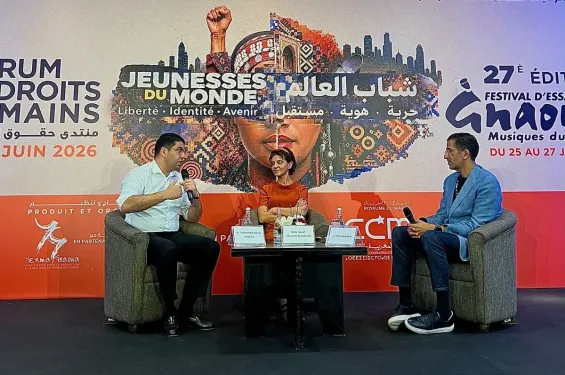
 Mohamed Mehdi Bensaid, Najat Vallaud-Belkacem and Driss Bennani gathered for the 13th Human Rights Forum, held in Essaouira. © Gwendydd VailliéMohamed Mehdi Bensaid, Najat Vallaud-Belkacem and Driss Bennani gathered for the 13th Human Rights Forum, held in Essaouira. © Gwendydd Vaillié
He also called for a more nuanced understanding of social media. «They depend on what each person produces. Without that collective production, there would be no social media.» In his view, these platforms have profoundly reshaped cultural production, allowing people long deprived of visibility to create and share their own narratives without relying on traditional gatekeepers.
It is a view shared by Najat Vallaud-Belkacem, France's former education minister. Beyond cultural production, she argues, social media has enabled global mobilizations such as the #MeToo movement. For her, the hashtag demonstrates that these platforms can become powerful tools for emancipation and social change. Yet that democratic promise is increasingly undermined by the way the platforms operate. Algorithms help «fragment users' thinking» and erode «the sense of solidarity and empathy», she warns.
«We need to draw up another narrative, another framework for thinking»
Reinventing youth cannot happen without reinventing politics, the speakers argued. The crisis is not one of engagement, but of the forms that engagement takes. Young people still want to act. They are simply doing so elsewhere: through associations, NGOs, environmental causes and social entrepreneurship.
«What can reconcile young people with politics is giving them the sense that we are genuinely thinking about what troubles them», said Najat Vallaud-Belkacem, now president of the NGO France terre d'asile. She also called for rebuilding a shared collective imagination. «We need to draw up another narrative, another framework for thinking», she said.
 Mohamed Mehdi Bensaid, Minister of Youth, Culture and Communication ©Gwendydd VailliéMohamed Mehdi Bensaid, Minister of Youth, Culture and Communication ©Gwendydd Vaillié
Mohamed Mehdi Bensaid, Morocco's Minister of Youth, Culture and Communication, stressed that public policies must adapt to the diversity of young people's lives and aspirations. During his remarks, he highlighted an often-overlooked reality: «Someone who is 18 does not face the same issues as someone who is 30.» Youth, he argued, is far from a homogeneous group.
Among the initiatives already launched in Morocco, the minister highlighted the nationwide rollout of the Youth Pass, which gives 16- to 30-year-olds easier access to cultural, sports, transport, training and leisure services. He also pointed to the expansion of the national volunteering program to encourage civic engagement, as well as training initiatives such as Maharat, designed to strengthen skills and improve young people's access to the job market. Together, these measures reflect an effort to tailor public policy to a generation whose aspirations, life paths and needs can no longer be treated as uniform.
A final word
Throughout the morning, the discussions underscored the younger generation's determination to reclaim its own narrative. It composes, writes, films, paints, sculpts, draws and speaks out to tell the world through the lens of its own experiences, without waiting for others to do it on its behalf.
In closing, novelist Samira El Ayachi posed two questions: «Are we sufficiently attentive to the contributions of youth that will structurally change politics?» and «Are politicians allowing themselves to be dreamed and written by youth?» It was a reminder that transmission may no longer simply mean passing down a legacy, but also accepting that those who come after us will reshape it.