

 chargement...


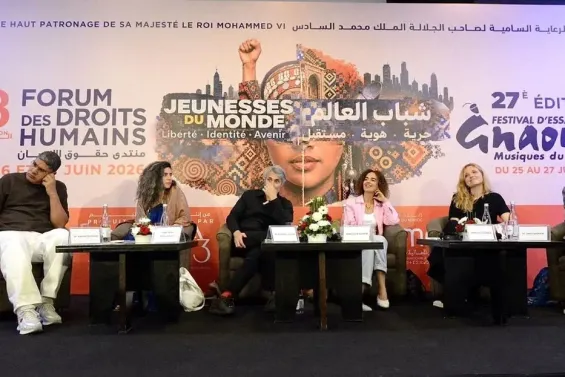
At the heart of the Human Rights Forum, one concept echoed repeatedly: identity. Speakers universally rejected the idea of fixed identities, illustrating instead a fluid and evolving concept of self. Renowned author Leïla Slimani launched the dialogue with a cautionary statement: «The way we view mixed heritage imposes a value on it.» She critiqued societal categories that pigeonhole individuals, emphasizing that mixed-race individuals, foreigners, dual nationals, or exiles are often predefined before they can self-identify.
Slimani shifted the conversation with a poignant question: «Is integration a matter of maintaining integrity—staying true to oneself amid change?» This query encapsulates the paradox of modern life. Migration transcends mere geographical shifts, necessitating the navigation of various value systems, languages, traditions, and religions. «Living between two worlds,» she observed, also means existing among diverse social classes, cultures, and generations. «We constantly grapple with defending our uniqueness while desiring belonging,» Slimani remarked. She urged that this contradiction is not to be solved but embraced, asserting, «We can inhabit both spaces; it's crucial to defend this middle ground.»
 Leïla Slimani, Franco-Moroccan journalist and writer, at the Human Rights Forum. ©Gwendydd VailliéLeïla Slimani, Franco-Moroccan journalist and writer, at the Human Rights Forum. ©Gwendydd Vaillié
A Generation Navigating Multiple Worlds
Today's youth epitomize shifting identities, as migration paths and diasporas breed multifaceted affiliations that defy traditional classifications. Drawing on years of research with unaccompanied minors (MNA), anthropologist Cléo Marmier challenged audiences to expand their perspectives. Behind bureaucratic categories are teens making harsh life choices, who speak of «practising adventure», a term reflecting both departure and struggle. Far from impulsive, these young individuals are acutely aware of global chaos and the power dynamics of modern mobility, according to Marmier. Borders are not mere lines but physical experiences, felt through arduous journeys across seas, militarized zones, and fences.
 Cléo Marmier, sociology doctoral researcher at the School for Advanced Studies in the Social Sciences ©Gwendydd Vaillié DRCléo Marmier, sociology doctoral researcher at the School for Advanced Studies in the Social Sciences ©Gwendydd Vaillié DR
For Marmier, these journeys are political acts,«a protest in motion, a form of resistance.» She prefers to discuss «belongings» over «identity», emphasizing that migration produces multiple presences rather than a dual absence. Fundamentally, she insisted, «These are ordinary youths seeking normalcy but confronting extraordinary challenges.»
The Influence of Language on Identity
Rachid Benzine highlighted that the debate extends beyond political theories, calling for a reassessment of the words we use. «Freedom, identity, future: we must interrogate these overloaded terms,» he stated. Words do more than describe reality; they shape our worldview. He delved into the Arabic language's roots, noting that youth evokes a rearing horse, freedom denotes searing sun heat, and identity originates from an emptiness, akin to a handprint in clay. «Identity isn’t a static substance; it emerges from a void that invites movement.»
 Rachid Benzine, Franco-Moroccan scholar of Islam, political scientist and lecturer ©Gwendydd VailliéRachid Benzine, Franco-Moroccan scholar of Islam, political scientist and lecturer ©Gwendydd Vaillié
He criticized rigid definitions, arguing, «Every definition is an act of aggression because it halts movement and action.» Humans are inherently storytellers. Drawing from philosopher Paul Ricœur, Benzine reminded us that narratives connect us to time, keeping the possibility of action alive. «Meaning often forgets the gesture,» he concluded.
Searching for Desire
As the discussions unfolded, a common sentiment emerged: society is fatigued by identity debates. «People are weary of questioning identity,» Slimani noted, adding that «they already understand their flaws.» Raphaël Liogier concurred, suggesting that the identity obsession reveals a larger crisis. «Pure identity is ideology,» he claimed, arguing that identity is inherently unstable and rooted in desire. «In life, there is only desire and form,» he stated. When societies fail to sustain this desire, a «mythical depression» ensues. The current fixation on identity, he argued, signals this depression. «A key indicator of mythical depression is incessantly discussing identity.»
Liogier insisted that identity isn't about contemplation but enactment. «We can either leave the void open as a space of freedom or continuously fill it, often distracting ourselves digitally, risking disconnection from the self.»
Thus concluded the 13th Human Rights Forum in Essaouira: identity is neither a source nor a label nor a legacy to guard. It’s a narrative, a gesture, a blend, occasionally a void—but fundamentally, it’s an ongoing experience.