


 chargement...


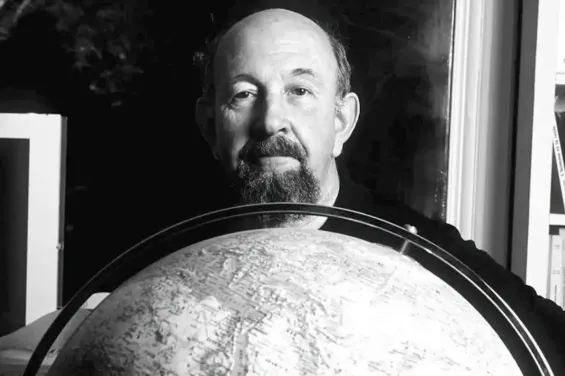
Yves Lacoste, the renowned French geographer, was born in Fez in 1929 and passed away on June 22, 2026, at the age of 96. Son of geologist Jean Lacoste, he spent his early years in Morocco before moving to France for his education. However, this move did not sever his scientific and emotional connection to his homeland, where his journey diverged from that of his father.
Jean Lacoste had settled in Morocco during the French Protectorate (1912–1956) to «map the pre-Rif hills for the French Residency General». As reported by Le Grand Continent, his missions aimed to uncover «the riches of Morocco’s subsoil for more efficient exploitation».
After losing his father to tuberculosis upon returning to France, young Yves initially pursued geology but his struggles with mathematics redirected him to geography. Armed with a degree, he returned to Morocco to study the geomorphology of the Gharb plain for his postgraduate work.
Merging Geography with Anti-Colonial History
Yves Lacoste passed the agrégation in geography in 1952 and taught at Lycée Bugeaud in Algiers until 1955. His interest extended beyond Morocco to the broader Maghreb region and the «Third World». The writings of Ibn Khaldun were pivotal, shaping his thoughts on underdevelopment and geopolitics.
These readings provided a historical perspective distinct from the French narrative, prompting him to distance himself from his father's views. He embraced a theoretical approach leading to his early works on the Maghreb's history, such as «Les études sur Ibn Khaldoun» (1957).

A committed anti-colonialist, Lacoste saw research not as an academic pursuit isolated in a French ivory tower but intertwined with political activism. A former member of the French Communist Party, he left in 1956 after it backed granting special powers to Guy Mollet’s government in Algeria. Instead, he aligned with the Algerian Communist Party, supporting the resistance.
In his numerous scholarly articles, Lacoste frequently cited the 14th-century Maghrebi thinker to explore political life cycles in the region. This intellectual journey culminated in his seminal work, «Ibn Khaldoun – Naissance de l’histoire du Tiers-Monde», published in 1965.
Aligning his political and academic pursuits, Lacoste joined the Committee for the Independence of Europe (CIE), advocating for a «non-aligned, Third World-oriented Europe» that included the Soviet Union.
«Active Geography»: A Framework for Analyzing Inequality
Lacoste introduced the concept of «natural constraints» in geography, integrating political issues and development agendas. This approach shaped the contours of an «active geography» and led to his 1965 publication, «Géographie du sous-développement». The book became a cornerstone in examining «global inequalities at the territorial scale».
In this work, Lacoste redefined underdevelopment not as mere delay but as resulting from imbalances in spatial and economic structures. Fellow geographer Paul Claval explored this vision in his 1966 essay «Une géographie du sous-développement, d’après Yves Lacoste» in Cahiers d’outre-mer. Claval noted, «Mr. Lacoste shows, through historical analysis, the mechanisms responsible for underdevelopment and their likely future trajectories».
Lacoste’s work challenged colonialism and social inequality, scrutinizing the external and internal forces reshaping conquered lands into economic dependencies. This new research angle wasn’t universally accepted among peers, leading to the third edition’s exclusion from the Presses Universitaires de France’s Magellan collection.

Nevertheless, this work anticipated discussions that emerged in the 1970s, offering insights into international relations and North-South dynamics and laying the foundation for modern geopolitics. Lacoste boldly presented his ideas in the provocative 1976 book, «La Géographie, ça sert, d’abord, à faire la guerre» (Maspero).
Building the Foundations for Accessible Geopolitics
Challenging the claim of neutrality in geography, this book demonstrated the discipline’s role in conquest. Describing geography as a «strategic form of knowledge», Lacoste faced criticism but gained popularity among students and researchers, leading to the 1977 launch of HÉrodote — a journal focused on geography and geopolitics.
Pursuing his thesis «Unité et diversité du Tiers-Monde. Des représentations planétaires aux stratégies sur le terrain», Lacoste earned his state doctorate in 1979, complementing his academic teaching. In 1989, he founded the Center for Geopolitical Research and Analysis, which later evolved into the French Institute of Geopolitics.
Over the years, global economic, political, and social changes shaped geography, with Lacoste’s works providing valuable insights, distinguishing them from a more «textbook» approach. This methodology is detailed in «Dictionnaire de géopolitique» (1993) and «Géopolitique de la Méditerranée» (2006).

In 2000, Yves Lacoste was awarded the Vautrin-Ludd International Geography Prize, honoring his contributions, with the Maghreb remaining a central theme— notably in the collective volume «Maghreb, peuples et civilisations», co-edited in 2004.





 Fil Info