


 chargement...


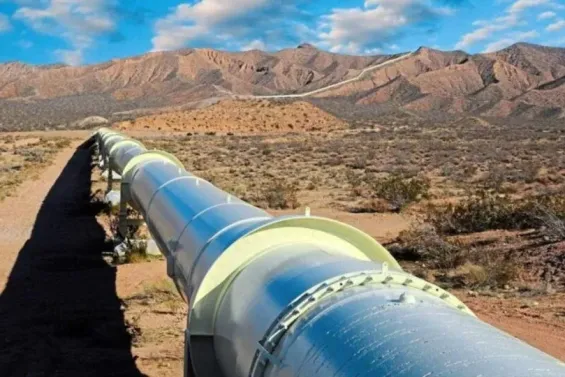
The African Atlantic Gas Pipeline, which will connect Nigeria and Morocco, has entered a new phase of implementation following the completion of technical and engineering studies and the launch of preparations ahead of construction.
An environmental and social impact assessment for the Moroccan section of the project, details of which were published by Asharq Bloomberg, shows that the pipeline will stretch nearly 6,900 kilometers across 13 countries along Africa's west coast. The Moroccan segment will extend 2,220 kilometers, including 1,830 kilometers onshore and 390 kilometers offshore, with the total investment estimated at around $25 billion.
According to the study, the Moroccan section will include four compressor stations near Boujdour, Tan-Tan, Agadir and Safi. These facilities are essential to the pipeline's operation, restoring gas pressure during long-distance transmission to ensure a continuous and efficient flow.
The stations will be spaced 300 to 320 kilometers apart, the optimal distance for a 48-inch-diameter pipeline. Each will occupy approximately 64 hectares, with locations selected near ports and transport infrastructure to facilitate the movement of equipment and services.
The project will also feature two receiving stations in Morocco. The first will receive gas arriving from Mauritania through the offshore section, while the second will mark the end of the onshore segment and connect directly to the Maghreb-Europe Gas Pipeline, enabling gas to be transported to European markets through the existing network.
The study also details the construction of six temporary camps along the Moroccan route, including worker accommodation, pipe storage areas and equipment maintenance workshops. Each camp will serve roughly 300 kilometers of the pipeline and accommodate between 1,000 and 1,200 workers during construction. Priority will be given to local hiring, supported by specialized training programs.
Within Moroccan waters, the offshore section will run for nearly 390 kilometers, from the maritime border with Mauritania to the Dakhla area, at depths ranging from 15 to 100 meters. As it approaches the coast, the pipeline will be gradually buried over a distance of about eight kilometers and protected by a concrete coating, anti-corrosion lining and cathodic protection system, ensuring its stability and safety throughout its projected 40-year operating life.
Construction of the Moroccan section is expected to begin after the final investment decision, anticipated by the end of 2026, with commercial operations scheduled to start in the second quarter of 2031.





 Fil Info